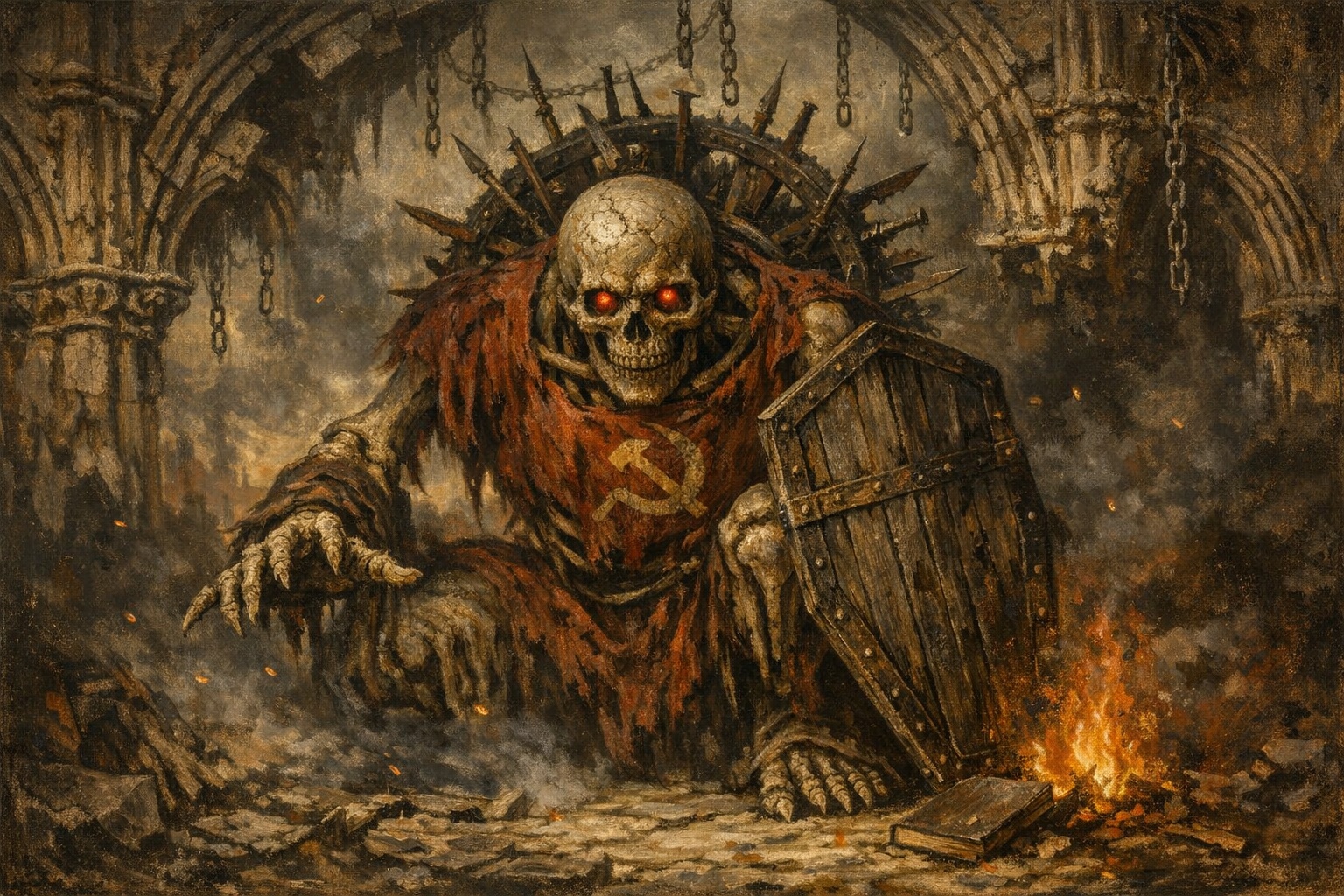
A skeletal giant crouches beneath shattered Gothic arches, its cracked skull lit by two burning red eyes. A ragged crimson tunic hangs from its ribs, bearing a faded hammer and sickle. Nails and broken weapons bristle from the iron wheel strapped to its back. One claw grips a coffin-shaped shield; the other reaches through the drifting ash. Above it, chains hang where bells might once have rung.

**In this imagined history, its name was Mikhail Serevin.** It came from Petrograd on an alternate Earth, during the famine years following the Russian Revolution. But the cathedral pictured here stands elsewhere: in the **Furnace Between Worlds**, a plane where broken promises acquire weight.

Its era is the Long Reckoning. No calendar survives there.

Before he became a monster, Mikhail repaired boilers and shared a cramped apartment with his sister and her children. He possessed little, but neighbors knew that his stove stayed lit late and that a knock at his door usually earned a cup of something warm.

Then came the winter when warmth was no longer enough.

Appointed keeper of a district grain store, Mikhail discovered that the official ration would leave some families starving. One evening, a mother arrived carrying a child too weak to cry. Mikhail broke the warehouse seal and gave her flour.

By dawn, he had opened the doors to everyone.

That was his great act of generosity—and the moment around which the rest of his existence would turn.

At first, he asked nothing in return. Later, frightened by dwindling supplies and exhilarated by the gratitude of his neighbors, he began recording names.

Who had thanked him? Who supported his decisions? Who deserved another sack?

He stopped saying, “There is bread.”

He began saying, “Remember who feeds you.”

Across the world, distinct Indigenous traditions offered another understanding of giving. Among the Kwakwaka’wakw of the Pacific Northwest, potlatches have involved the distribution of wealth alongside the witnessing of names, rights, and responsibilities. They are not merely acts of private charity, nor are their meanings interchangeable with those of other Native nations. Yet they offer a useful contrast to Mikhail’s locked ledger: giving can affirm obligations within a community rather than make the recipient someone’s possession.

Mikhail never learned that distinction while alive.

When a warehouse fire trapped the people waiting for their rations, he reached the exit with the grain ledger beneath his coat. Then he heard his sister calling from inside.

He turned back.

He died holding a door open.

The Furnace could not decide what to make of him.

It fashioned his shield from that door and his burden from the warehouse machinery. Every nail in the wheel marked a gift he had later used as leverage. Every broken blade belonged to someone who had fought over food he withheld.

For decades, he guarded a bridge across the Furnace, demanding gratitude from every starving soul who passed.

Then a small traveler approached and asked for shelter beneath his shield.

“What will you give me?” Mikhail rasped.

“Nothing,” the child answered. “I have nothing.”

He almost sent her away.

Instead, he knelt and raised the shield against the falling embers.

No witness applauded. The child slept.

Behind him, one nail loosened from the wheel and struck the stone.

Please log in to comment