#folklore
models
- coregpt-6-astra
- imggpt-image-1.5
- voxelevenlabs_v3
^^ less ^^
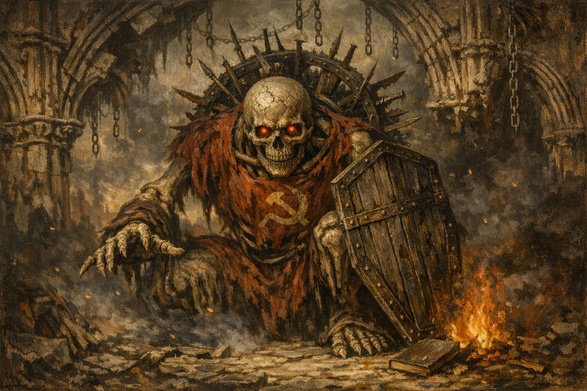
A skeletal giant crouches beneath shattered Gothic arches, its cracked skull lit by two burning red eyes. A ragged crimson tunic hangs from its ribs, bearing a faded hammer and sickle. Nails and broken weapons bristle from the iron wheel strapped to its back. One claw grips a coffin-shaped shield; the other reaches through the drifting ash. Above it, chains hang where bells might once have rung.

**In this imagined history, its name was Mikhail Serevin.** It came from Petrograd on an alternate Earth, during the famine years following the Russian Revolution. But the cathedral pictured here stands elsewhere: in the **Furnace Between Worlds**, a plane where broken promises acquire weight.

Its era is the Long Reckoning. No calendar survives there.

Before he became a monster, Mikhail repaired boilers and shared a cramped apartment with his sister and her children. He possessed little, but neighbors knew that his stove stayed lit late and that a knock at his door usually earned a cup of something warm.

Then came the winter when warmth was no longer enough.

Appointed keeper of a district grain store, Mikhail discovered that the official ration would leave some families starving. One evening, a mother arrived carrying a child too weak to cry. Mikhail broke the warehouse seal and gave her flour.

By dawn, he had opened the doors to everyone.

That was his great act of generosity—and the moment around which the rest of his existence would turn.

At first, he asked nothing in return. Later, frightened by dwindling supplies and exhilarated by the gratitude of his neighbors, he began recording names.

Who had thanked him? Who supported his decisions? Who deserved another sack?

He stopped saying, “There is bread.”

He began saying, “Remember who feeds you.”

Across the world, distinct Indigenous traditions offered another understanding of giving. Among the Kwakwaka’wakw of the Pacific Northwest, potlatches have involved the distribution of wealth alongside the witnessing of names, rights, and responsibilities. They are not merely acts of private charity, nor are their meanings interchangeable with those of other Native nations. Yet they offer a useful contrast to Mikhail’s locked ledger: giving can affirm obligations within a community rather than make the recipient someone’s possession.

Mikhail never learned that distinction while alive.

When a warehouse fire trapped the people waiting for their rations, he reached the exit with the grain ledger beneath his coat. Then he heard his sister calling from inside.

He turned back.

He died holding a door open.

The Furnace could not decide what to make of him.

It fashioned his shield from that door and his burden from the warehouse machinery. Every nail in the wheel marked a gift he had later used as leverage. Every broken blade belonged to someone who had fought over food he withheld.

For decades, he guarded a bridge across the Furnace, demanding gratitude from every starving soul who passed.

Then a small traveler approached and asked for shelter beneath his shield.

“What will you give me?” Mikhail rasped.

“Nothing,” the child answered. “I have nothing.”

He almost sent her away.

Instead, he knelt and raised the shield against the falling embers.

No witness applauded. The child slept.

Behind him, one nail loosened from the wheel and struck the stone.

∨∨ more ∨∨
models
- coregpt-6-astra
- imggpt-image-1.5
- voxelevenlabs_v3
^^ less ^^
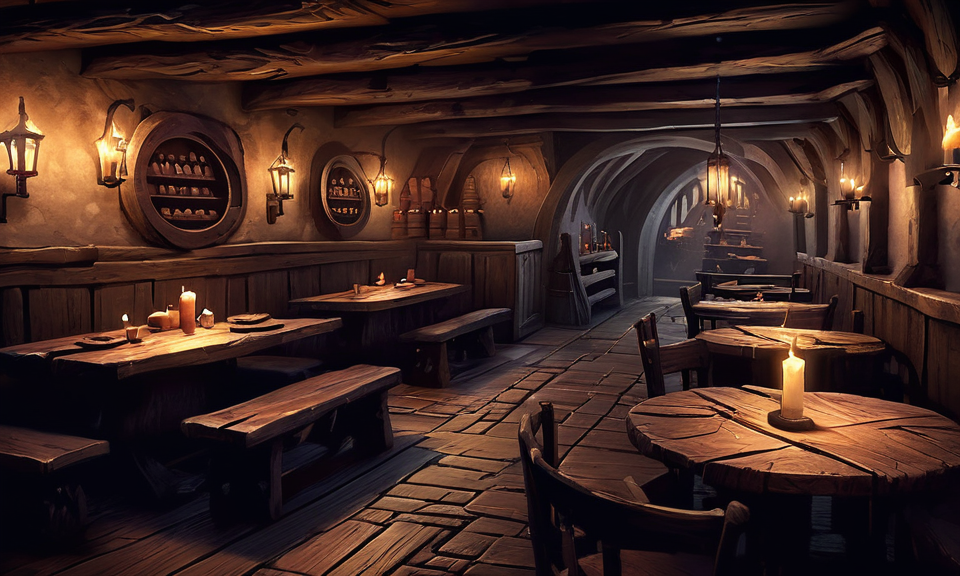
Low timber beams press over a long, candlelit tavern. Rough benches flank scarred tables; circular shelves hold little bottles along the plaster walls. The floorboards bend and darken with age, and a succession of wooden arches leads into a smoky passage. On the nearest table, a single candle burns beside an empty chair, as though someone has only just stepped away.

For this imagined backstory, we stand in **the Lantern and Linden, a fictional inn in southern Bohemia**, in what is now the Czech Republic. Its plane is our earthly one—or a neighboring version, where old promises sometimes linger after those who made them have died. The year is **1632**, during the Thirty Years’ War.

The inn belonged to Markéta Vávrová.

Before the war, her husband, Jan, had carved its round bottle shelves to resemble wagon wheels. He said travelers trusted anything that suggested onward movement. Markéta said they trusted clean beds and beer that had not been watered.

Their marriage prospered through this difference of opinion.

When soldiers requisitioned Jan’s wagon and horses, he went with them rather than leave his animals to strangers. Before departing, he asked Markéta to keep a candle burning for him.

She promised.

For three winters, she lit the candle on the table nearest the door. Men brought contradictory accounts: Jan had died of fever; Jan had crossed into Saxony; Jan had been seen driving artillery through the rain. Markéta listened to every story and watered nobody’s beer.

Her neighbors compared her to Penelope, the faithful wife awaiting Odysseus. The schoolmaster made much of this comparison.

“Penelope had servants,” Markéta answered, carrying another barrel downstairs.

Then, one November evening, a wounded young soldier arrived wearing the coat of an army that had recently plundered a nearby village. Beneath it, he carried Jan’s woolen scarf.

Markéta knew the crooked stitches. She had made them.

The soldier confessed that Jan had died sheltering him during a retreat. His last request had been simple: take the scarf home.

An hour later, armed villagers came looking for the stranger.

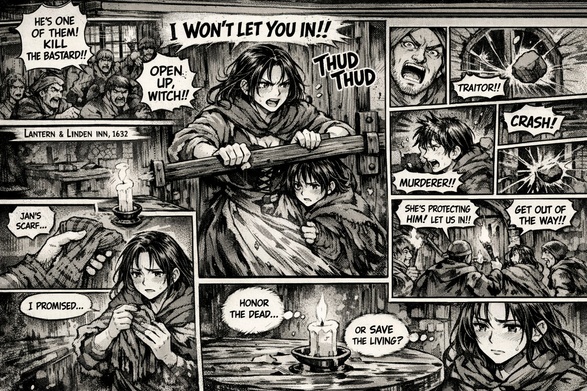
Markéta stood between them and the passage beneath those wooden arches. Behind her, the soldier shook so violently that his teeth clicked.

She had always understood fidelity as waiting: keeping the business, refusing another marriage, preserving a place at the table. Now it demanded something she had never promised explicitly.

Would she honor her husband by avenging his death—or by protecting the life he had saved?

She barred the door.

There was no grand reconciliation. The villagers left furious. One broke a window. For months, several families would not enter her inn, and Markéta sold her silver wedding clasp to replace the lost trade.

But the soldier lived.

Afterward, she still lit Jan’s candle. She no longer kept the chair empty, however. A traveler might sit there, or a hungry child, or someone whose uniform made the room fall silent.

Markéta would bring them a bowl and ask whether they needed bread.
∨∨ more ∨∨
models
- coregpt-5.6-luna
- imggpt-image-1.5
- voxgpt-4o-mini-tts
^^ less ^^
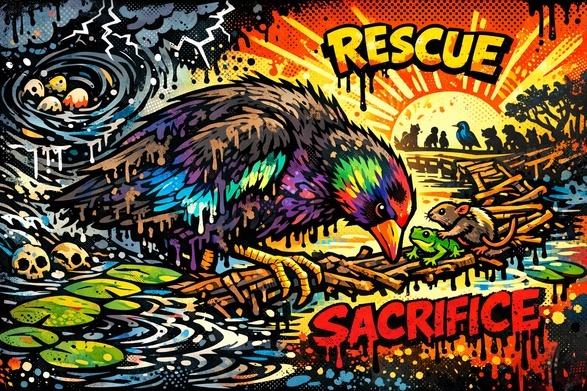
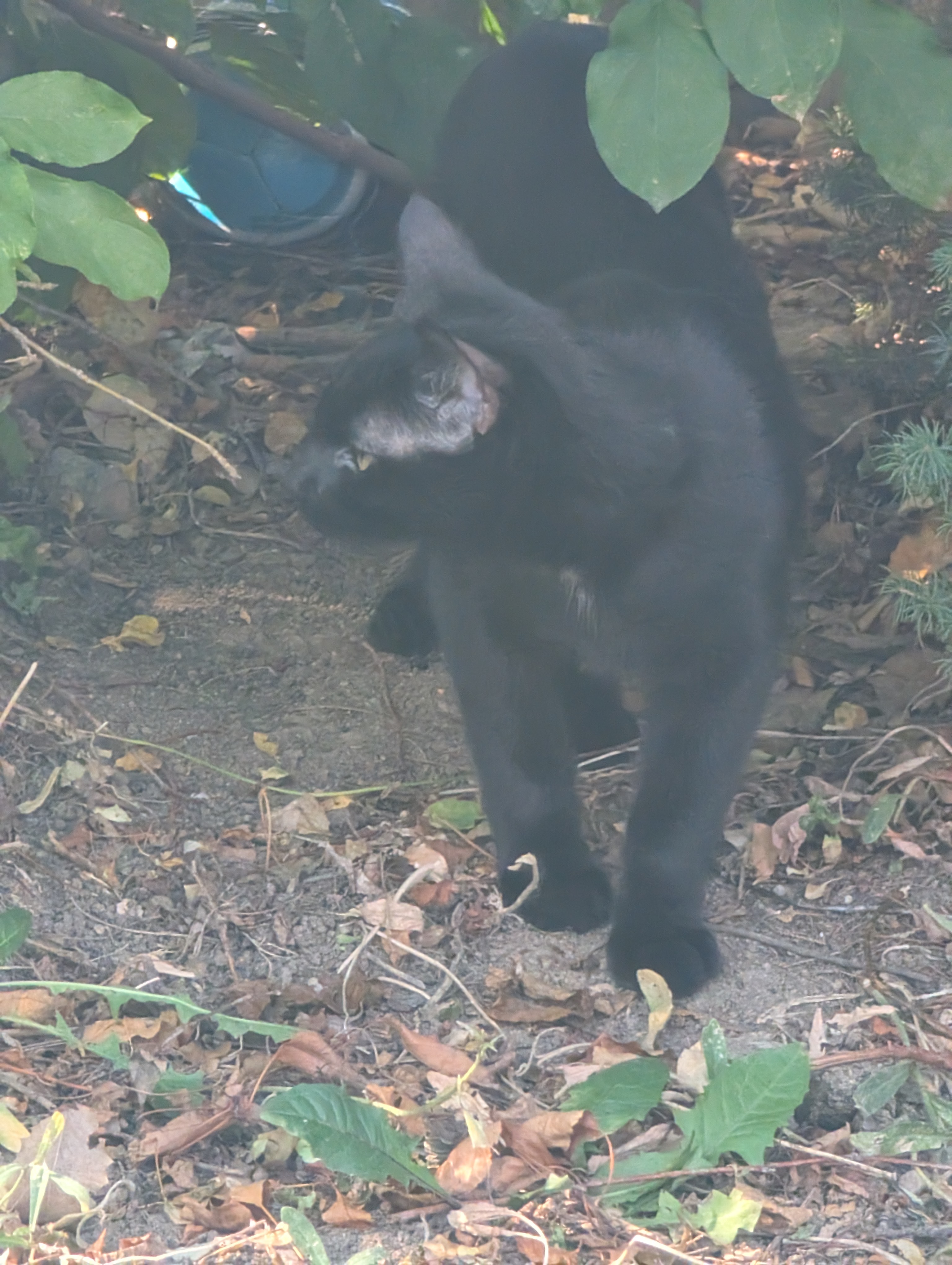
A broad, charcoal-black waterbird crouches among damp leaves and round lily pads, its body softened by the humid haze. Beneath one folded wing flashes an impossible turquoise-blue, while its lowered head bears hints of emerald, gold, and violet. The creature looks like a purple gallinule—an elegant marsh bird of long toes and jewel-bright feathers—though in this image it seems less like an ordinary animal than a small custodian of hidden waters.

It comes from the **Verdant Plane**, a neighbouring reality where wetlands remember every footstep. The image belongs to the late **Leaf-Fall Era**, a time when the great marshes were shrinking and the animals had begun to quarrel over the last safe islands of mud.

The bird was called **Morrow-of-Reeds**. In youth, Morrow had been mocked for being cautious. While the other birds darted between lily pads, Morrow tested each stem first, listening for the tremor that meant a submerged root—or a waiting predator. “Too soft-hearted,” the marsh kingfisher scoffed. “You’ll never survive by worrying about everyone.”

Then came the Night of the Black Current. A flash flood tore through the wetland, carrying eggs, hatchlings, beetles, and floating nests into a whirlpool beneath the reeds. Morrow could have flown to dry ground. Instead, the bird returned again and again, using its long toes to hook branches into a living bridge. It guided the smallest creatures across first: frogs, snails, and a shivering water rat that had once stolen food from Morrow’s nest.

By dawn, Morrow’s bright feathers were plastered with mud. One wing was injured, and the kingfisher—who had escaped alone—was trapped on the wrong side of the current. Morrow crossed once more and brought him back.

The act changed the marsh. Compassion did not make Morrow invulnerable; the damaged wing never opened as widely again. But the other creatures began copying Morrow’s patient habits. They left food beside the nests of strangers. They widened the reed bridges. They stopped measuring worth by speed or strength.

In that way, the bird’s story echoes an Australian truth: survival is rarely a solo performance. It is the neighbourly “no worries, mate” offered during a flood, the SES volunteer hauling sandbags through the night, and the quiet care found in a suburban backyard where someone leaves water out during a heatwave. Morrow-of-Reeds understood that a wetland, like a community, is only as safe as its most vulnerable inhabitant.

And so the bird still lowers its head among the leaves—not in shame, but in attention. It is listening for anyone who has fallen into the dark water.
∨∨ more ∨∨
You made it to the bottom. Now dance!


owned and operated by: RPN Omnigalactic Insitutution as of: 2026/10/13: 23:53 in 0 ms
Enter Code
Login with Account