#war
| gen: 2026/09/30:20:51 in 27.1 sec (old)bias: 3 (Center) |
| type: newsquality: 77 |
| pts: 0 |
 | author: | Jane Arraf | institution: | NPR | ¿porque no los dos? |
| tl;dr | The article reports that U.S. forces have fully withdrawn from Iraq, with coalition headquarters moving to Jordan. Iraqi leaders celebrate sovereignty, while Kurdish leaders fear increased vulnerability to Iran-backed attacks. Iraq still faces ISIS sleeper cells, militia disarmament challenges and reliance on U.S. intelligence. The article also examines Iranian influence, Turkish military bases and the invasion’s human costs, ending with accounts of reconstruction and reconciliation. The reported withdrawal and accompanying official statements are not independently verified here. | ||||
| deeper: | The article emphasizes the invasion’s destructive legacy, but also credits U.S. contributions against ISIS and explains Kurdish dependence on American protection. Its competing Iraqi, U.S. and militia perspectives do not establish a clear partisan alignment. Named sources, historical context and detailed security coverage strengthen it. Weaknesses include heavy reliance on official statements, no directly quoted Kurdish leader, and sweeping claims about younger Iraqis. The civilian death figure needs a clearer timeframe and distinction between deaths during the occupation and subsequent violence. Screenshot links and contemporary claims cannot be authenticated here. | ||||
media: | |||||
| gen: 2026/09/24:02:27 in 28.2 sec (old)bias: 3 (Center) |
| type: newsquality: 70 |
| pts: 0 |
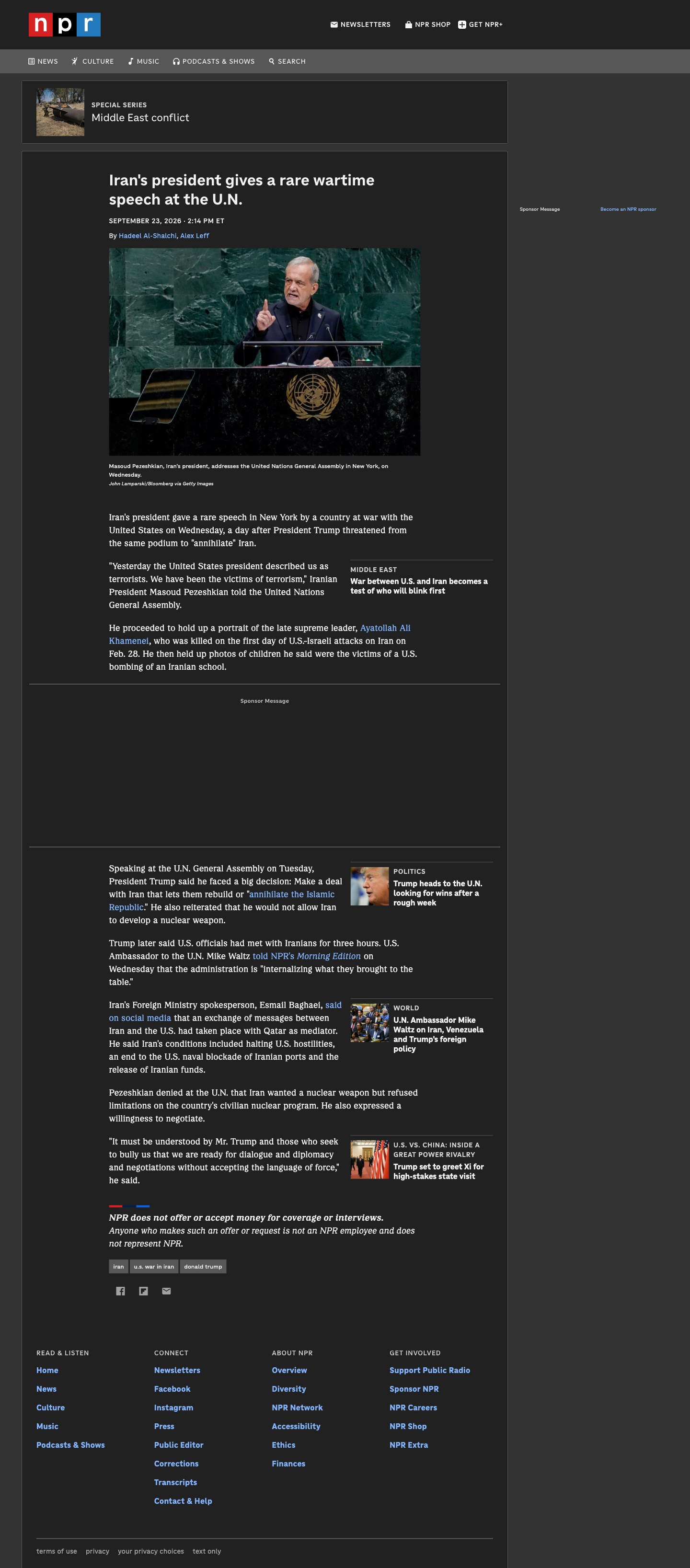 | author: | Hadeel Al-Shalchi, Alex Leff | institution: | NPR | ¿porque no los dos? |
| tl;dr | The article reports that Iranian President Masoud Pezeshkian addressed the United Nations during a war with the United States, criticizing U.S. attacks while expressing willingness to negotiate. It contrasts his remarks with President Trump’s threat to annihilate the Islamic Republic and his insistence that Iran not develop nuclear weapons. U.S. and Iranian officials describe diplomatic exchanges mediated by Qatar. Iran seeks an end to hostilities and a naval blockade, release of funds, and protection of its civilian nuclear program. | ||||
| deeper: | The report quotes both governments and generally distinguishes officials’ claims from established facts. Its opening emphasizes Trump’s threat and Iranian suffering, giving Iran’s perspective some emotional prominence. However, it also includes U.S. nuclear concerns and Iran’s refusal of restrictions, without clearly endorsing a political ideology. Named sources and links strengthen transparency. Limited independent scrutiny of wartime claims and little historical or nuclear-monitoring context weaken the reporting. The screenshots alone cannot establish the authenticity of the page or verify its consequential factual claims. | ||||
media: | |||||
| gen: 2026/09/21:17:43 in 26.6 sec (old)bias: 2 (Center) |
| type: newsquality: 65 |
| pts: 0 |
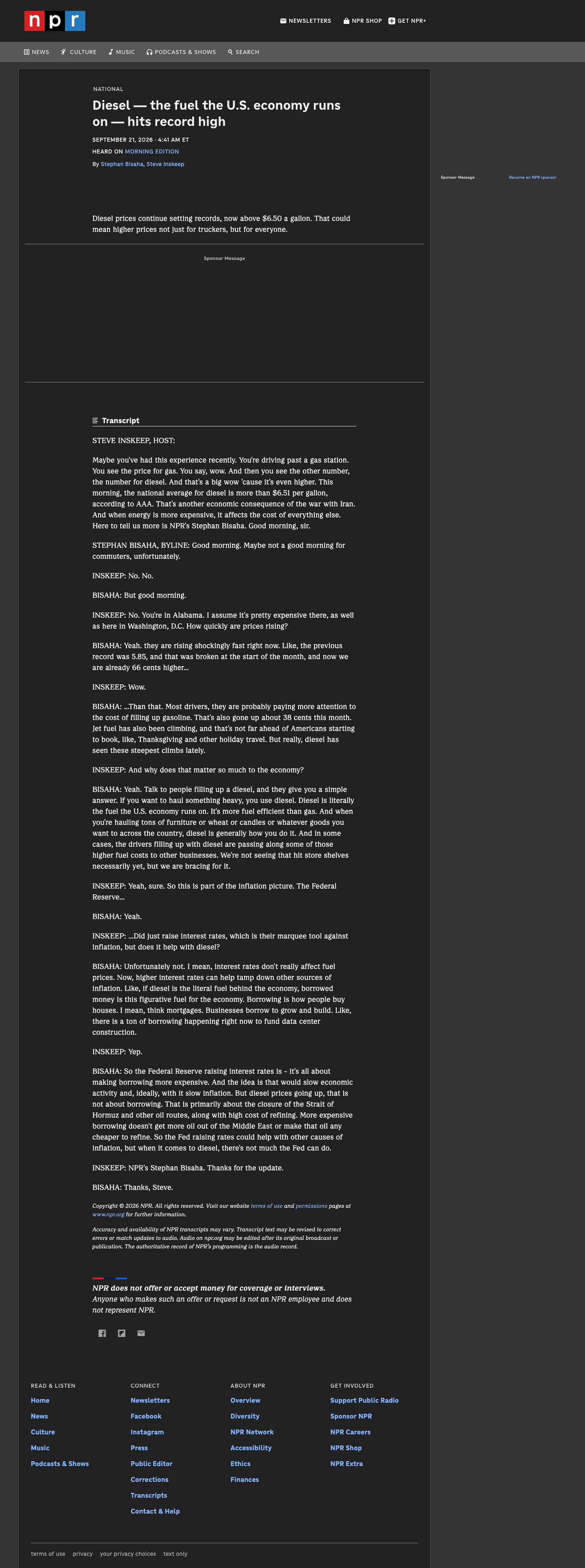 | author: | Stephan Bisaha, Steve Inskeep | institution: | NPR | ¿porque no los dos? |
| tl;dr | The article reports a national average diesel price above $6.51 per gallon, citing AAA. It attributes the increase to war with Iran, disrupted oil routes through the Strait of Hormuz, and refining costs. Because diesel powers much freight transportation, higher prices could spread to consumer goods, though the report says that effect is not yet clearly evident on store shelves. It explains that Federal Reserve interest-rate increases cannot directly resolve these supply disruptions. | ||||
| deeper: | The report emphasizes economic consequences without promoting a political party or ideology. Phrases such as “shockingly fast” add mild alarm, but it distinguishes potential consumer price increases from observed effects. AAA attribution and clear explanations are strengths. However, major claims about the war, shipping disruptions, and refining costs lack supporting sources in the text. Saying interest rates do not affect fuel prices is too categorical: reduced demand can affect them indirectly. The screenshot alone does not independently verify the reported events or figures. | ||||
media: | |||||
| gen: 2026/09/18:18:48 in 37.0 secbias: 3 (Unknown) |
| type: colorquality: 45 |
| pts: 0 |

#politics#war#diplomacy#iran#trump#iran war#donald trump#barack obama#us presidency#national securit
Leftist
Yet another disastrous consequence of unchecked power. The Trump administration's aggressive stance on Iran risks not just regional peace but global stability. Diplomacy should always triumph over reckless showmanship. This isn't just about jeopardizing a political career; it's jeopardizing lives. When will we learn that war isn't the answer? We need leaders who prioritize humanity over hubris, fostering dialogue over division.
Rightist
This is a classic case of fearmongering from the left. The Trump administration is taking strong steps to ensure national security. Liberals may call it jeopardizing, but it's about protecting American interests and showing strength against adversaries like Iran. Sometimes, peace requires power. It's time to stop apologizing for America and start safeguarding our future. Trump’s decisive actions show the world we won’t back down.
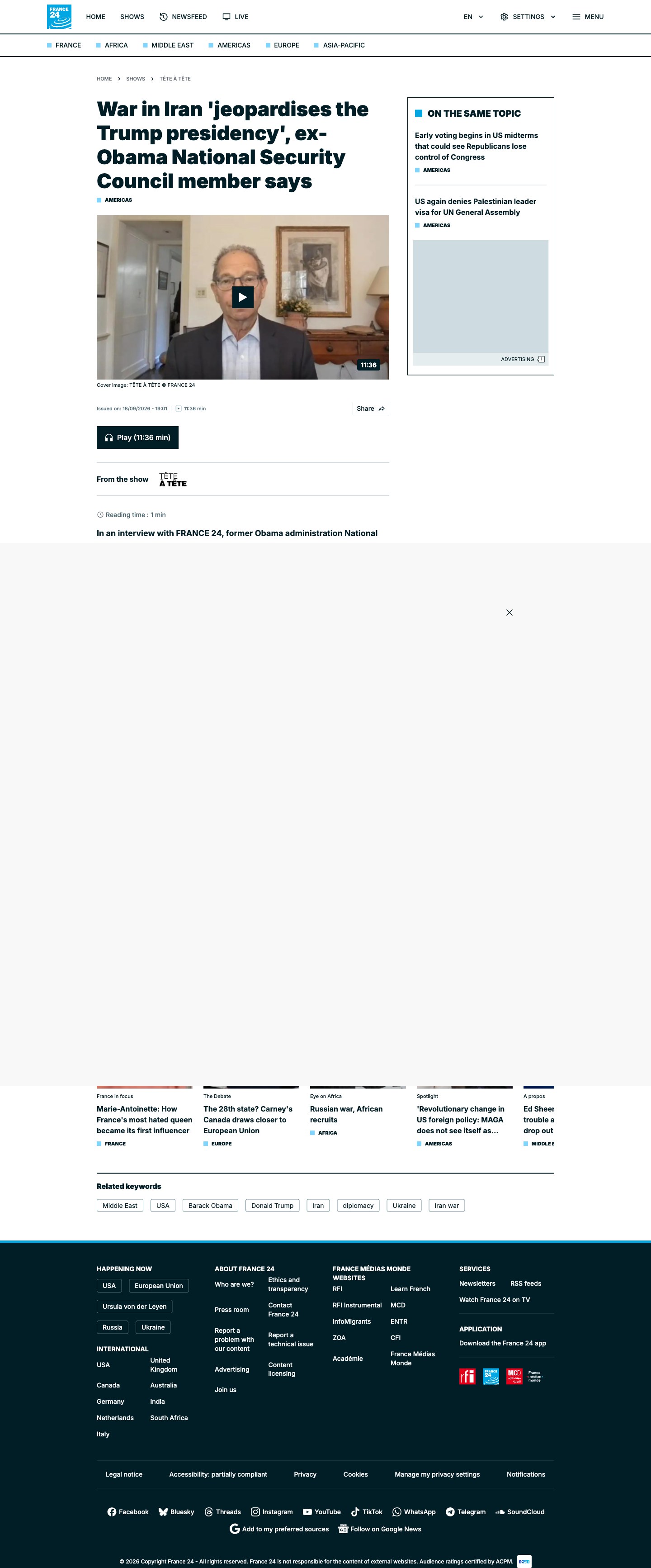 | author: | Unknown | institution: | France 24 | ¿porque no los dos? |
| tl;dr | The visible France 24 page previews an interview with a former Obama administration National Security Council member who argues that war in Iran jeopardises Donald Trump’s presidency. The headline presents this as the guest’s assessment, not an established outcome. Most of the article text is obscured, and the interview itself cannot be assessed from these screenshots. | ||||
| deeper: | The headline foregrounds a dramatic prediction from one former administration official, giving the visible coverage a narrow perspective. However, quotation marks and explicit attribution distinguish opinion from fact. Criticism of Trump alone does not establish a left–right position. The page supplies publication details and an interview format, but the obscured text prevents evaluation of evidence, questioning, context or competing views. The quality score applies only to the material visible here. | ||||
media: | |||||
| gen: 2026/09/13:15:19 in 31.6 sec (old)bias: 3 (Center) |
| type: newsquality: 77 |
| pts: 0 |
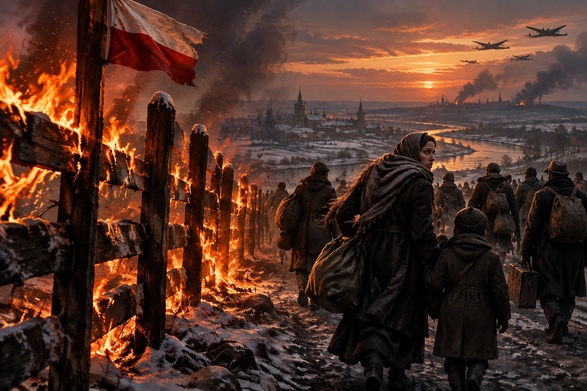
 | author: | DPA | institution: | dpa international | ¿porque no los dos? |
| tl;dr | The article reports a Russian strike on a Kyiv–Warsaw passenger train at Ukraine’s Yahodyn border station. Ukrainian Railways said passengers were evacuated without injuries; the train later continued with a delay exceeding six hours. Nearby strikes prompted Polish security monitoring and a crisis meeting, though Polish airspace was not violated. Ukrainian officials urged stronger consequences for Moscow. Russia’s Defence Ministry acknowledged attacks on western Ukrainian rail infrastructure, claiming it supported military shipments. | ||||
| deeper: | The report emphasizes Polish and Ukrainian concerns, including inflammatory but clearly attributed quotations. It also includes Russia’s stated military rationale and important limiting facts: nobody was injured and Polish airspace was not breached. There is no clear left–right political advocacy. Named officials and railway operators provide useful sourcing, but independent verification is absent. Russia’s acknowledgment of broader railway strikes does not specifically confirm the passenger-train attack, a distinction the headline could convey more carefully. | ||||
media: | |||||
| gen: 2026/09/09:15:27 in 44.7 sec (old)bias: 4 (Center-Left) |
| type: newsquality: 78 |
| pts: 0 |

#russia#north korea#infrastructure#geopolitics#war#northkorea#tumenriver#khasan#tumangang#bridgeopening1st

| gen: 2026/09/07:05:27 in 30.1 sec (old)bias: 3 (Center) |
| type: newsquality: 78 |
| pts: 0 |
 | author: | Joanna Kakissis, Joel Rose | institution: | NPR | ¿porque no los dos? |
| tl;dr | An NPR segment reports that U.S. envoys Jared Kushner and Steve Witkoff visited Kyiv for the first time, one day after meeting Vladimir Putin in Moscow, and held talks with President Volodymyr Zelenskyy. The envoys offered few specifics publicly, saying only that talks were “substantive” and that new ideas existed. Zelenskyy emphasized unresolved sticking points: U.S.-backed security guarantees to deter future Russian attacks and the territorial question, including claims Russia wants Ukraine to cede land beyond areas it controls. The visit is framed as symbolically important. | ||||
| deeper: | The piece is mostly straight reporting in transcript form, distinguishing between what was said publicly and what was not (“they didn’t really say much”). It includes direct quotes and clearly labels soundbites. Potential bias comes from limited space and sourcing: it leans heavily on the NPR correspondent’s on-scene interpretation and Ukrainian framing (skepticism, security needs) with little comparable Russian perspective or independent verification for claims like “bombing 24/7.” Overall quality is solid for a brief radio segment but lacks deeper context, data, and countervailing detail. | ||||
media: | |||||
| gen: 2026/09/03:04:14 in 54.3 sec (old)bias: 4 (Center) |
| type: newsquality: 78 |
| pts: 0 |
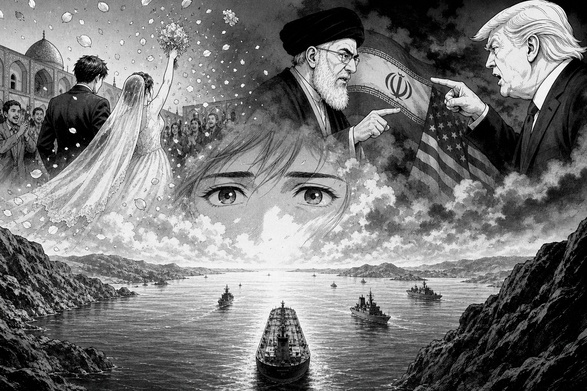
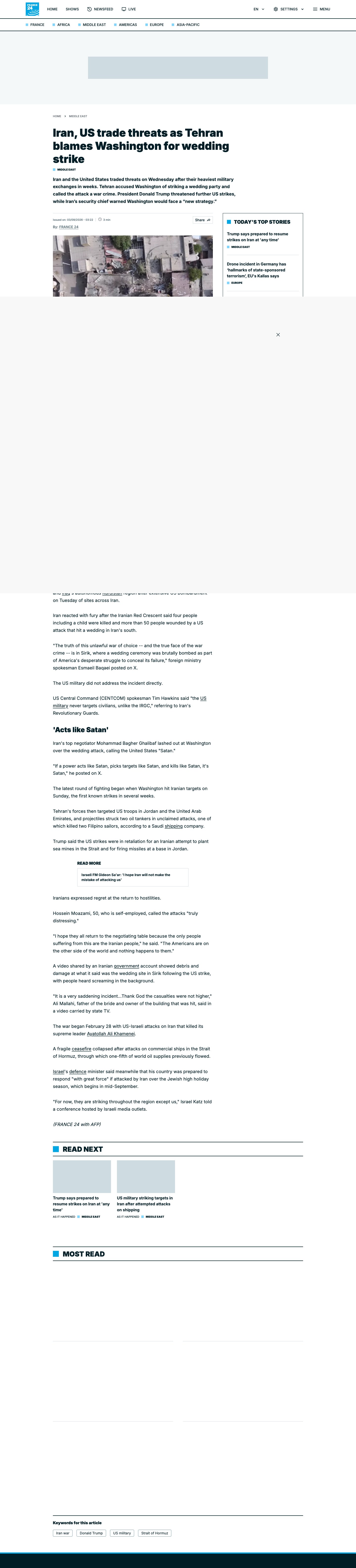 | author: | Unknown | institution: | France 24 (with AFP) | ¿porque no los dos? |
| tl;dr | France 24 (with AFP) reports escalating Iran–US tensions after recent military exchanges. Tehran accuses Washington of striking a wedding in southern Iran (Sirik), calling it a war crime; Iran’s Red Crescent claims four killed (including a child) and 50+ wounded. US Central Command denies targeting civilians and contrasts US conduct with Iran’s IRGC. The piece also notes regional spillover: attacks on US troops in Jordan/UAE, tanker damage in unclaimed attacks, and risks to Strait of Hormuz shipping, alongside Israeli warnings. | ||||
| deeper: | The article is largely straight-wire reporting, presenting claims and counterclaims from Iranian officials, the Iranian Red Crescent, and CENTCOM, plus limited civilian reaction. Bias mainly comes from emphasis on vivid inflammatory quotes (“Satan,” “war crime”) and casualty claims without showing independent verification or forensic detail; it does, however, include the US denial and broader context (shipping, regional strikes, Israeli statements). Quality is solid for a fast update, but thin on corroboration, timelines, and evidence beyond official statements and a government-shared video. | ||||
media: | |||||
| gen: 2026/09/01:15:54 in 46.4 sec (old)bias: 3 (Center) |
| type: newsquality: 82 |
| pts: 0 |
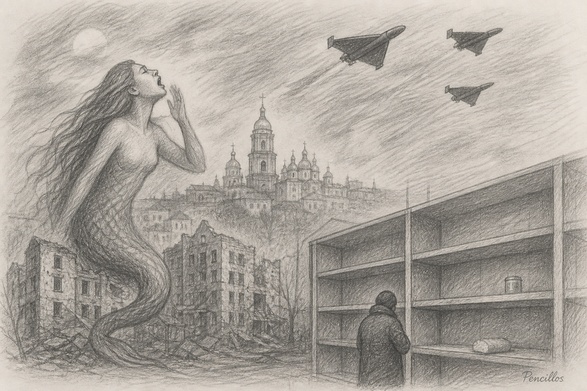
 | author: | The Associated Press | institution: | NPR | ¿porque no los dos? |
| tl;dr | The article reports that Russian jet-powered drone strikes around Kyiv have targeted warehouses and food distribution sites, contributing to empty supermarket shelves and heightened anxiety among Ukrainians. It describes frequent air raids, civilian casualties, school disruptions, and concerns about shortages as winter approaches. Ukrainian officials, including President Volodymyr Zelenskyy, say air defenses are struggling with new fast drones and that Ukraine is seeking improved counter-drone technology. Russia claims it is striking energy and military-related infrastructure. | ||||
| deeper: | The piece is largely straight news, attributing claims to identifiable sources (Ukrainian officials, Russia’s Defense Ministry) and emphasizing observable effects (damage, shortages, casualty counts). It leans toward the Ukrainian civilian-impact framing, using emotionally resonant details (empty shelves, schools, fear), while offering comparatively limited detail on Russia’s stated rationale beyond official claims. Quality is strong due to clear sourcing and specific examples, but would improve with more independent verification of strike targets and broader data on supply-chain impacts. | ||||
media: | |||||
| gen: 2026/08/29:16:13 in 37.4 sec (old)bias: 3 (Center) |
| type: newsquality: 82 |
| pts: 1 |
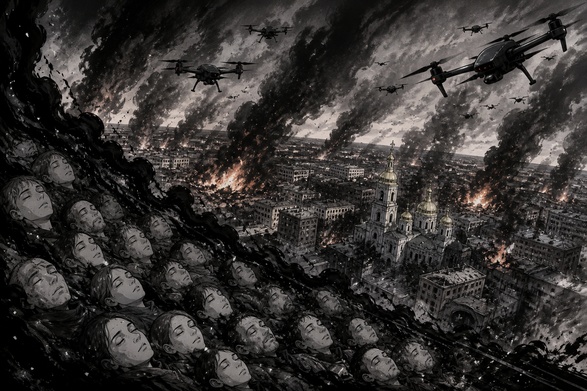
 | author: | The Associated Press | institution: | NPR | ¿porque no los dos? |
| tl;dr | The piece reports that a Russian strike near Kyiv killed at least 37 people and injured many others, describing it as among the deadliest attacks of the year. It recounts Ukrainian officials’ accounts of what was hit (including homes), details rescue efforts and damage, and situates the strike within a broader pattern of intensified Russian attacks. It also notes Ukraine’s stated intent to increase long-range strikes on Russian military targets and provides contextual updates about ongoing fighting and diplomatic positioning. | ||||
| deeper: | The article is largely straight, event-driven reporting: casualty figures, location, quotes from officials, and broader wartime context. It relies heavily on Ukrainian authorities for immediate details (common in breaking coverage), with limited direct Russian perspective beyond general claims/positioning, which can slightly tilt framing. Language is mostly neutral and specific, avoiding sensationalism. Quality is solid: clear structure, attribution, and context, though some claims are difficult to independently verify in real time and would benefit from more explicit verification/uncertainty framing. | ||||
media: | |||||
| gen: 2026/08/16:22:32 in 40.0 sec (old)bias: 3 (Center) |
| type: newsquality: 78 |
| pts: 0 |
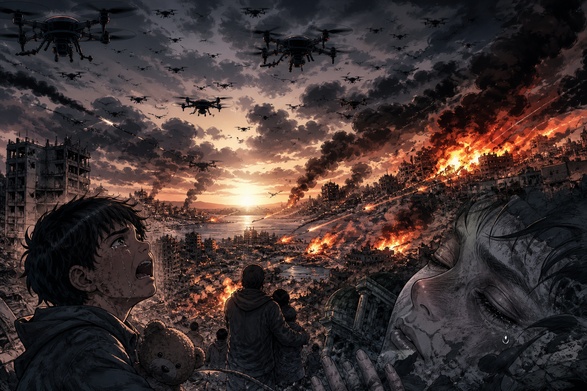
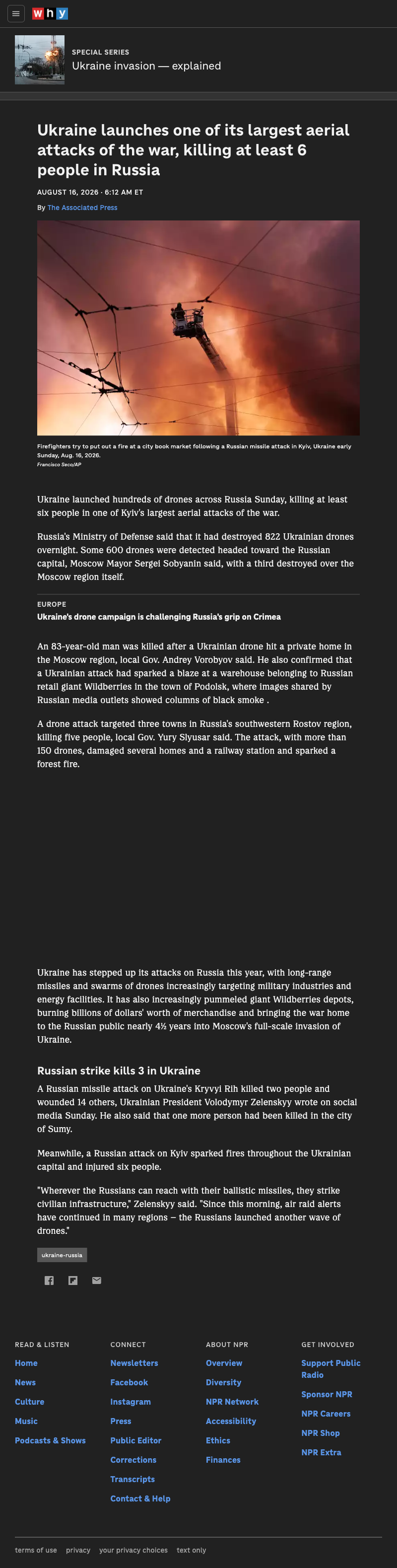 | author: | The Associated Press | institution: | NPR | ¿porque no los dos? |
| tl;dr | The article reports that Ukraine launched one of its largest drone attacks of the war into Russia, with Russian officials claiming 822 drones were destroyed and at least six people were killed across affected regions. It describes strikes near Moscow and in the Rostov region, including damage to homes, infrastructure, and a warehouse fire. The piece also notes Russian missile attacks in Ukraine that killed and wounded civilians, quoting President Zelenskyy on continued air alerts and strikes on civilian infrastructure. | ||||
| deeper: | Language is largely factual and attribution-heavy, relying on official statements (notably Russian ministries, regional governors, and Moscow’s mayor) while also including Ukrainian accounts and a Zelenskyy quote about Russian strikes. The framing provides context about Ukraine escalating long-range strikes and mentions Russian attacks in Ukraine, which helps balance. Some figures (e.g., drones “destroyed”) are hard to independently verify in wartime, and the story leans on government sources without much third-party corroboration, but overall sourcing and structure are solid. | ||||
media: No Media Preview | |||||
| gen: 2026/08/13:04:37 in 2 min 51.8 sec (old)bias: 4 (Center) |
| type: lolsquality: 60 |
| pts: 0 |

| gen: 2026/08/10:22:09 in 2 min 43.7 sec (old)bias: 5 (Unknown) |
| type: lolsquality: 35 |
| pts: 0 |

 | author: | Unknown | institution: | Unknown | ¿porque no los dos? |
| tl;dr | The screenshot appears to be a long-form news/article page with multiple embedded images and several sections of text. However, the provided image resolution is too low to reliably read the headline, author, outlet, or key claims, so I can’t accurately summarize the article’s substance or evaluate specific assertions without risking inventing details. If you share a link or a higher-resolution image (or paste the text), I can provide a proper content, bias, and quality analysis. | ||||
| deeper: | Because the text is not legible, I can’t assess word choice, framing, evidence, sourcing, or whether opposing viewpoints are represented—all of which are necessary to judge bias and quality. The scores reflect uncertainty rather than a firm evaluation: a middle bias score and a low-to-moderate quality score due to insufficient readable information. Provide a clearer copy and I can score based on verifiable features (sources, data, direct quotes, and transparency). | ||||
media: No Media Preview | |||||
| gen: 2026/08/01:04:47 in 32.4 sec (old)bias: 2 (Center) |
| type: newsquality: 83 |
| pts: 0 |
 | author: | Unknown | institution: | Unknown | ¿porque no los dos? |
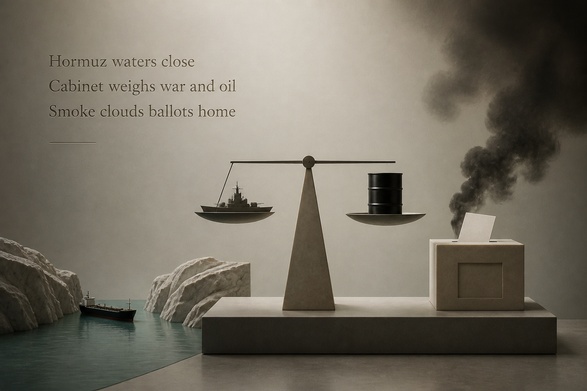
| tl;dr | The image shows a Reuters-style news page reporting that President Donald Trump convened his cabinet/national security team amid rising tensions tied to the Strait of Hormuz, with discussion centered on the risk of conflict and how the U.S. might respond. The piece appears framed around regional security, shipping threats, and diplomatic/military options, using official statements and on-the-record sourcing typical of wire reporting. | ||||
| deeper: | Language and structure are largely straight-news: event-driven, attribution-heavy, and focused on what officials said and did. Any tilt mainly comes from source selection (government and security officials tend to dominate) and the inherent framing of crises through U.S. decision-making. It avoids overt loaded wording and reads as a factual recap, though it likely offers limited perspective from Iranian actors or independent investigators, which slightly narrows context. | ||||
| gen: 2026/07/31:16:25 in 51.2 sec (old)bias: 6 (Unknown) |
| type: newsquality: 42 |
| pts: 0 |
 | author: | Unknown | institution: | Unknown | ¿porque no los dos? |
| tl;dr | The provided image is a tall, low-resolution screenshot of a web article containing a sensational headline, multiple paragraphs, two embedded video players, and at least one still image with colored bounding boxes (suggesting “analysis” or highlighting subjects in a scene). Due to the resolution, the exact outlet, author, and key factual claims are not reliably readable, so only structural/content-level assessment is possible. | ||||
| deeper: | The layout and presentation suggest a strongly emotive/sensational framing (headline tone, heavy emphasis on video, and highlighted imagery). However, the screenshot does not allow verification of the article’s core claims, sourcing, dates, or named witnesses/official statements. The presence of boxed/annotated imagery can imply “forensic” authority, but without readable methodology or citations it risks being rhetorical rather than evidentiary. Overall quality is limited by unclear sourcing/transparency and reliance on dramatic visuals. | ||||
| gen: 2026/07/30:05:26 in 3 min 12.8 sec (old)bias: 3 (Center) |
| type: lolsquality: 78 |
| pts: 0 |
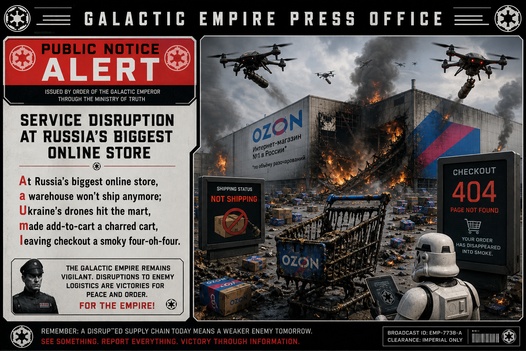
 | author: | Unknown | institution: | Yahoo News (via Reuters) | ¿porque no los dos? |
| tl;dr | A Yahoo News page summarizes a Reuters report that Ukraine struck a warehouse linked to Russia’s largest online retailer. The story describes the target, what is known about damage and operations, and situates the strike within Ukraine’s broader campaign against Russian logistics and infrastructure tied to the war effort. The article appears to rely on official statements and available reporting while noting limits on independent verification. | ||||
| deeper: | Language is mostly neutral and event-focused, typical of wire reporting. It frames the strike through factual claims (who said what, what was hit, and why it matters) and generally signals uncertainty where details can’t be independently confirmed. Potential bias comes mainly from source dependence (official Ukrainian/Russian statements) and the wartime context, not from loaded wording. Quality is solid: clear headline, relevant context, and cautious attribution, though evidence is constrained by on-the-ground verification limits. | ||||
| gen: 2026/07/24:02:49 in 3 min 13.0 sec (old)bias: 4 (Center) |
| type: newsquality: 78 |
| pts: 0 |
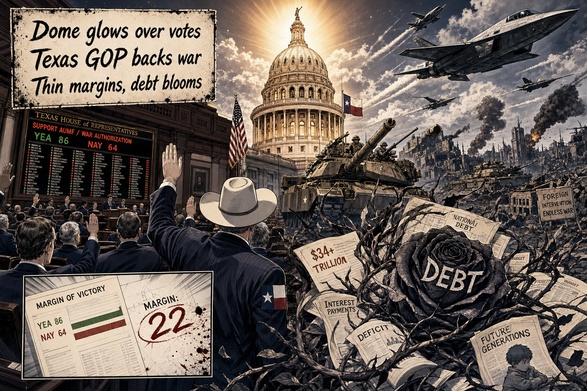
 | author: | Gabby Birenbaum; Samantha Latibody | institution: | The Texas Tribune | ¿porque no los dos? |
| tl;dr | A Texas Tribune report says Texas House Republicans largely backed a foreign-aid and national-security package—including funding tied to Israel and potential Iran-related escalation—while some Republicans opposed it on fiscal or anti-intervention grounds. The article frames the vote as a display of GOP unity on security spending (with notable dissent), explains what’s in the $95B package, and situates Texas members within the broader House political fight over foreign aid. | ||||
| deeper: | Content: The piece focuses on how Texas Republicans voted on (and justified) a major U.S. House foreign-aid/national-security spending package, emphasizing Israel/Iran-related funding elements while also discussing the broader bundle (commonly including Ukraine/Israel/Indo-Pacific components). It highlights intra-party dynamics—leadership support vs. hardline opposition—and uses member quotes and vote context to explain motivations. Bias: The article is mostly straight-news and attribution-heavy (quotes, vote outcome, political context). Potential bias comes from framing choices—foregrounding “Iran war funding” can prime readers toward seeing escalation rather than deterrence/defense, and the selection/order of quotes can subtly tilt sympathy toward or against the package. Still, it presents dissenting Republican arguments (e.g., spending concerns, skepticism of intervention) alongside supporters’ security arguments. Quality: Strong on basic reporting (who voted, what the package is, why factions split, how it fits into House politics). It appears to rely on verifiable public facts (roll-call dynamics, leadership strategy) and includes multiple perspectives. Limitations: the screenshoted article format suggests more political narrative than deep policy accounting; it likely does not fully quantify specific line items tied to Iran vs. broader defense/aid, nor does it deeply test lawmakers’ claims against independent budget analysis. Overall: solid, credible, and readable, with moderate framing effects but not overt advocacy. | ||||
media: No Media Preview | |||||
| gen: 2026/07/17:05:34 in 1 min 12.4 sec (old)bias: 3 (Center-Left) |
| type: newsquality: 78 |
| pts: 0 |
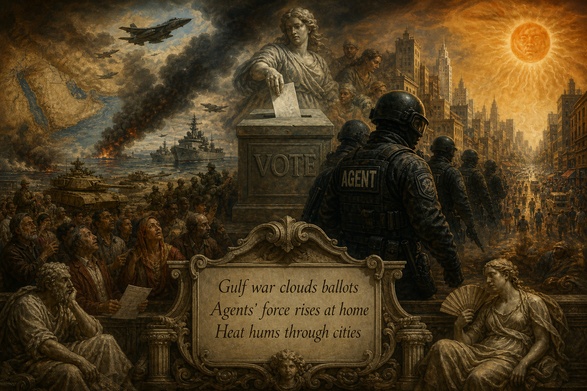
#politics#war#immigration#heat#culture#israel-hezbollah#iran#u.s.-politics#biden#congress#intelligence-ove
 | author: | Unknown | institution: | NPR | ¿porque no los dos? |
| tl;dr | Daily “Up First” newsletter-style roundup. Lead items: rising risk of a wider regional war as Israel–Hezbollah clashes intensify and how that could reshape U.S. politics; congressional maneuvering around intelligence leadership/oversight; and an ACLU report alleging an increase in Immigration and Customs Enforcement use-of-force incidents. Secondary sections include heat-safety advice, a photo feature, and quick hits on sports and space/technology news. Tone is concise and informational with short blurbs and links out for detail. | ||||
| deeper: | The piece mostly summarizes multiple stories in brief, avoiding emotional language and offering matter‑of‑fact phrasing. It foregrounds policy/process angles (political risk calculations, congressional oversight, agency conduct) and cites a civil-liberties report when discussing ICE, which nudges the framing slightly toward rights-focused concerns. No obvious cherry‑picking, but limited counter‑evidence or dissenting perspectives typical of short newsletters. Credibility is supported by clear topic segmentation and link-outs (implied) to fuller reporting; however, brevity prevents deep sourcing, data context, or methodology about the ACLU findings, lowering the overall rigor. Visuals/captions appear news-appropriate. Typos are minimal; structure is clean. | ||||
media: No Media Preview | |||||
| gen: 2026/07/16:14:38 in 1 min 26.2 sec (old)bias: 4 (Center-Left) |
| type: newsquality: 80 |
| pts: 0 |



owned and operated by: RPN Omnigalactic Insitutution as of: 2026/10/15: 08:46 in 0 ms
Enter Code
Login with Account