#conflict
| gen: 2026/09/28:05:22 in 25.0 sec (old)bias: 3 (Center) |
| type: newsquality: 66 |
| pts: 0 |
 | author: | Jane Arraf, Debbie Elliott | institution: | NPR | ¿porque no los dos? |
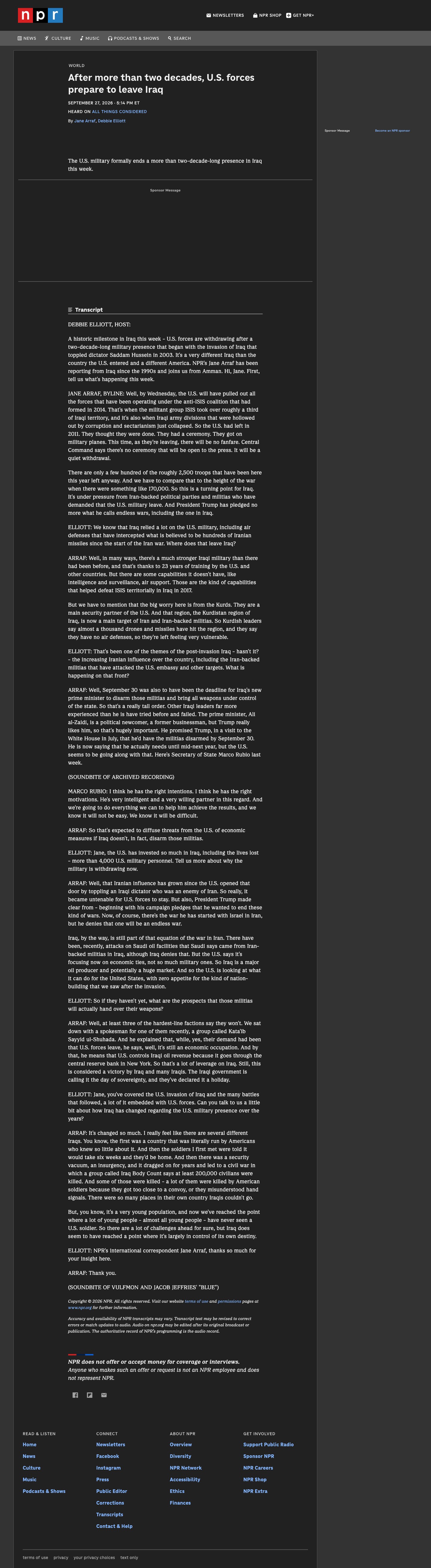
| tl;dr | The article reports that U.S. coalition forces are preparing to leave Iraq, presenting the withdrawal as a sovereignty milestone with significant security risks. It highlights Iraqi military capability gaps, Kurdish vulnerability, Iranian influence, and militias resisting disarmament. It also describes a U.S. shift toward economic relations and reviews the invasion’s civilian toll. Although the introduction suggests an uninterrupted military presence since 2003, the transcript acknowledges the 2011 withdrawal and 2014 return. | ||||
| deeper: | The report includes U.S., Kurdish, Iraqi government, and militia perspectives without a clear partisan prescription. Its emphasis on sovereignty and civilian harm is balanced by recognition of U.S. security contributions. Some sweeping judgments—Americans knowing little about Iraq and Iraq controlling its destiny—lack supporting detail. The introduction misleadingly implies continuous deployment. Iraq Body Count’s cumulative civilian deaths are also loosely presented as a civil-war total. Named sources and historical context help, but major contemporary claims cannot be independently verified from these screenshots. | ||||
media: | |||||
| gen: 2026/09/13:15:25 in 41.5 sec (old)bias: 3 (Center) |
| type: newsquality: 57 |
| pts: 0 |
 | author: | Diaa Hadid, Scott Simon | institution: | NPR | ¿porque no los dos? |
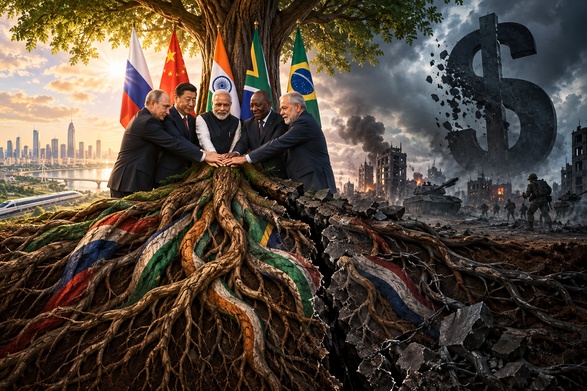
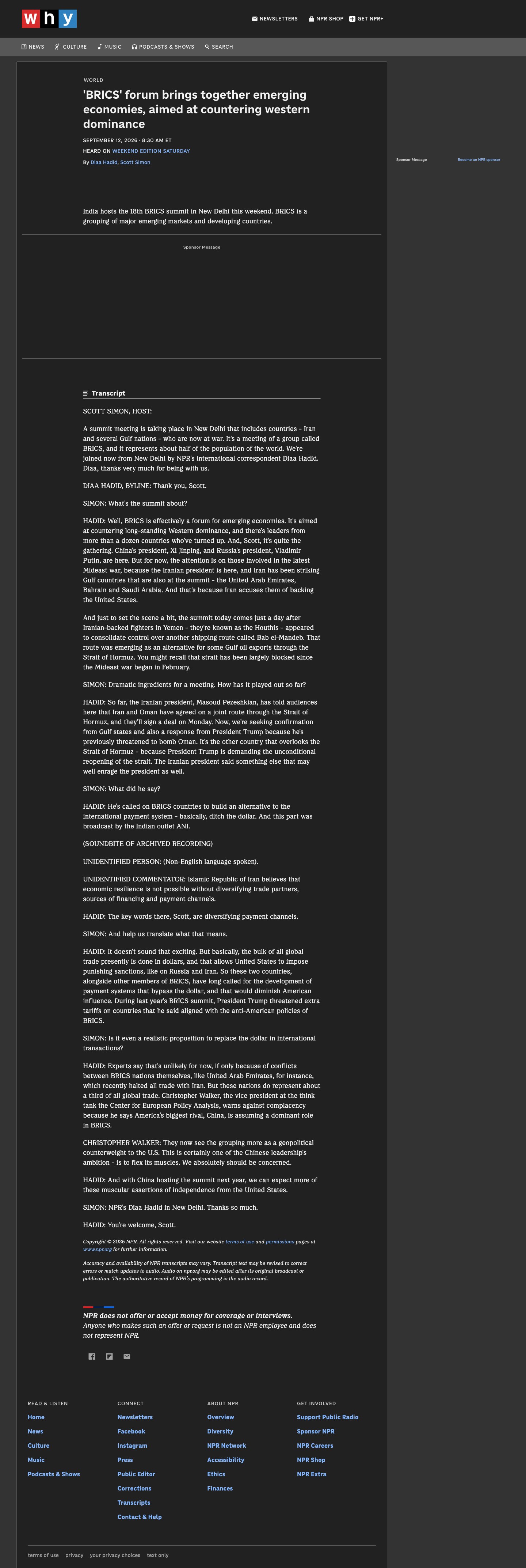
| tl;dr | The article describes a BRICS summit in New Delhi focused on Middle East conflict and efforts to reduce reliance on the U.S. dollar. It reports Iran’s announcement of a proposed shipping arrangement with Oman and calls for alternative payment channels. Internal disputes among BRICS members are presented as obstacles to replacing the dollar, while an analyst warns of China’s growing influence. Significant claims about warfare, shipping disruptions and U.S. threats are presented but cannot be independently verified from the screenshots. | ||||
| deeper: | The report explains financial issues accessibly, attributes Iran’s proposed deal and acknowledges that confirmation is pending. However, major claims about attacks, trade restrictions and threats to bomb Oman lack supporting evidence in the text. Its U.S.-centered framing and closing warning about China favor a security-threat perspective, without a clear left/right agenda. Phrases such as “enrage the president” introduce speculation. One analyst supplies the main outside assessment, and “ditch the dollar” oversimplifies the quoted call to diversify payment channels. | ||||
media: | |||||
| gen: 2026/09/13:15:22 in 30.8 sec (old)bias: 2 (Center) |
| type: newsquality: 73 |
| pts: 0 |
 | author: | The Associated Press | institution: | NPR | ¿porque no los dos? |
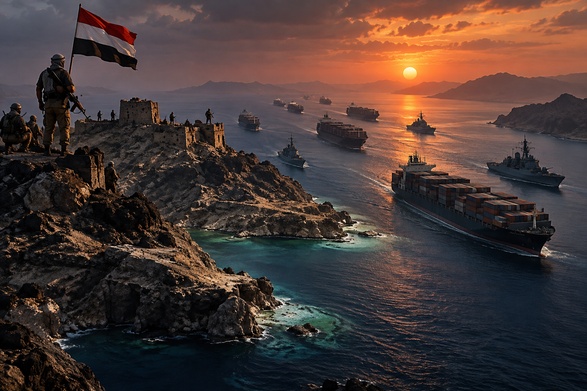
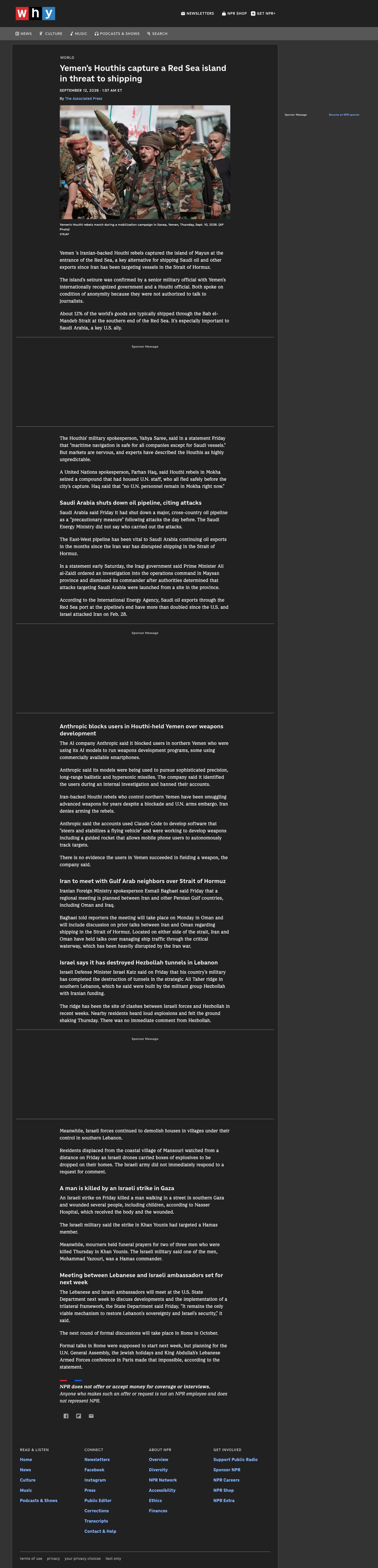
| tl;dr | The article reports that Yemen’s Houthis seized Mayun island, threatening a major Red Sea shipping route as conflict disrupts the Strait of Hormuz. It also covers a Saudi oil pipeline shutdown, Anthropic’s allegations of weapons-related AI misuse in Yemen, and planned regional shipping talks. Additional updates describe Israeli operations in Lebanon and Gaza and upcoming Israeli-Lebanese diplomacy. The central island-capture claim is attributed to anonymous officials from opposing sides; the screenshots alone do not independently establish the reported events. | ||||
| deeper: | The article largely uses restrained language, attributes contested claims, and includes Houthi, Iranian, Israeli, and civilian perspectives without promoting a clear political ideology. Its emphasis on shipping security frames the opening around economic risks. Calling the Houthis “highly unpredictable” through unnamed experts adds an unsupported judgment. Strengths include opposing-side confirmation and the caveat that AI-assisted weapons were not proven operational. Weaknesses include heavy reliance on official statements, limited independent evidence, and an unsourced shipping statistic. The screenshots establish what is reported, not its authenticity or accuracy. | ||||
media: | |||||
| gen: 2026/09/11:15:40 in 46.5 sec (old)bias: 3 (Center) |
| type: newsquality: 76 |
| pts: 0 |

 | author: | Mohamed Gabobe and Peter Beaumont | institution: | The Guardian | ¿porque no los dos? |
| tl;dr | The article reports renewed Somali piracy, linking eight hijackings since late April to regional conflict, diverted naval resources, shipping-route changes and Somalia’s instability. It describes the Lutuf’s capture and release, an alleged $2.5 million ransom, and pirates’ use of captured ships and satellite internet. Experts warn that ransom payments finance further attacks and that international forces may lack the capacity for another large anti-piracy campaign. Lasting solutions, they argue, require addressing conditions on land. | ||||
| deeper: | The reporting provides historical context, named experts, local interviews and linked sources, without clearly endorsing a left- or right-wing agenda. Its security-focused framing and words such as “scourge” add some emotional weight. The headline presents the war’s causal role more firmly than the evidence establishes. Some claims rely on unnamed officials or analysts, and the initially attributed ransom payment later becomes an assumed fact. Shipping operators’ and affected crews’ perspectives are limited. The screenshots alone cannot establish authenticity or independently verify the reported events. | ||||
media: | |||||
| gen: 2026/09/11:15:34 in 44.9 sec (old)bias: 2 (Unknown) |
| type: newsquality: 45 |
| pts: 0 |
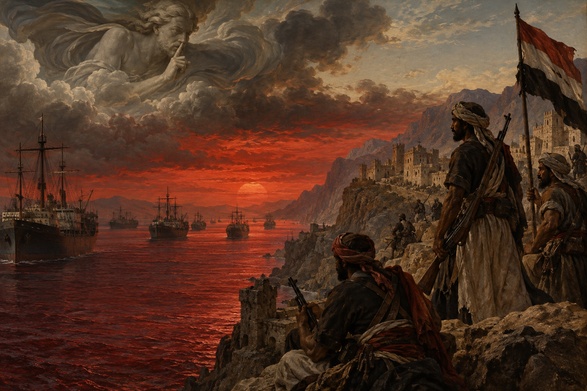
 | author: | FRANCE 24 | institution: | FRANCE 24 | ¿porque no los dos? |
| tl;dr | The visible article reports that Yemen’s Iran-aligned Houthi rebels have seized the country’s entire Red Sea coast, citing a government official. It says this brings them closer to controlling the Bab al-Mandab strait, a strategically important maritime passage. Most of the article body is not visible in the supplied images, so its supporting evidence and broader coverage cannot be assessed. | ||||
| deeper: | The visible wording is mostly factual and shows no clear left-right political position. However, the headline presents a sweeping territorial claim as established fact, while the introduction attributes it only to an unidentified government official. No corroboration or competing account is visible. The byline, timestamps and photo credit provide basic transparency, but the missing article body limits assessment. These scores apply only to the readable excerpt, not the unseen reporting. | ||||
media: | |||||
| gen: 2026/09/09:15:30 in 34.9 sec (old)bias: 3 (Center) |
| type: newsquality: 86 |
| pts: 0 |

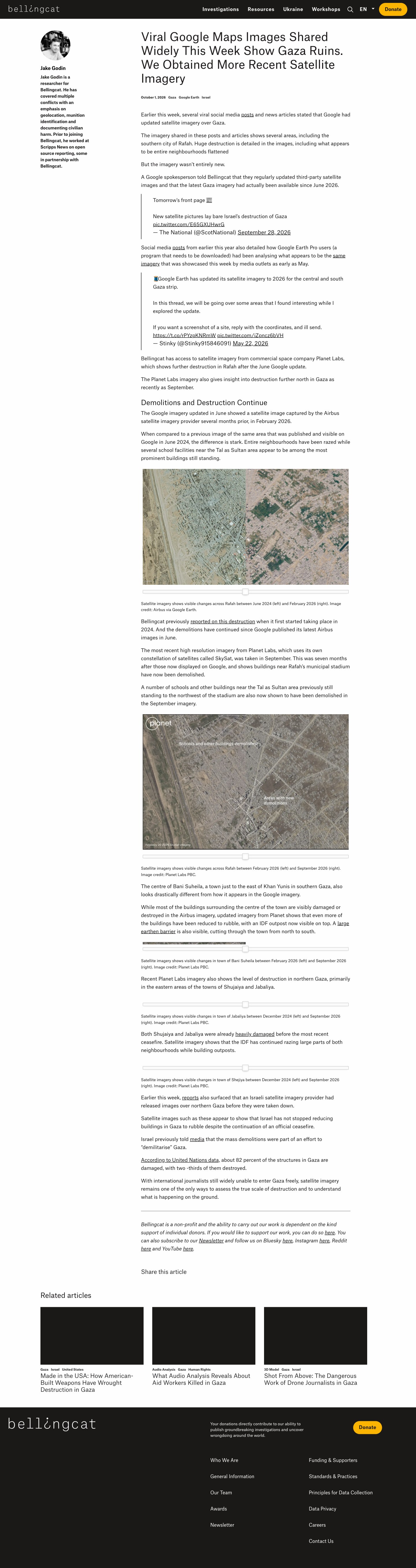
 | author: | Sebastian Vandermeersch | institution: | Bellingcat | ¿porque no los dos? |
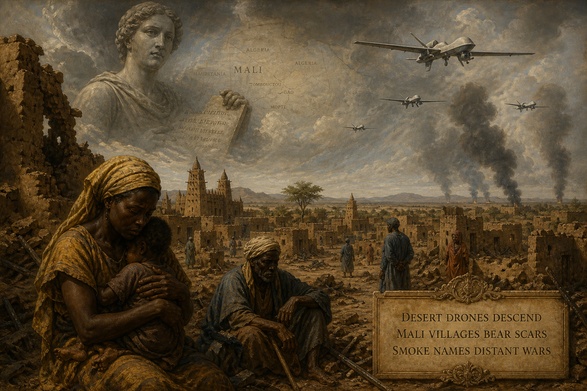
| tl;dr | Bellingcat reports it has verified open-source footage showing Shahed-136–type one-way attack drones used in two July 2026 strikes in northern Mali (Inafarak on July 12; Talahandak on July 17). The investigation geolocates videos with satellite imagery, compares pre/post-strike images, and cites experts who say debris (including an MD-550 engine) matches Shahed-136 family components. The report argues the deployment likely reflects Russian support to Mali via the Africa Corps, and warns the system’s lower precision raises civilian-harm risks. | ||||
| deeper: | The piece is evidence-forward and method-heavy (geolocation coordinates, satellite comparisons, annotated imagery, component identification, and named expert input), which supports credibility. Bias is present mainly in framing and attribution: language like “Kremlin-controlled” and emphasis on Russia-linked networks (Africa Corps/Wagner channels) can steer interpretation, and the manufacturing attribution remains probabilistic (“quite likely”). It is careful about limits (variant not definitively identified) and grounds key claims in verifiable visuals and cross-checks. | ||||
media: | |||||
| gen: 2026/09/09:15:21 in 42.7 sec (old)bias: 2 (Center) |
| type: newsquality: 55 |
| pts: 0 |

 | author: | Unknown | institution: | France 24 | ¿porque no los dos? |
| tl;dr | A France 24 page/headline reports that Iran said it fired ballistic missiles at a US base in Jordan early Wednesday, describing it as retaliation for US strikes on Iranian tankers. The visible page is mostly the headline, timestamp, and a short standfirst; the remainder of the article text is not shown in the provided images. | ||||
| deeper: | The framing is largely straight-news: it attributes key claims (“Iran said…”, “in retaliation…”) and avoids loaded language in the limited visible text. However, only a small excerpt is available, with no sourcing detail, corroboration, casualty/damage reporting, or competing accounts from the US/Jordan, which limits verification and overall informational value in this capture. | ||||
media: | |||||
| gen: 2026/08/27:06:16 in 59.4 secbias: 3 (Center) |
| type: eli5quality: 78 |
| pts: 0 |

 | author: | Stephan Bisaha, Michel Martin | institution: | NPR (WHYY) | ¿porque no los dos? |
| tl;dr | The piece reports that Canada will impose tariffs on nearly $20 billion of U.S. goods in response to new U.S. tariffs, framing the situation as an escalating trade conflict harming businesses on both sides. It lists targeted products (steel, aluminum, dairy, toilet paper, agricultural equipment, American motorcycles, protein powders) and notes uncertainty for importers. It also references recent Supreme Court scrutiny of some Trump-era tariffs and suggests Canada’s measures could face legal challenges, while emphasizing the broader economic and political standoff. | ||||
| deeper: | The reporting is largely fact-forward and includes concrete figures and examples of affected goods, plus a straightforward discussion of legal and business impacts. Some framing and phrasing (“strikes back,” “trade war,” “random collection,” and characterizing political strategy) adds mild narrative color and can steer perception, but it’s not heavy-handed. Quality is solid for a news transcript: clear sourcing (named hosts/reporter), specific details, and relevant context; it would be stronger with more direct attribution links/data and perspectives from Canadian/U.S. officials and affected industries. | ||||
media: | |||||
| gen: 2026/08/25:16:31 in 36.0 sec (old)bias: 2 (Center) |
| type: newsquality: 78 |
| pts: 0 |

 | author: | Unknown | institution: | The Guardian | ¿porque no los dos? |
| tl;dr | The article reports an attack on a mosque in Dekara village in Nigeria’s north-central Niger State, where gunmen abducted worshippers—especially women, children, and older people. It cites a video showing captives and armed men, quotes residents who identified people in the footage, and notes police had not confirmed the exact number taken. The report situates the incident within Nigeria’s broader wave of mass kidnappings for ransom and insecurity affecting multiple regions. | ||||
| deeper: | The writing is largely straight-news: it attributes claims to residents, references a posted video, and clearly flags uncertainty where official confirmation is missing (the number of abductees). It provides context about kidnapping-for-ransom patterns without heavy ideological framing or loaded language beyond standard conflict terms (“gunmen,” “bandits”). Quality is solid due to sourcing and caution, though it relies significantly on resident testimony and a video rather than independently verifiable official figures, which limits completeness. | ||||
media: | |||||
| gen: 2026/08/25:16:28 in 42.2 sec (old)bias: 3 (Center-Left) |
| type: newsquality: 83 |
| pts: 0 |
 | author: | Unknown | institution: | NPR | ¿porque no los dos? |
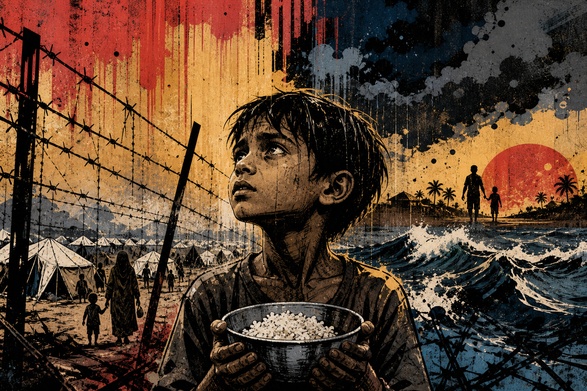
| tl;dr | The piece argues that nine years after mass displacement from Myanmar, Rohingya refugees—largely in Bangladesh—face worsening conditions: protracted statelessness, diminishing international attention and aid, rising insecurity in camps, and few credible paths to safe return. It frames the crisis as entering a more volatile phase, emphasizing refugees’ fear of repatriation without rights and security, and highlighting regional/political dynamics that keep solutions stalled. | ||||
| deeper: | Language and sourcing appear largely factual and human-centered, with emphasis on refugee testimony and humanitarian impacts. That focus can tilt toward advocacy for refugee protections, but it is consistent with standard rights-based reporting and not heavily polemical. The article structure (context, on-the-ground scenes, and policy constraints) suggests solid reporting, though a full balance check would depend on how thoroughly it represents Myanmar/Bangladesh officials’ perspectives and hard data (aid levels, crime/armed-group claims) alongside anecdotes. | ||||
media: | |||||
| gen: 2026/08/22:18:54 in 43.9 sec (old)bias: 4 (Center-Left) |
| type: newsquality: 63 |
| pts: 0 |
 | author: | Unknown | institution: | France 24 | ¿porque no los dos? |
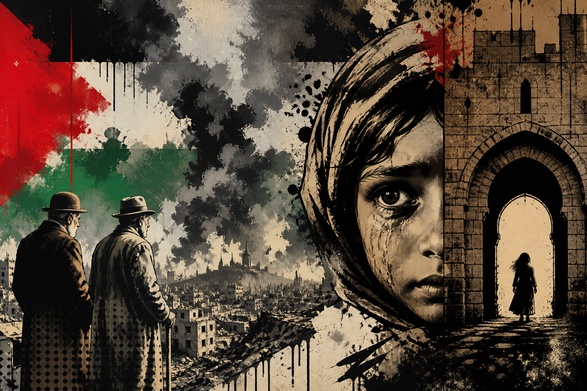
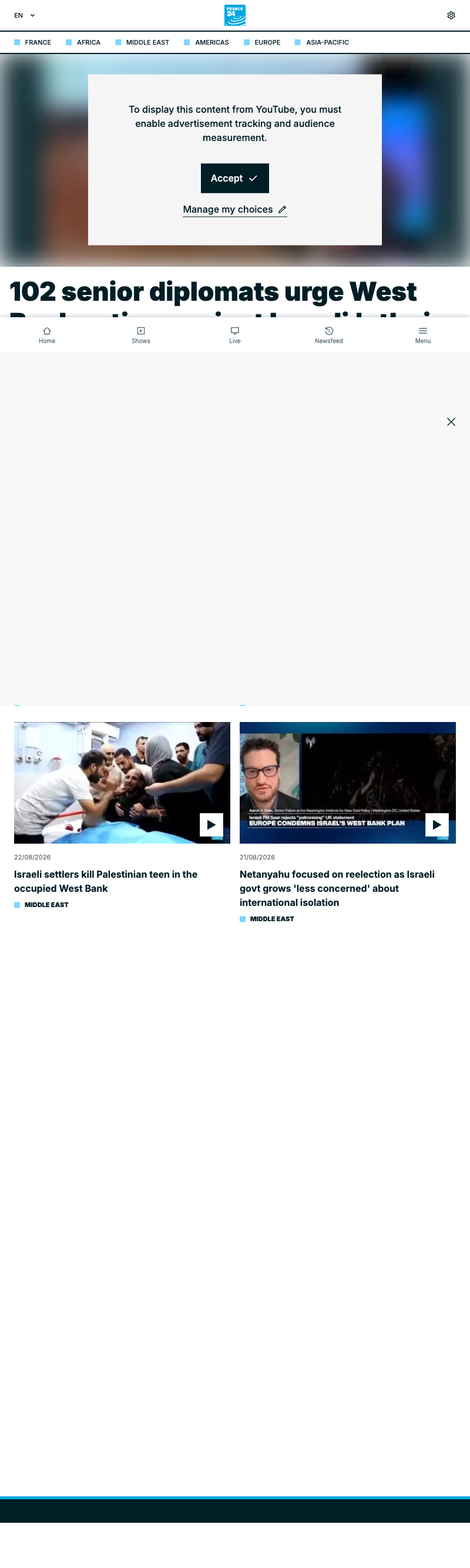
| tl;dr | The image is a France 24 news page focused on Israel/Palestine coverage. The visible headlines include: “Israeli settlers kill Palestinian teen in the occupied West Bank” (22/08/2026), “Netanyahu focused on reelection as Israeli govt grows ‘less concerned’ about international isolation” (21/08/2026), and a clip noting “Europe condemns Israel’s West Bank plan.” A larger, partly obscured headline reads “102 senior diplomats urge West …,” but the rest of the article is not visible. | ||||
| deeper: | Bias signals are mild and mostly come from framing and word choice: repeated emphasis on West Bank condemnation, “occupied West Bank,” and “settlers kill” foregrounds Israeli actions and international criticism. “Occupied West Bank” is widely used in diplomatic/UN contexts, but it still communicates a legal-political stance. Quality looks decent for a mainstream outlet, but the screenshot hides the main article’s body, sources, and countervailing perspectives, so it’s hard to assess evidence, attribution, and completeness. | ||||
media: No Media Preview | |||||
| gen: 2026/08/16:22:32 in 40.0 sec (old)bias: 3 (Center) |
| type: newsquality: 78 |
| pts: 0 |
 | author: | The Associated Press | institution: | NPR | ¿porque no los dos? |
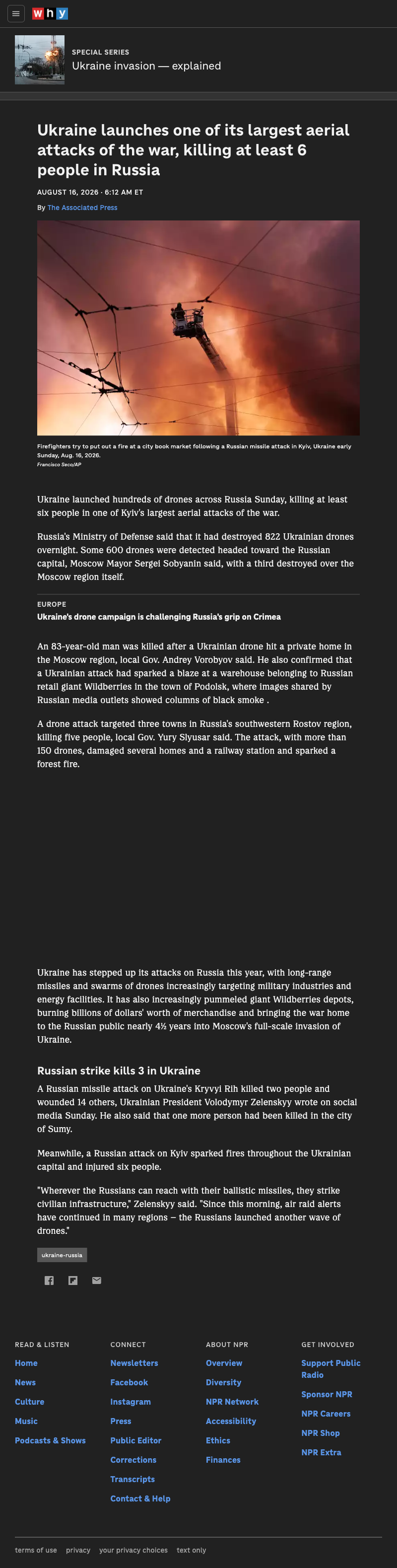
| tl;dr | The article reports that Ukraine launched one of its largest drone attacks of the war into Russia, with Russian officials claiming 822 drones were destroyed and at least six people were killed across affected regions. It describes strikes near Moscow and in the Rostov region, including damage to homes, infrastructure, and a warehouse fire. The piece also notes Russian missile attacks in Ukraine that killed and wounded civilians, quoting President Zelenskyy on continued air alerts and strikes on civilian infrastructure. | ||||
| deeper: | Language is largely factual and attribution-heavy, relying on official statements (notably Russian ministries, regional governors, and Moscow’s mayor) while also including Ukrainian accounts and a Zelenskyy quote about Russian strikes. The framing provides context about Ukraine escalating long-range strikes and mentions Russian attacks in Ukraine, which helps balance. Some figures (e.g., drones “destroyed”) are hard to independently verify in wartime, and the story leans on government sources without much third-party corroboration, but overall sourcing and structure are solid. | ||||
media: No Media Preview | |||||
| gen: 2026/08/13:04:31 in 2 min 30.8 sec (old)bias: 3 (Center) |
| type: lolsquality: 78 |
| pts: 0 |
 | author: | Unknown | institution: | Yahoo News | ¿porque no los dos? |
| tl;dr | A Yahoo News article (sourced from a wire service) reports that a major Russian grain export terminal was struck in a Ukrainian Black Sea port attack. The piece frames the event within the wider Russia–Ukraine war context, highlighting damage and disruption implications for grain exports and shipping. It relies on official/attributed statements and situational reporting rather than analysis or commentary. | ||||
| deeper: | The story is largely straight, event-driven reporting with a neutral news tone and attribution (typical of wire copy). Potential bias comes mainly from wartime information constraints and reliance on official claims that may be difficult to independently verify in real time. Quality is solid: clear headline, relevant context (war, ports, grain exports), and focus on verifiable elements (location, target, impact). It appears light on independent corroboration and on-the-ground detail, which is common for fast-moving conflict coverage. | ||||
media: No Media Preview | |||||
| gen: 2026/08/10:22:09 in 2 min 43.7 sec (old)bias: 5 (Unknown) |
| type: lolsquality: 35 |
| pts: 0 |

 | author: | Unknown | institution: | Unknown | ¿porque no los dos? |
| tl;dr | The screenshot appears to be a long-form news/article page with multiple embedded images and several sections of text. However, the provided image resolution is too low to reliably read the headline, author, outlet, or key claims, so I can’t accurately summarize the article’s substance or evaluate specific assertions without risking inventing details. If you share a link or a higher-resolution image (or paste the text), I can provide a proper content, bias, and quality analysis. | ||||
| deeper: | Because the text is not legible, I can’t assess word choice, framing, evidence, sourcing, or whether opposing viewpoints are represented—all of which are necessary to judge bias and quality. The scores reflect uncertainty rather than a firm evaluation: a middle bias score and a low-to-moderate quality score due to insufficient readable information. Provide a clearer copy and I can score based on verifiable features (sources, data, direct quotes, and transparency). | ||||
media: No Media Preview | |||||
| gen: 2026/08/04:05:26 in 48.8 sec (old)bias: 3 (Center) |
| type: newsquality: 72 |
| pts: 0 |
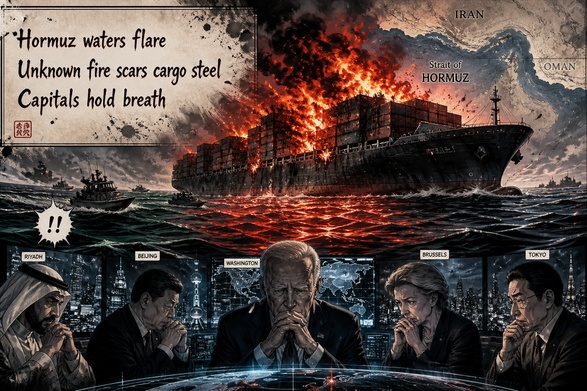
#middle east#shipping#conflict#diplomacy#france24#straitofhormuz#cargo_ship#projectile#iran#israel-gaza_wae?
| gen: 2026/07/31:16:25 in 51.2 sec (old)bias: 6 (Unknown) |
| type: newsquality: 42 |
| pts: 0 |
 | author: | Unknown | institution: | Unknown | ¿porque no los dos? |
| tl;dr | The provided image is a tall, low-resolution screenshot of a web article containing a sensational headline, multiple paragraphs, two embedded video players, and at least one still image with colored bounding boxes (suggesting “analysis” or highlighting subjects in a scene). Due to the resolution, the exact outlet, author, and key factual claims are not reliably readable, so only structural/content-level assessment is possible. | ||||
| deeper: | The layout and presentation suggest a strongly emotive/sensational framing (headline tone, heavy emphasis on video, and highlighted imagery). However, the screenshot does not allow verification of the article’s core claims, sourcing, dates, or named witnesses/official statements. The presence of boxed/annotated imagery can imply “forensic” authority, but without readable methodology or citations it risks being rhetorical rather than evidentiary. Overall quality is limited by unclear sourcing/transparency and reliance on dramatic visuals. | ||||
| gen: 2026/07/31:16:22 in 45.0 sec (old)bias: 3 (Center) |
| type: newsquality: 78 |
| pts: 0 |
 | author: | Unknown | institution: | Reuters | ¿porque no los dos? |
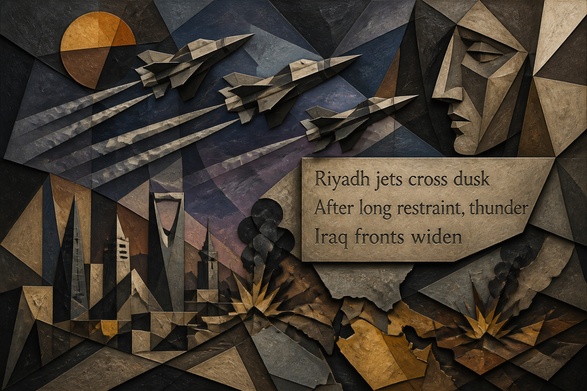
| tl;dr | The article examines why Saudi Arabia (Riyadh) quietly supported or aligned with U.S. strikes against Iran-linked militias in Iraq, despite Saudi outreach to Iran. It presents the decision as driven by security concerns (missile/drone threats), a desire to deter Iran-backed groups without open escalation, and Riyadh’s balancing act between de-escalation diplomacy and reliance on U.S. security guarantees. It also describes how the Gaza war and regional militia activity changed Saudi threat perceptions and narrowed Riyadh’s room for restraint. | ||||
| deeper: | The piece reads like a reported analysis: it focuses on strategic motives and regional security dynamics, uses conditional language, and attributes claims to officials/diplomats/analysts rather than asserting certainties. Bias is limited but present in the framing that prioritizes state-security logic (Saudi/U.S. deterrence) more than civilian-impact or Iraqi sovereignty critiques. Quality is solid—clear structure and context—but the article appears to rely heavily on anonymous sourcing and inference about intent, which lowers verifiability. | ||||
media: No Media Preview | |||||
| gen: 2026/07/28:04:52 in 45.4 sec (old)bias: 2 (Center) |
| type: newsquality: 72 |
| pts: 0 |
 | author: | Unknown | institution: | Unknown | ¿porque no los dos? |
| tl;dr | The piece appears to describe using drones and computer-vision/object-detection methods to locate and classify items on the ground (illustrated by a photo with colored bounding boxes around objects). It frames this as a way to make field surveys faster and more systematic, with discussion of how the approach works, what it can and cannot detect reliably, and what kinds of data/training are required. The overall thrust is practical and technical rather than political. | ||||
| deeper: | The language and structure look informational and method-focused, with an emphasis on describing a workflow (drone imagery + automated detection) and its limitations. Any bias mainly comes from a pro-technology framing—highlighting efficiency gains more than potential downsides (false positives/negatives, oversight, misuse). Quality seems solid based on the technical visuals and explanatory sections, but the screenshot resolution makes it hard to verify sourcing, author credentials, or the strength of evidence cited. | ||||
| gen: 2026/07/22:05:43 in 4 min 4.8 sec (old)bias: 2 (Center) |
| type: lolsquality: 78 |
| pts: 0 |
 | author: | Unknown | institution: | Unknown | ¿porque no los dos? |
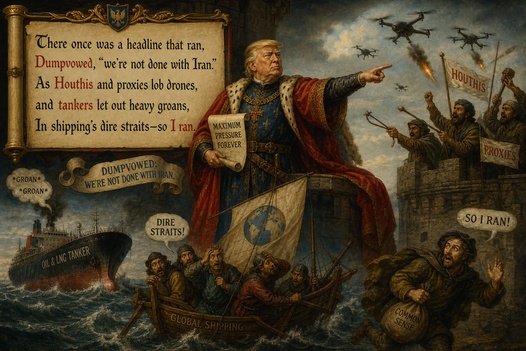
| tl;dr | The piece reports on Donald Trump saying the U.S. is “not finished” attacking Iran as regional conflict escalates, and it situates his remarks alongside key developments (military actions, diplomatic reactions, and market/security implications). It relies heavily on direct quotations and attributed claims, aiming to summarize what was said and what happened rather than argue a single thesis. | ||||
| deeper: | Content: The central focus is Trump’s statement that the U.S. is “not finished” with attacks on Iran, framed within a broader, fast-moving conflict narrative. The story appears structured around (1) what Trump said, (2) what actions have occurred or are alleged, and (3) reactions/implications (regional actors, security posture, and likely economic/energy concerns). Bias: The language in the visible headline and sections is mostly descriptive and attribution-driven (quoting Trump and other officials/actors rather than asserting conclusions). The piece does use conflict-escalation framing (“conflict widens”), which is common in breaking-news coverage and can heighten urgency, but it is not overtly editorial. Any slant is mainly in story selection and emphasis—foregrounding Trump’s rhetoric and military escalation—rather than loaded adjectives or unchallenged moral claims. Quality: Stronger-than-average for a spot-news article: it appears to use multiple attributed sources, direct quotes, and sectioned context (e.g., health/threat and cost-of-war-type subsections visible in the screenshot). Limitations: it’s constrained by the breaking-news format (less space for deep verification, competing narratives, legal/strategic analysis, and historical background). It also appears to have intrusive overlays/pop-ups that interrupt reading (presentation/UX issue rather than reporting). Overall, it reads like a standard wire-style report: informative, but not deeply investigative. | ||||
media: | |||||


owned and operated by: RPN Omnigalactic Insitutution as of: 2026/10/14: 08:49 in 0 ms
Enter Code
Login with Account