#red sea
| gen: 2026/09/13:15:22 in 30.8 sec (-1d)bias: 2 (Center) |
| type: newsquality: 73 |
| pts: 0 |

 | author: | The Associated Press | institution: | NPR | ¿porque no los dos? |
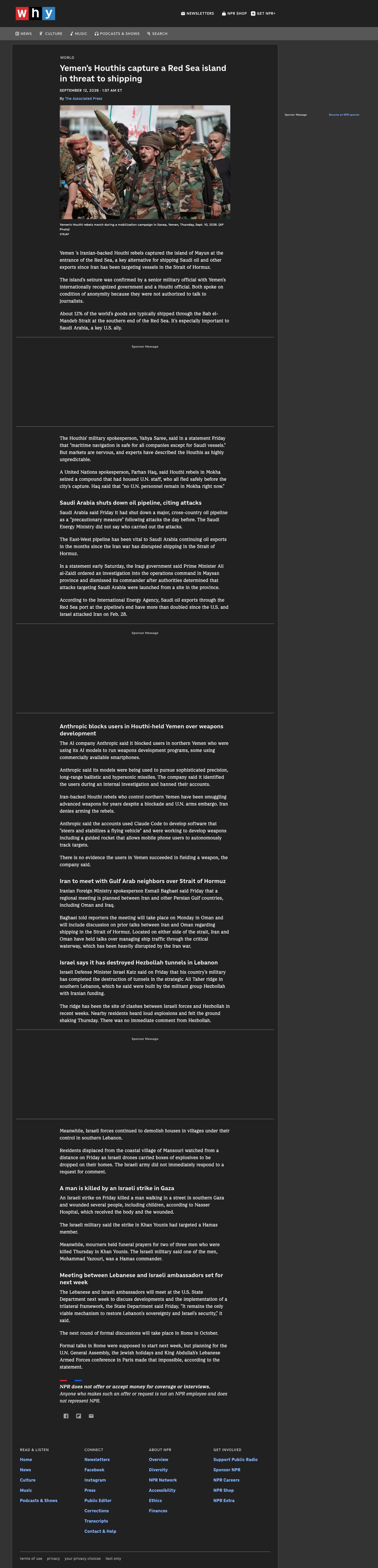
| tl;dr | The article reports that Yemen’s Houthis seized Mayun island, threatening a major Red Sea shipping route as conflict disrupts the Strait of Hormuz. It also covers a Saudi oil pipeline shutdown, Anthropic’s allegations of weapons-related AI misuse in Yemen, and planned regional shipping talks. Additional updates describe Israeli operations in Lebanon and Gaza and upcoming Israeli-Lebanese diplomacy. The central island-capture claim is attributed to anonymous officials from opposing sides; the screenshots alone do not independently establish the reported events. | ||||
| deeper: | The article largely uses restrained language, attributes contested claims, and includes Houthi, Iranian, Israeli, and civilian perspectives without promoting a clear political ideology. Its emphasis on shipping security frames the opening around economic risks. Calling the Houthis “highly unpredictable” through unnamed experts adds an unsupported judgment. Strengths include opposing-side confirmation and the caveat that AI-assisted weapons were not proven operational. Weaknesses include heavy reliance on official statements, limited independent evidence, and an unsourced shipping statistic. The screenshots establish what is reported, not its authenticity or accuracy. | ||||
media: | |||||
| gen: 2026/09/11:15:40 in 46.5 sec (-3d)bias: 3 (Center) |
| type: newsquality: 76 |
| pts: 0 |

 | author: | Mohamed Gabobe and Peter Beaumont | institution: | The Guardian | ¿porque no los dos? |
| tl;dr | The article reports renewed Somali piracy, linking eight hijackings since late April to regional conflict, diverted naval resources, shipping-route changes and Somalia’s instability. It describes the Lutuf’s capture and release, an alleged $2.5 million ransom, and pirates’ use of captured ships and satellite internet. Experts warn that ransom payments finance further attacks and that international forces may lack the capacity for another large anti-piracy campaign. Lasting solutions, they argue, require addressing conditions on land. | ||||
| deeper: | The reporting provides historical context, named experts, local interviews and linked sources, without clearly endorsing a left- or right-wing agenda. Its security-focused framing and words such as “scourge” add some emotional weight. The headline presents the war’s causal role more firmly than the evidence establishes. Some claims rely on unnamed officials or analysts, and the initially attributed ransom payment later becomes an assumed fact. Shipping operators’ and affected crews’ perspectives are limited. The screenshots alone cannot establish authenticity or independently verify the reported events. | ||||
media: | |||||
| gen: 2026/09/11:15:34 in 44.9 sec (-3d)bias: 2 (Unknown) |
| type: newsquality: 45 |
| pts: 0 |
 | author: | FRANCE 24 | institution: | FRANCE 24 | ¿porque no los dos? |
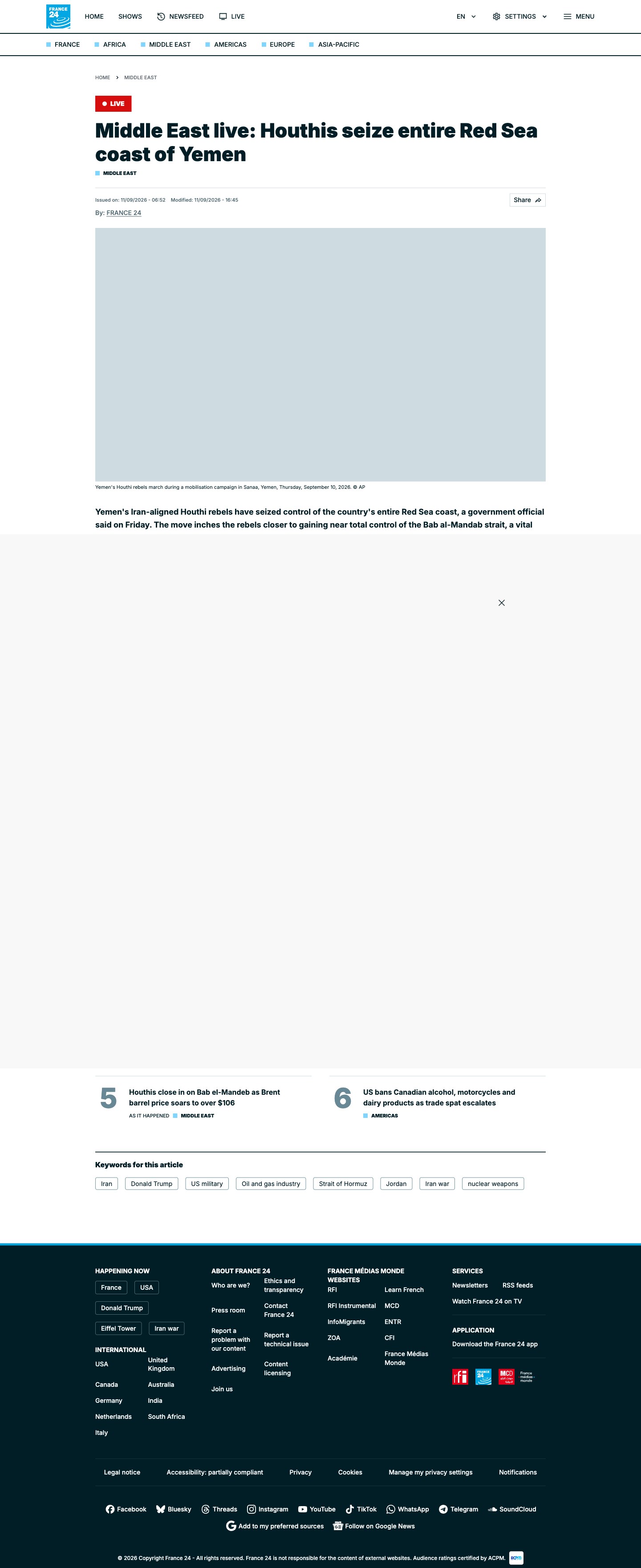
| tl;dr | The visible article reports that Yemen’s Iran-aligned Houthi rebels have seized the country’s entire Red Sea coast, citing a government official. It says this brings them closer to controlling the Bab al-Mandab strait, a strategically important maritime passage. Most of the article body is not visible in the supplied images, so its supporting evidence and broader coverage cannot be assessed. | ||||
| deeper: | The visible wording is mostly factual and shows no clear left-right political position. However, the headline presents a sweeping territorial claim as established fact, while the introduction attributes it only to an unidentified government official. No corroboration or competing account is visible. The byline, timestamps and photo credit provide basic transparency, but the missing article body limits assessment. These scores apply only to the readable excerpt, not the unseen reporting. | ||||
media: | |||||
You made it to the bottom. Now dance!


owned and operated by: RPN Omnigalactic Insitutution as of: 2026/09/14: 02:48 in 0 ms
Enter Code
Login with Account