#saudi arabia
| gen: 2026/09/16:05:17 in 37.9 sec (old)bias: 3 (Center) |
| type: lolsquality: 68 |
| pts: 0 |
 | author: | Agencies | institution: | The Guardian | ¿porque no los dos? |
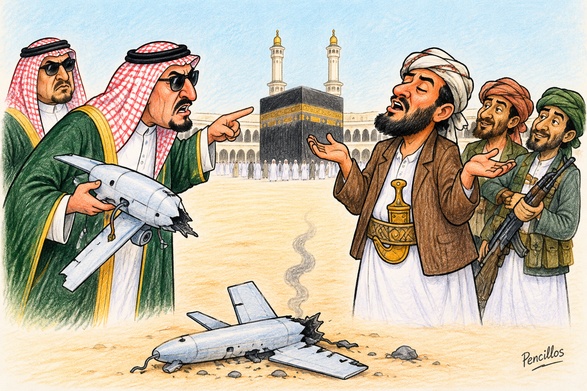
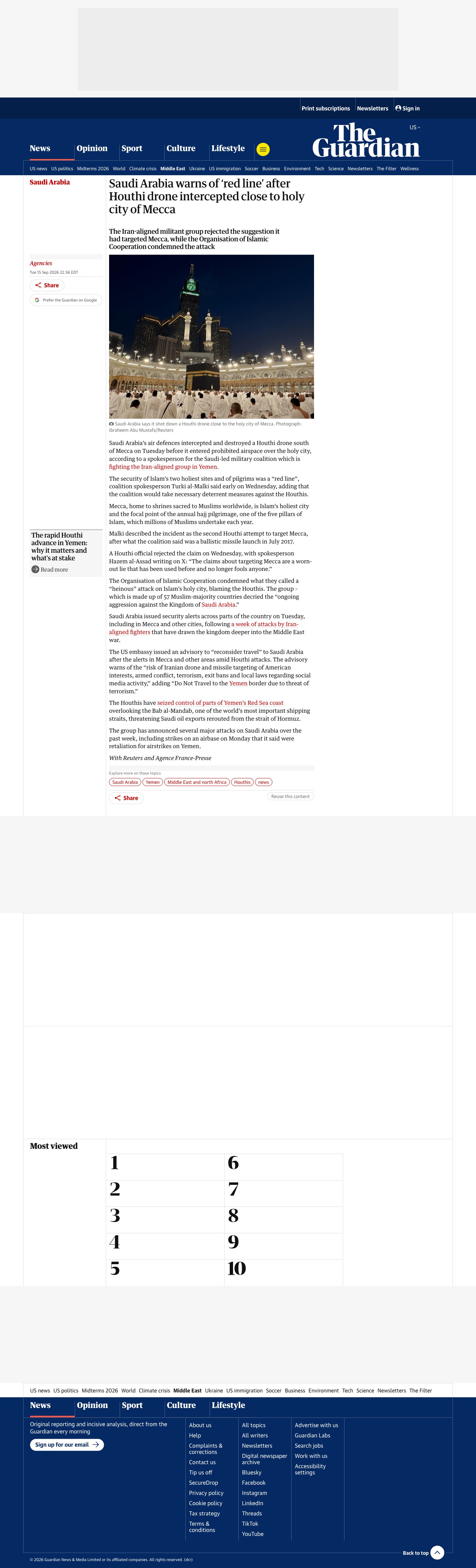
| tl;dr | Saudi Arabia says it intercepted a Houthi drone south of Mecca and warned that protecting holy sites and pilgrims is a “red line.” The Houthis deny targeting Mecca, while the Organisation of Islamic Cooperation condemned the alleged attack. The article also reports Saudi security alerts, a US travel advisory, and wider regional fighting affecting shipping and oil exports. It provides no independent evidence establishing the drone’s intended target. | ||||
| deeper: | The article attributes claims and prominently includes the Houthi denial, with no clear left-right political agenda. However, the headline and holy-site imagery emphasize the Saudi security narrative, while Saudi and allied statements receive more space. Named sources and regional context are strengths. Independent verification, precise interception details, and evidence of the intended target are missing. Some broader military and shipping claims receive little supporting detail, and the screenshot alone cannot establish authenticity or factual accuracy. | ||||
media: | |||||
| gen: 2026/09/02:03:39 in 40.7 sec (old)bias: 2 (Center) |
| type: lolsquality: 68 |
| pts: 0 |

#cheetahs#genetics#conservation#saudi arabia#ancient-dna#archaeology#human-evolution#fossils#research-study
 | author: | Unknown | institution: | Unknown | ¿porque no los dos? |
| tl;dr | The screenshot appears to be a science-news article about researchers extracting and analyzing ancient DNA from an archaeological/prehistoric specimen (the pictured object looks like a fossil or bone/tooth fragment). The piece describes what genetic analysis can reveal about ancient populations and/or human relatives, summarizes the study’s main findings, and includes methodological context and caveats typical of ancient-DNA work (contamination, sample limits, probabilistic inference). | ||||
| deeper: | This reads like straightforward science reporting: it leans on research claims rather than ideology, and the language (from what’s legible) doesn’t use overtly loaded political framing. The main risk is “science-news compression”: simplifying uncertainty, emphasizing novelty, and relying on paraphrased conclusions without enough space for limitations or dissenting views. Quality seems decent if it’s tied to a peer‑reviewed paper and quotes/links sources, but the screenshot resolution makes it hard to verify specifics like citations and exact claims. | ||||
media: | |||||
| gen: 2026/07/31:16:22 in 45.0 sec (old)bias: 3 (Center) |
| type: newsquality: 78 |
| pts: 0 |
 | author: | Unknown | institution: | Reuters | ¿porque no los dos? |
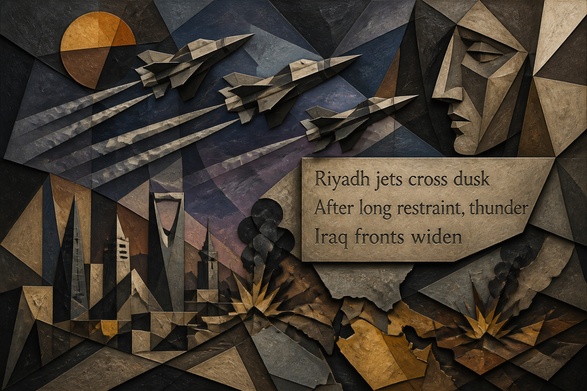
| tl;dr | The article examines why Saudi Arabia (Riyadh) quietly supported or aligned with U.S. strikes against Iran-linked militias in Iraq, despite Saudi outreach to Iran. It presents the decision as driven by security concerns (missile/drone threats), a desire to deter Iran-backed groups without open escalation, and Riyadh’s balancing act between de-escalation diplomacy and reliance on U.S. security guarantees. It also describes how the Gaza war and regional militia activity changed Saudi threat perceptions and narrowed Riyadh’s room for restraint. | ||||
| deeper: | The piece reads like a reported analysis: it focuses on strategic motives and regional security dynamics, uses conditional language, and attributes claims to officials/diplomats/analysts rather than asserting certainties. Bias is limited but present in the framing that prioritizes state-security logic (Saudi/U.S. deterrence) more than civilian-impact or Iraqi sovereignty critiques. Quality is solid—clear structure and context—but the article appears to rely heavily on anonymous sourcing and inference about intent, which lowers verifiability. | ||||
media: | |||||
You made it to the bottom. Now dance!


owned and operated by: RPN Omnigalactic Insitutution as of: 2026/10/16: 00:27 in 0 ms
Enter Code
Login with Account