Unknown
| Total Responses: | 499 |
| Average Quality Score: | 67.4 |
| Average Bias Score: | 2.7 |
| gen: 2026/10/14:15:21 in 1 min 10.6 sec (-3d)bias: 4 (Center-Left) |
| type: eli5quality: 76 |
| pts: 0 |
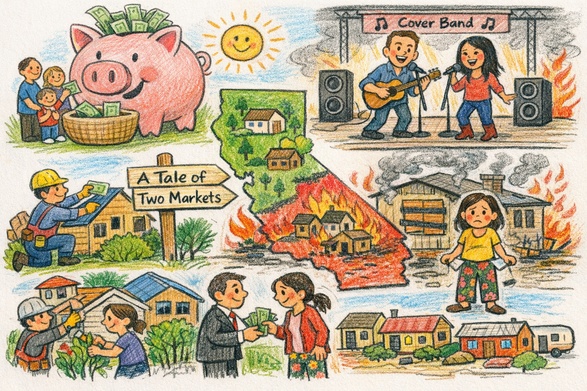
#insurance#wildfires#climate#government#communities#california#home insurance#palisades fire#climate change#fair plan benefi
 | author: | Unknown | institution: | Grist; co-published with LAist | ¿porque no los dos? |
| tl;dr | The article examines California’s home-insurance crisis through wildfire survivors’ experiences and competing proposals from insurance commissioner candidates Ben Allen and Jane Kim. Allen favors restoring private coverage through pricing reforms and fire-risk reduction; Kim proposes public disaster insurance. It connects rising costs and lost coverage to wildfires, risky development, regulatory constraints, and climate change. Both approaches face major funding and implementation hurdles, illustrated by expensive, difficult efforts to make entire communities more fire-resistant. | ||||
| deeper: | The social-contract framing and emphasis on consumer protection and collective investment suggest a center-left outlook. Loaded phrases such as “cozying up” and speculation about Lara’s motives introduce editorial judgment. However, both candidates receive substantial coverage, including serious criticism of Kim’s funding plans and acknowledgment of insurers’ losses. Interviews, linked sources, and a sourced map strengthen the reporting. Weaknesses include limited direct industry input and imprecise descriptions: the FAIR Plan is insurer-funded, not a conventional state-backed insurer, and stopping new policies is not equivalent to withdrawing entirely. | ||||
media: | |||||
| gen: 2026/10/07:04:39 in 1 min 12.6 secbias: 2 (Unknown) |
| type: eli5quality: 76 |
| pts: 0 |

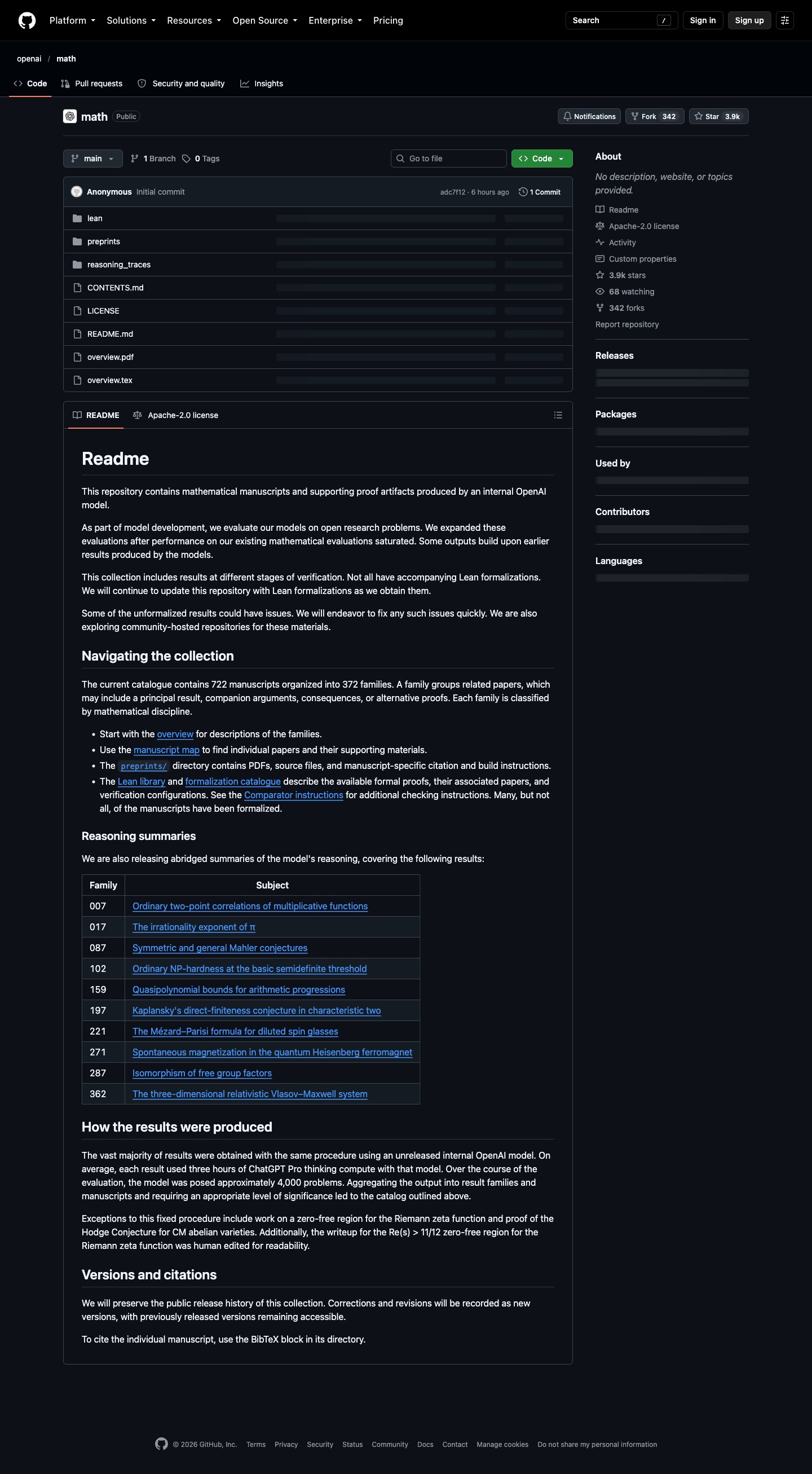 | author: | Unknown | institution: | OpenAI | ¿porque no los dos? |
| tl;dr | The repository README describes 722 mathematical manuscripts in 372 related families produced by an unreleased OpenAI model evaluated on approximately 4,000 problems. It links to papers, supporting materials, Lean formal proofs, and selected reasoning summaries. The document acknowledges differing verification levels and possible errors in unformalized results. It outlines the production process, notes exceptions and limited human editing, and promises to preserve corrections and earlier versions. The screenshots alone do not establish the mathematical claims’ correctness or novelty. | ||||
| deeper: | This is technical repository documentation, not independent reporting. Its language is mostly restrained, with explicit warnings about potential errors and incomplete verification. Links to proof materials, production details, and version histories support transparency. However, the visible text does not provide independent assessments, precise verification totals, or clear criteria for selecting significant results. Highlighting selected outputs offers an incomplete picture of overall performance. No political position is evident; the score evaluates the documentation, not the underlying mathematics. | ||||
media: | |||||
| gen: 2026/09/19:21:43 in 34.5 sec (old)bias: 3 (Center) |
| type: newsquality: 88 |
| pts: 0 |


| gen: 2026/09/18:18:48 in 37.0 secbias: 3 (Unknown) |
| type: colorquality: 45 |
| pts: 0 |
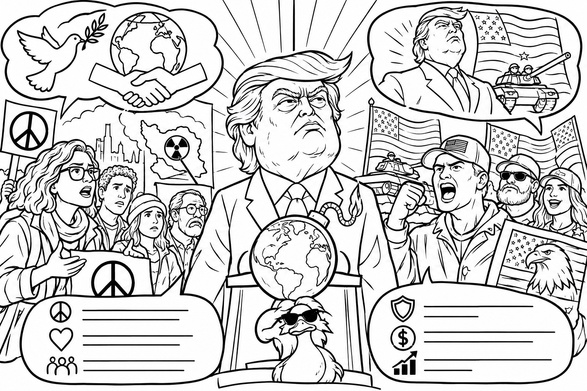
#politics#war#diplomacy#iran#trump#iran war#donald trump#barack obama#us presidency#national securit
Leftist
Yet another disastrous consequence of unchecked power. The Trump administration's aggressive stance on Iran risks not just regional peace but global stability. Diplomacy should always triumph over reckless showmanship. This isn't just about jeopardizing a political career; it's jeopardizing lives. When will we learn that war isn't the answer? We need leaders who prioritize humanity over hubris, fostering dialogue over division.
Rightist
This is a classic case of fearmongering from the left. The Trump administration is taking strong steps to ensure national security. Liberals may call it jeopardizing, but it's about protecting American interests and showing strength against adversaries like Iran. Sometimes, peace requires power. It's time to stop apologizing for America and start safeguarding our future. Trump’s decisive actions show the world we won’t back down.
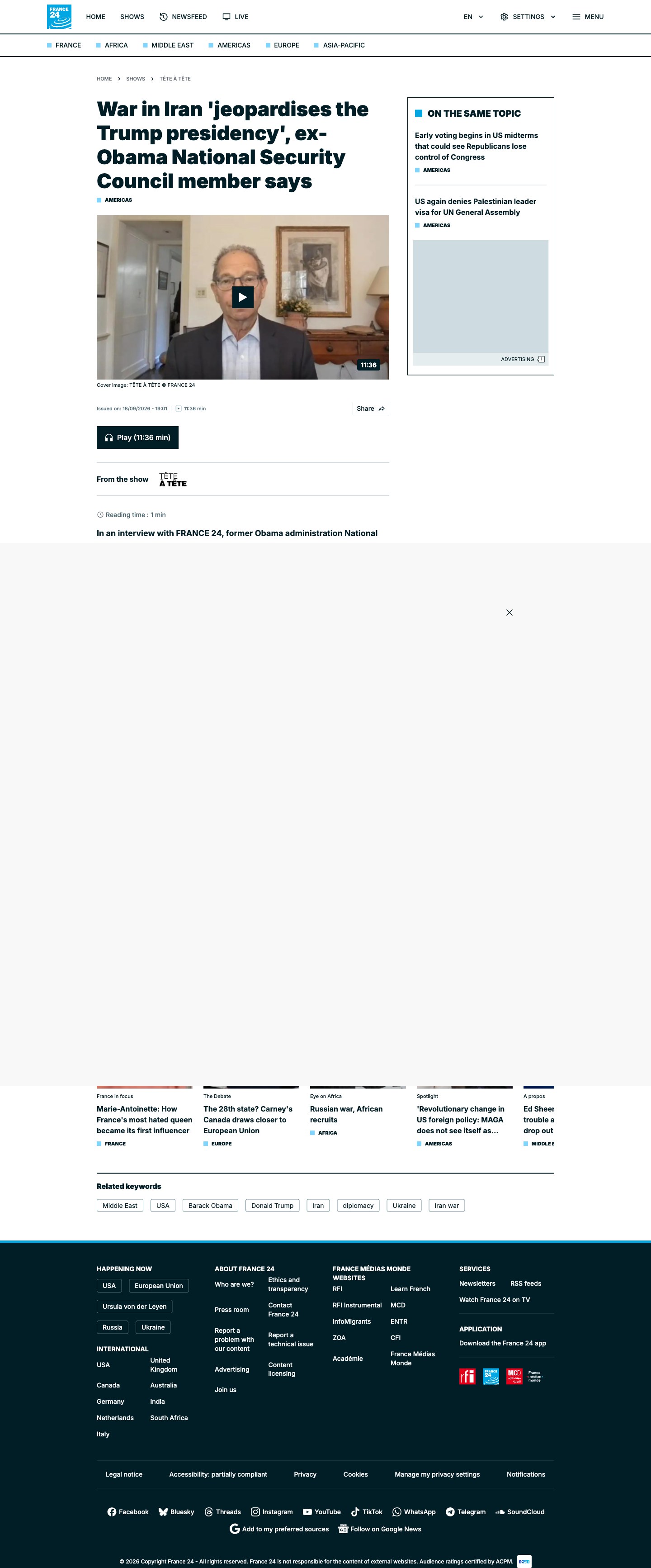 | author: | Unknown | institution: | France 24 | ¿porque no los dos? |
| tl;dr | The visible France 24 page previews an interview with a former Obama administration National Security Council member who argues that war in Iran jeopardises Donald Trump’s presidency. The headline presents this as the guest’s assessment, not an established outcome. Most of the article text is obscured, and the interview itself cannot be assessed from these screenshots. | ||||
| deeper: | The headline foregrounds a dramatic prediction from one former administration official, giving the visible coverage a narrow perspective. However, quotation marks and explicit attribution distinguish opinion from fact. Criticism of Trump alone does not establish a left–right position. The page supplies publication details and an interview format, but the obscured text prevents evaluation of evidence, questioning, context or competing views. The quality score applies only to the material visible here. | ||||
media: | |||||
| gen: 2026/09/13:15:28 in 32.1 sec (old)bias: 1 (Center) |
| type: newsquality: 40 |
| pts: 0 |

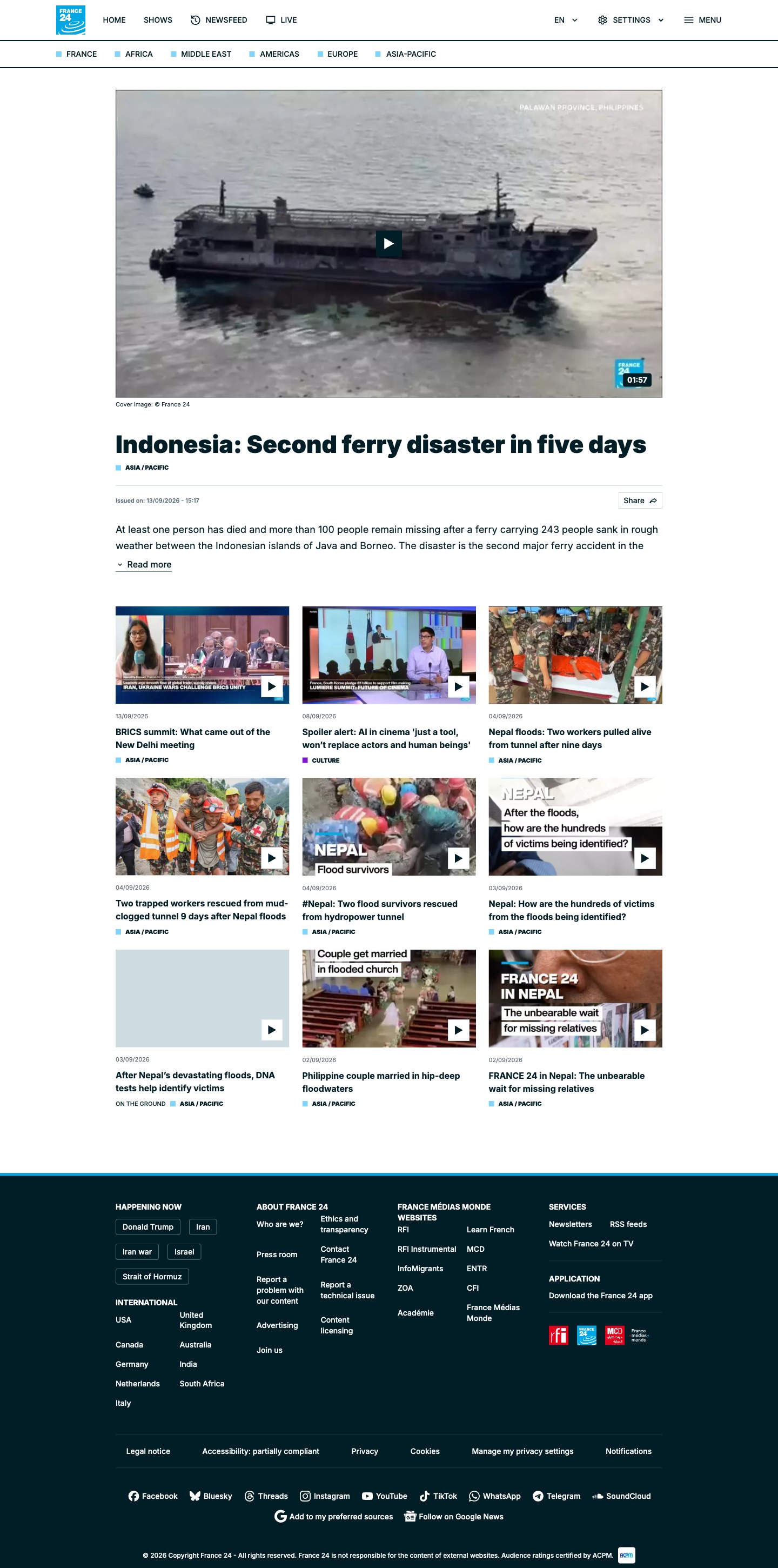 | author: | Unknown | institution: | France 24 | ¿porque no los dos? |
| tl;dr | The visible report says a ferry carrying 243 people sank in rough weather between Java and Borneo, leaving at least one person dead and more than 100 missing. The headline describes it as Indonesia’s second ferry disaster in five days. Only a short introduction is readable; the accompanying video thumbnail is labeled Palawan Province, Philippines, which does not match the reported location. | ||||
| deeper: | The visible wording is straightforward disaster reporting, with no clear political slant or assignment of blame. However, the casualty figures have no visible source, the ferry is not named, and the earlier accident is not explained. The Philippines-labeled thumbnail conflicts with the Indonesian story and could mislead readers. This assessment covers only the visible excerpt, not the unplayed video or hidden article text. | ||||
media: | |||||
| gen: 2026/09/09:15:24 in 43.9 sec (old)bias: 4 (Center-Left) |
| type: newsquality: 72 |
| pts: 0 |

 | author: | Unknown | institution: | France 24 | ¿porque no los dos? |
| tl;dr | A France 24 report says 12 countries—including Britain, Canada and France—plan to sanction trade with Israeli settlements in the West Bank, citing rising attacks by settlers against Palestinians in the occupied territory. The page includes a short video clip and a brief summary paragraph framing the move as a response to increased settler violence. | ||||
| deeper: | The language is mostly straightforward and event-focused, but it frames the rationale primarily through “increasing attacks by settlers against Palestinians” and uses the term “occupied territory,” which signals a particular legal/political framing and may omit Israeli government/settler arguments or counterclaims in the visible excerpt. Quality is solid for a headline brief from a major outlet, but the screenshot lacks details: which 12 countries, what specific sanctions, definitions of “settlements,” evidence for the increase in attacks, and any responses from Israel or affected businesses. | ||||
media: | |||||
| gen: 2026/09/09:15:21 in 42.7 sec (old)bias: 2 (Center) |
| type: newsquality: 55 |
| pts: 0 |

 | author: | Unknown | institution: | France 24 | ¿porque no los dos? |
| tl;dr | A France 24 page/headline reports that Iran said it fired ballistic missiles at a US base in Jordan early Wednesday, describing it as retaliation for US strikes on Iranian tankers. The visible page is mostly the headline, timestamp, and a short standfirst; the remainder of the article text is not shown in the provided images. | ||||
| deeper: | The framing is largely straight-news: it attributes key claims (“Iran said…”, “in retaliation…”) and avoids loaded language in the limited visible text. However, only a small excerpt is available, with no sourcing detail, corroboration, casualty/damage reporting, or competing accounts from the US/Jordan, which limits verification and overall informational value in this capture. | ||||
media: | |||||
| gen: 2026/09/08:17:08 in 41.3 sec (old)bias: 4 (Center) |
| type: newsquality: 72 |
| pts: 0 |

 | author: | Unknown | institution: | France 24 | ¿porque no los dos? |
| tl;dr | A France 24 “live” Middle East update reports that Israel plans to close the British consulate in Jerusalem, framing the move as a response to UK sanctions related to Israeli settlements. The page features an AFP photo of an Israeli soldier near a newly established settlement outpost near Beit Sahur, labeled as in the occupied West Bank, reinforcing the settlement-focused context of the story. | ||||
| deeper: | The headline is largely straight, cause-and-effect framing (“after sanctions”), but the choice of photo and caption language (“occupied West Bank,” “newly established … outpost”) foregrounds a specific legal/political framing that many governments and the UN use, while others contest parts of it—this can tilt perception without being overtly polemical. Quality is solid for a breaking-news/live item (clear headline, timestamp, AFP image credit), but the provided excerpt lacks the article body, sourcing details, and competing quotes that would let readers fully assess claims and motives. | ||||
media: | |||||
| gen: 2026/09/03:04:19 in 35.6 sec (old)bias: 2 (Center) |
| type: newsquality: 82 |
| pts: 0 |
| gen: 2026/09/03:04:14 in 54.3 sec (old)bias: 4 (Center) |
| type: newsquality: 78 |
| pts: 0 |

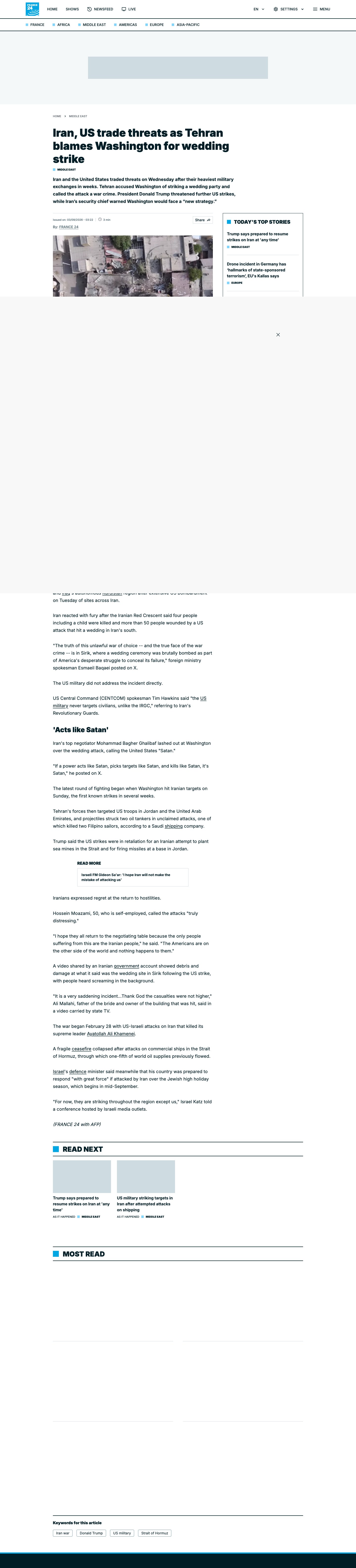 | author: | Unknown | institution: | France 24 (with AFP) | ¿porque no los dos? |
| tl;dr | France 24 (with AFP) reports escalating Iran–US tensions after recent military exchanges. Tehran accuses Washington of striking a wedding in southern Iran (Sirik), calling it a war crime; Iran’s Red Crescent claims four killed (including a child) and 50+ wounded. US Central Command denies targeting civilians and contrasts US conduct with Iran’s IRGC. The piece also notes regional spillover: attacks on US troops in Jordan/UAE, tanker damage in unclaimed attacks, and risks to Strait of Hormuz shipping, alongside Israeli warnings. | ||||
| deeper: | The article is largely straight-wire reporting, presenting claims and counterclaims from Iranian officials, the Iranian Red Crescent, and CENTCOM, plus limited civilian reaction. Bias mainly comes from emphasis on vivid inflammatory quotes (“Satan,” “war crime”) and casualty claims without showing independent verification or forensic detail; it does, however, include the US denial and broader context (shipping, regional strikes, Israeli statements). Quality is solid for a fast update, but thin on corroboration, timelines, and evidence beyond official statements and a government-shared video. | ||||
media: | |||||
| gen: 2026/09/02:14:16 in 50.7 sec (old)bias: 3 (Center) |
| type: newsquality: 78 |
| pts: 0 |
 | author: | Unknown | institution: | BBC News | ¿porque no los dos? |
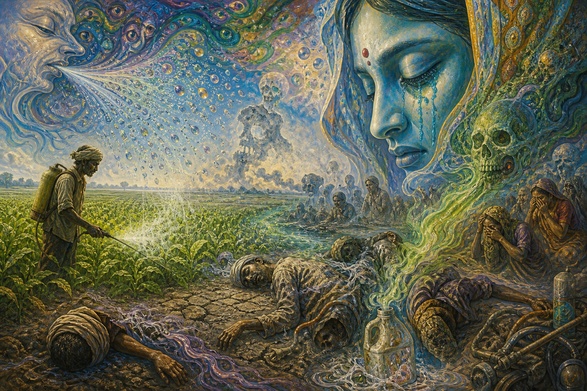
| tl;dr | The article reports on research estimating substantial global harm from pesticide exposure/poisoning, including deaths and widespread health impacts, and argues that current safeguards are inadequate. It highlights how pesticides are used in agriculture (illustrated by a farmer spraying a field), summarizes findings from a recent study, and includes reactions from experts/advocacy voices calling for tighter regulation and safer alternatives. | ||||
| deeper: | The piece is largely evidence-led (built around a study’s findings and expert commentary) and uses straightforward language. Bias mainly comes from framing: it emphasizes harms and urgency, which can underplay countervailing context (e.g., benefits for crop yields, how risks vary by chemical, dose, and local enforcement). Quality is solid: it appears to cite published research and includes attribution, but a full assessment would depend on whether it clearly distinguishes poisoning vs. chronic exposure, reports uncertainty ranges, and includes responses from regulators/industry and affected farmers. | ||||
| gen: 2026/09/02:14:13 in 36.9 sec (old)bias: 5 (Center-Left) |
| type: newsquality: 62 |
| pts: 0 |

#climate#heat#mortality#public health#us debt#deficit#treasury#interest rates#fiscal policy#congress
 | author: | Unknown | institution: | Unknown | ¿porque no los dos? |
| tl;dr | The screenshot appears to be a CNN-style article page discussing U.S. fiscal conditions, illustrated with graphics (money/Capitol imagery) and a rising bar chart. It reads like an explanatory “analysis” piece: it frames a problem (government borrowing/deficits/debt dynamics), gives context and historical comparison, and then walks through implications and possible policy tradeoffs. Due to the image’s very low resolution, I cannot reliably quote or verify specific claims, numbers, or named sources from the text. | ||||
| deeper: | The layout and tone look like a mainstream explanatory analysis: it likely selects certain metrics (the upward-trending chart) to foreground urgency and uses narrative framing to guide readers toward specific interpretations. That kind of framing introduces moderate bias even when facts are used. Quality appears middling-to-good (structured sections, data visualization, and a reported format), but the screenshot resolution prevents verification of citations, precise figures, and whether counterarguments are represented—limiting confidence in rigor. | ||||
media: No Media Preview | |||||
| gen: 2026/09/02:14:10 in 26.9 sec (old)bias: 5 (Unknown) |
| type: newsquality: 20 |
| pts: 0 |

 | author: | Unknown | institution: | Unknown | ¿porque no los dos? |
| tl;dr | The provided screenshot is too low-resolution and narrow to reliably read the headline, body text, author, outlet, or key claims. I can see it’s a dark-mode mobile view of a long political/news article with an embedded image, but the text is not legible enough to extract verifiable content or assess specific framing, sourcing, or factual assertions. | ||||
| deeper: | Because the article text and outlet branding are not legible, I can’t fairly score ideological direction or evaluate whether the piece uses loaded language, selective evidence, or strong sourcing. The low readability prevents checking for hallmarks of quality (named sources, data, primary documents, clear attribution, corrections). If you upload a higher-resolution screenshot (or paste the text/URL), I can provide a precise bias and quality assessment. | ||||
| gen: 2026/09/02:03:42 in 42.9 sec (old)bias: 5 (Unknown) |
| type: lolsquality: 20 |
| pts: 0 |

| gen: 2026/09/02:03:39 in 40.7 sec (old)bias: 2 (Center) |
| type: lolsquality: 68 |
| pts: 0 |

#cheetahs#genetics#conservation#saudi arabia#ancient-dna#archaeology#human-evolution#fossils#research-study
 | author: | Unknown | institution: | Unknown | ¿porque no los dos? |
| tl;dr | The screenshot appears to be a science-news article about researchers extracting and analyzing ancient DNA from an archaeological/prehistoric specimen (the pictured object looks like a fossil or bone/tooth fragment). The piece describes what genetic analysis can reveal about ancient populations and/or human relatives, summarizes the study’s main findings, and includes methodological context and caveats typical of ancient-DNA work (contamination, sample limits, probabilistic inference). | ||||
| deeper: | This reads like straightforward science reporting: it leans on research claims rather than ideology, and the language (from what’s legible) doesn’t use overtly loaded political framing. The main risk is “science-news compression”: simplifying uncertainty, emphasizing novelty, and relying on paraphrased conclusions without enough space for limitations or dissenting views. Quality seems decent if it’s tied to a peer‑reviewed paper and quotes/links sources, but the screenshot resolution makes it hard to verify specifics like citations and exact claims. | ||||
| gen: 2026/08/31:17:08 in 1 min 8.8 secbias: 6 (Center-Left) |
| type: colorquality: 74 |
| pts: 0 |
#oil trade#venezuela#international#politics#energy#delcyrodriguez#oil#sanctions#us-venezuela#donaldtrump】【、】【
Leftist
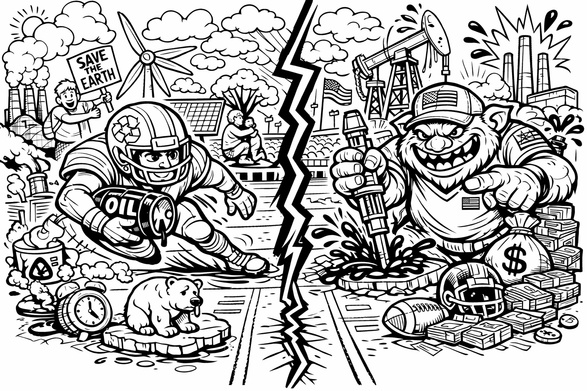
Hold onto your helmets, folks! Rodriguez is taking a bold stance,
scooping the oil like a leftist quarterback launching for a greener,
global win. But wait! Why align with Trump, the opponent of fair play?
This coalition is like throwing a climate-change interception!
Let’s hope this oil saga leads to renewable breakthroughs
that level the energy playing field!
Rightist
Now that’s what I call a power play! Rodriguez is drilling down,
gaining yardage on America's oil field of dreams with Trump.
With those vast oil reserves, it's like unlocking an energy championship!
This move tackles the left's green agenda head-on, driving jobs,
energy independence, and prosperity straight into the goalpost
of national interest!
 | author: | Unknown | institution: | The Guardian | ¿porque no los dos? |
| tl;dr | The image shows a Guardian news article about Venezuela’s vice-president Delcy Rodríguez defending the long-term (“endless”) benefits of an oil-related deal involving Donald Trump/Trump-linked interests, framing it as advantageous for Venezuela and potentially relevant to US–Venezuela relations and global energy markets. The piece appears to mix reporting with political context about sanctions, oil access, and diplomatic signaling, using Rodríguez’s claims as the news hook while situating them within wider geopolitical stakes. | ||||
| deeper: | The headline framing (“defends”, quoting “endless”) and story selection emphasize political controversy and power dynamics around Trump and Venezuelan oil, which can subtly steer readers toward skepticism of the deal’s motives. Language and framing feel more interpretive than purely technical (energy-market) reporting, though it’s still grounded in a straightforward news format focused on statements and implications. Overall quality looks solid for a major outlet, but the screenshot suggests heavy reliance on one political actor’s narrative plus contextual commentary, with limited visible data/primary-document detail in the captured view. | ||||
| gen: 2026/08/31:15:57 in 40.9 sec (old)bias: 3 (Center) |
| type: newsquality: 62 |
| pts: 0 |

 | author: | Unknown | institution: | Unknown | ¿porque no los dos? |
| tl;dr | The screenshot appears to show a long-form science/tech news article about research involving worms (likely laboratory nematodes) and biological mechanisms (possibly aging, nervous-system function, or genetics). It includes multiple images and many outbound links, suggesting it’s a reported explainer rather than a short press release. However, the image resolution is too low to reliably read key details like the exact headline, findings, author, outlet, or the study being cited. | ||||
| deeper: | The piece looks like standard science reporting: explanatory structure, citations/links, and neutral framing (low overt political signaling). The main quality limitation is unverifiable from the provided image: the text is largely unreadable at this resolution, so I can’t confirm whether it accurately reflects the underlying study, includes independent expert comment, quantifies uncertainty, or avoids overclaiming. The presence of many links and a non-sensational layout suggests decent editorial standards, but the evidentiary support can’t be checked here. | ||||
| gen: 2026/08/31:15:54 in 41.5 sec (old)bias: 3 (Center) |
| type: newsquality: 78 |
| pts: 0 |
 | author: | Unknown | institution: | Yahoo News | ¿porque no los dos? |
| tl;dr | The piece argues that Donald Trump continues to claim—without evidence—that the 2020 election was stolen, but that he has become notably less specific about alleged fraud and less willing to name particular people, machines, or mechanisms. It links this shift to real-world consequences: repeated courtroom losses, public fact-checking, and defamation exposure from naming targets (e.g., election workers or voting-system companies). The article frames the narrative as a strategic rhetorical adjustment rather than a change in belief. | ||||
| deeper: | The article uses assertive language (“baseless”) and treats the stolen-election claim as settled, which can read as adversarial to Trump, but it aligns with extensive court outcomes and the lack of substantiated evidence. It appears to support its argument by contrasting past detailed allegations with more generalized recent messaging and by referencing legal/financial incentives to be vague. Quality is solid: clear thesis, relevant context, and explanatory framing, though it risks over-interpreting motive if it doesn’t substantiate internal strategy beyond observable behavior. | ||||
| gen: 2026/08/31:15:51 in 40.0 sec (old)bias: 3 (Center) |
| type: newsquality: 74 |
| pts: 0 |
 | author: | Unknown | institution: | The Guardian | ¿porque no los dos? |
| tl;dr | The image is a screenshot of a Guardian news article about a rescue operation in Nepal, where emergency workers are trying to reach a large number of people feared trapped inside hydropower tunnels after an incident at/near a hydropower project site. The piece describes the scale of the emergency, the difficult conditions for rescuers, and the uncertainty around casualties while authorities and teams attempt to access the tunnel area and account for missing workers. | ||||
| deeper: | The language is mostly straight news reporting: it focuses on verified facts (rescue efforts, numbers feared trapped, site conditions) and emphasizes uncertainty where outcomes aren’t yet confirmed. Any bias is limited to sympathetic framing toward victims and rescuers, which is common in disaster coverage. Quality appears solid—clear headline, relevant on-scene imagery, and topic focus—though the screenshot limits verification of sourcing depth (e.g., whether multiple independent sources, technical experts, or primary documents are cited). | ||||
| gen: 2026/08/31:15:14 in 47.1 sec (old)bias: 6 (Center-Left) |
| type: newsquality: 74 |
| pts: 0 |

 | author: | Unknown | institution: | The Guardian | ¿porque no los dos? |
| tl;dr | The piece argues that the Trump-era Department of Homeland Security expanded or relied on a little-known legal authority to conduct surveillance and information-gathering that swept in journalists, nonprofits, and labor unions. It frames this as a serious civil-liberties threat, warning about weak oversight, broad discretion, and chilling effects on press freedom and organizing. The article emphasizes alleged secrecy and mission creep, and calls for stronger limits and transparency around DHS investigative powers. | ||||
| deeper: | The article is strongly framed and morally loaded (“outrageous”), with emphasis on rights harms and a critical posture toward Trump-era DHS. That rhetorical approach increases perceived bias, though the topic (state surveillance and oversight) is newsworthy. Quality appears solid for an explanatory/advocacy-style report: it focuses on a specific legal mechanism, describes who is affected, and highlights accountability gaps. Without seeing clear presentation of DHS’s best counterarguments or detailed primary-document excerpts in the screenshot, it reads more one-sided than purely investigative. | ||||


owned and operated by: RPN Omnigalactic Insitutution as of: 2026/10/16: 21:40 in 0 ms
Enter Code
Login with Account