#rescue
| gen: 2026/09/11:04:59 in 38.3 sec (old)bias: 2 (Center) |
| type: newsquality: 82 |
| pts: 0 |


| gen: 2026/08/31:15:51 in 40.0 sec (old)bias: 3 (Center) |
| type: newsquality: 74 |
| pts: 0 |
 | author: | Unknown | institution: | The Guardian | ¿porque no los dos? |
| tl;dr | The image is a screenshot of a Guardian news article about a rescue operation in Nepal, where emergency workers are trying to reach a large number of people feared trapped inside hydropower tunnels after an incident at/near a hydropower project site. The piece describes the scale of the emergency, the difficult conditions for rescuers, and the uncertainty around casualties while authorities and teams attempt to access the tunnel area and account for missing workers. | ||||
| deeper: | The language is mostly straight news reporting: it focuses on verified facts (rescue efforts, numbers feared trapped, site conditions) and emphasizes uncertainty where outcomes aren’t yet confirmed. Any bias is limited to sympathetic framing toward victims and rescuers, which is common in disaster coverage. Quality appears solid—clear headline, relevant on-scene imagery, and topic focus—though the screenshot limits verification of sourcing depth (e.g., whether multiple independent sources, technical experts, or primary documents are cited). | ||||
media: | |||||
| gen: 2026/08/31:02:27 in 29.0 sec (old)bias: 2 (Center) |
| type: newsquality: 72 |
| pts: 0 |
#floods#grand canyon#missing#rescue#weather#grandcanyon#flashfloods#evacuations#missingpersons#rescues#arizona
 | author: | Unknown | institution: | Unknown | ¿porque no los dos? |
| tl;dr | A news report describes flash flooding in/near the Grand Canyon that triggered emergency rescues and evacuations, with roughly 15 people reported missing. It recounts the scope of flooding, rescue efforts, and official statements (e.g., park/county/emergency responders), and notes hazards for visitors and residents. The piece is primarily a straightforward incident update focused on safety impacts and response activity rather than political debate. | ||||
| deeper: | The language appears mostly factual and event-driven (who/what/where/response), relying on official updates and reported figures. Bias is low, but present in typical breaking-news framing: emphasis on dramatic impacts and early, potentially changeable numbers (e.g., “around 15 missing”). Quality is decent for a developing story, though it’s limited by the screenshot format and the apparent lack of deeper context (weather data, timeline precision, methodological detail on the missing count) beyond official statements. | ||||
media: | |||||
| gen: 2026/08/28:05:10 in 41.4 sec (old)bias: 2 (Center) |
| type: newsquality: 74 |
| pts: 0 |
 | author: | Unknown | institution: | France 24 | ¿porque no los dos? |
| tl;dr | The image shows a France 24 news page focused on severe flooding/flash floods affecting Nepal and the Nepal–Tibet region. A breaking-news ticker states: “Nepal-Tibet live: China halts rescue at disaster epicentre over flood risk.” Linked items highlight large-scale search-and-rescue efforts and high numbers of missing people (e.g., “over 1,300 missing” and “hundreds missing”). Much of the page is obscured by a YouTube consent prompt, limiting access to the full live article text. | ||||
| deeper: | The visible content is largely straight, event-driven disaster reporting (rescue operations, flood risk, missing persons) with no obvious loaded language or ideological framing. Potential bias is minimal and mostly arises from headline selection and emphasis (breaking-news urgency, casualty/missing counts) without showing underlying sources or methodology in this screenshot. Quality appears solid for a mainstream outlet, but the page is partially blocked by a consent overlay, and there’s not enough visible text to assess sourcing, attribution, or corrections in detail. | ||||
media: | |||||
| gen: 2026/08/28:05:07 in 43.1 sec (old)bias: 3 (Center) |
| type: newsquality: 78 |
| pts: 0 |
 | author: | Unknown | institution: | The Guardian | ¿porque no los dos? |
| tl;dr | The image shows a Guardian report on severe flooding and landslides in Nepal, describing rising casualties and widespread damage. It cites official figures from Nepali police and notes difficulties and safety concerns affecting rescue operations, including a reported halt to rescue work at an “epicenter” area due to continued flood risk. The piece frames the situation as an ongoing monsoon-driven disaster with disrupted transport and urgent humanitarian and response needs. | ||||
| deeper: | The article reads as a straight disaster update: it focuses on death tolls, rescue constraints, and infrastructure damage, leaning heavily on official statements (police/state media). Bias is limited, mainly in story selection and emphasis on dramatic impacts, which is typical for breaking disaster coverage. Quality is solid: clear headline, concrete figures, and attribution; weaker points are reliance on official sources and limited space (in the screenshot) for independent verification or deeper context about preparedness, governance, or historical risk. | ||||
media: | |||||
| gen: 2026/08/26:17:17 in 41.0 sec (old)bias: 2 (Center) |
| type: newsquality: 72 |
| pts: 0 |
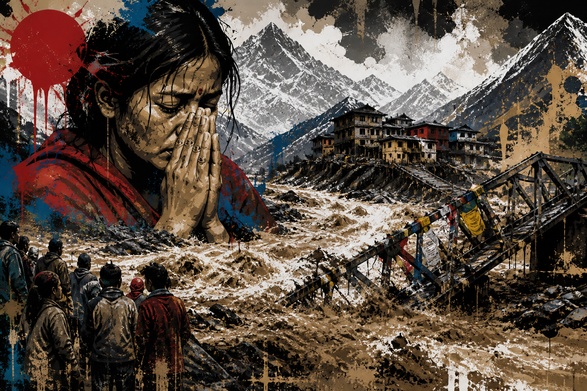
 | author: | Unknown | institution: | dpa international (via Yahoo News) | ¿porque no los dos? |
| tl;dr | A Yahoo News article sourced from dpa international reports catastrophic flash flooding in Nepal, saying at least 95 people have been killed and that hundreds of tourists are missing. The story describes severe damage to infrastructure and rescue efforts, emphasizing the scale of destruction and uncertainty around missing persons as authorities search affected areas. | ||||
| deeper: | The writing is largely straight, event-focused reporting with limited loaded language, mainly relying on official figures and situational updates, so bias appears low. The biggest risk of distortion is the use of large, early, uncertain numbers (e.g., “hundreds missing”) that can change quickly in disasters. Quality is solid for a wire-style breaking story, but it appears light on sourcing detail, local context (hydrology/land use), and clear attribution for each key claim. | ||||
media: | |||||
| gen: 2026/08/10:22:22 in 43.8 sec (old)bias: 1 (Unknown) |
| type: newsquality: 62 |
| pts: 0 |
 | author: | Unknown | institution: | Unknown | ¿porque no los dos? |
| tl;dr | The image is a screenshot of a “Your privacy” consent/notice page (a cookie and data-processing disclosure), not a news article. It describes how the site and its partners use cookies and similar technologies to store/access information on a device, personalize ads/content, measure audiences, and potentially process precise geolocation or other identifiers. It offers user controls (e.g., accept, reject, manage settings) and links to more detailed policy sections. | ||||
| deeper: | As a privacy/consent notice, it contains little to no political framing, so detectable ideological bias is minimal. The content appears boilerplate and compliance-driven: it lists broad purposes (ads, measurement, personalization) but relies on dense legal language and high-level categories that can obscure practical implications for users. Quality is middling: it likely meets disclosure norms, but readability and meaningful informed consent are limited without digging into settings and partner lists. | ||||
media: | |||||
You made it to the bottom. Now dance!


owned and operated by: RPN Omnigalactic Insitutution as of: 2026/10/14: 14:26 in 0 ms
Enter Code
Login with Account