#environment
| gen: 2026/09/30:20:56 in 27.3 sec (old)bias: 3 (Center-Left) |
| type: newsquality: 78 |
| pts: 0 |

#nuclear energy#data centers#public lands#utah#environment#valar atomics#project beehive#nuclear power#utahுட
 | author: | Geoff Brumfiel | institution: | NPR | ¿porque no los dos? |
| tl;dr | Valar Atomics proposes building Project Beehive near Price, Utah, with 456 small nuclear reactors powering data centers on more than 9,000 acres of federal land. The article reports a planned 9.6-gigawatt output, initial reactor operations in 2028 and possible completion by 2032. Environmental advocates raise public-land and oversight concerns. Federal officials confirm an application is under review and promise public input. The report also describes the company's technological milestones, ties to regulatory reforms and arguments for building reactors in phases. | ||||
| deeper: | The article mildly favors public-land conservation and regulatory oversight, giving environmental advocates prominent space and opening with a politically charged founder quote. It nevertheless includes federal officials' responses, earlier company assurances and potential benefits of modular reactors. Documents, named sources and numerical context strengthen the reporting. Limitations include little independent technical or financial assessment and an unexplained difference between 456 25-megawatt units and the stated 9.6-gigawatt output. The supplied text ends mid-quotation, so this assessment covers only the visible material. | ||||
media: | |||||
| gen: 2026/09/25:15:29 in 1 min 9.0 secbias: 5 (Center-Left) |
| type: eli5quality: 81 |
| pts: 0 |

#environment#health#history#military#community#guam#yigo#leevin camacho#dieldrin#water pollution#us military news
 | author: | Anita Hofschneider | institution: | Grist, in partnership with The Intercept | ¿porque no los dos? |
| tl;dr | The article follows Guam lawyer Leevin Camacho’s efforts to address contaminated drinking water and protect communities affected by U.S. military expansion. It connects pollution, land loss, habitat damage, housing costs, and threats to Indigenous cultural sites across Guam, Yap, and Palau. Residents and activists seek accountability and greater control over development. Military officials defend environmental compliance and missile-defense investments, while Guam’s governor emphasizes economic and security benefits. The source of Yigo’s dieldrin contamination remains under investigation; military responsibility is suspected, not established. | ||||
| deeper: | The article favors environmental justice, Indigenous rights, and community self-determination, supporting a center-left reading. Its sympathetic portrait of Camacho and phrases such as “Those injustices” sometimes adopt advocates’ judgments. Nevertheless, it includes substantial military responses, economic benefits, security concerns, and uncertainty about pollution sources. Named interviews, linked documents, historical context, and original photography strengthen the reporting. Missing contamination measurements and independent health expertise limit its treatment of risk; some broad climate and strategic claims need stronger support. Scores assess the supplied text, not independent verification of its links. | ||||
media: | |||||


| gen: 2026/09/02:18:18 in 1 min 3.5 secbias: 3 (Center-Left) |
| type: colorquality: 86 |
| pts: 0 |
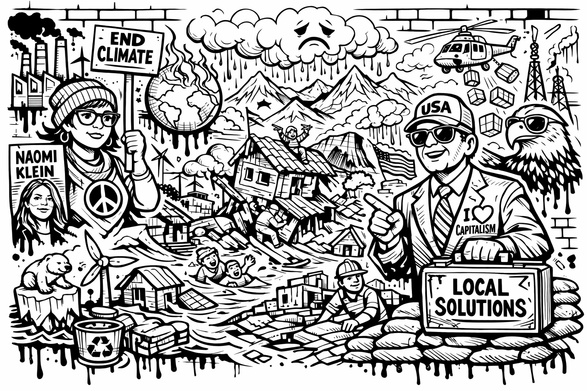
#climate change#disaster relief#community resili#environment#infrastructure#nepal#tibet#betrwati#rasuwa#trishuli#bhotekoshi
Leftist
This catastrophic event exemplifies the brutal impact of climate change on vulnerable communities. Nepal's tragedy, reminiscent of past environmental disasters, highlights the failure of global leaders to address climate change. Human lives are reduced to statistics; their homes and dreams washed away. We must demand accountability and push for a sustainable future, echoing the warnings of experts like Naomi Klein on the urgent need for environmental justice.
Rightist
This disaster underscores the need for self-reliance and efficient disaster management. While the tragedy in Nepal is heart-wrenching, we must focus on building resilient infrastructures. Prioritizing national interests and empowering local communities aligns with a strategy similar to the Reagan-era emphasis on strong national policies. International aid should facilitate local empowerment, ensuring communities aren't reliant on unpredictable foreign assistance.
 | author: | Hannah Ellis-Petersen and Gaurav Pokharel | institution: | The Guardian | ¿porque no los dos? |
| tl;dr | A Guardian feature reports on catastrophic flash floods in Nepal’s Betrawati and Rasuwa district, triggered by a glacier collapse in the Himalayas near the Nepal–Tibet border. It describes communities buried in mud or swept away, with survivors searching for missing relatives and aid struggling to reach remote areas due to washed-out roads. The piece cites death and missing counts across Nepal and Tibet/China, highlights overwhelmed recovery efforts, and uses firsthand accounts and vivid scene-setting to convey the scale of loss. | ||||
| deeper: | The reporting is largely factual and field-based, mixing specific figures (dead/missing), time-stamped event details, and on-the-ground observations with survivor quotes. Bias is mostly emotional framing—highly evocative language (“unfathomable,” “turned into hell”) and a human-interest focus that foregrounds suffering more than official responses or competing interpretations. Quality is high due to original reporting, named locations/people, and corroborating details, but would be stronger with clearer sourcing for casualty numbers and more explicit attribution/uncertainty ranges. | ||||
media: | |||||
| gen: 2026/09/02:14:16 in 50.7 sec (old)bias: 3 (Center) |
| type: newsquality: 78 |
| pts: 0 |

 | author: | Unknown | institution: | BBC News | ¿porque no los dos? |
| tl;dr | The article reports on research estimating substantial global harm from pesticide exposure/poisoning, including deaths and widespread health impacts, and argues that current safeguards are inadequate. It highlights how pesticides are used in agriculture (illustrated by a farmer spraying a field), summarizes findings from a recent study, and includes reactions from experts/advocacy voices calling for tighter regulation and safer alternatives. | ||||
| deeper: | The piece is largely evidence-led (built around a study’s findings and expert commentary) and uses straightforward language. Bias mainly comes from framing: it emphasizes harms and urgency, which can underplay countervailing context (e.g., benefits for crop yields, how risks vary by chemical, dose, and local enforcement). Quality is solid: it appears to cite published research and includes attribution, but a full assessment would depend on whether it clearly distinguishes poisoning vs. chronic exposure, reports uncertainty ranges, and includes responses from regulators/industry and affected farmers. | ||||
media: | |||||
| gen: 2026/08/27:17:44 in 2 min 14.9 sec (old)bias: 0 (Unknown) |
| type: lolsquality: 0 |
| pts: 0 |

 | author: | Unknown | institution: | Unknown | ¿porque no los dos? |
| tl;dr | The provided image appears to be blank (a solid white field) with no visible article text, headline, photos, charts, or discernible content to analyze. Because there is no readable material, I can’t assess the claims, sourcing, framing, or editorial choices that would indicate bias or quality. | ||||
| deeper: | There’s no legible content in the image—no text or visuals beyond an empty white background—so there’s nothing to evaluate for viewpoint, omissions, loaded language, evidence, or reporting standards. If you re-upload a clearer image or paste the article text/link, I can provide a real bias and quality assessment. | ||||
media: | |||||
| gen: 2026/08/11:02:40 in 53.8 sec (old)bias: 5 (Unknown) |
| type: newsquality: 25 |
| pts: 0 |

 | author: | Unknown | institution: | Unknown | ¿porque no los dos? |
| tl;dr | The provided image is a very low-resolution, tall screenshot of a dark-themed news page labeled “INDIA,” showing multiple story blocks and photos, but the article text is not legible enough to reliably extract the main claims, evidence, or framing. Because the actual wording and specifics can’t be read, only limited analysis is possible beyond noting the layout and use of multiple images and short story sections. | ||||
| deeper: | The screenshot resolution is too low to read headlines, quotes, numbers, sourcing, or even clearly identify a single “main” article versus several items. Without legible text, it’s not possible to judge whether the reporting uses loaded language, omits key context, or relies on strong evidence. The page appears to be a multi-story section (not one clearly dominant article), which further limits assessment. Share a higher-resolution image or the URL for a meaningful bias/quality review. | ||||
media: | |||||
| gen: 2026/08/11:02:39 in 47.4 sec (old)bias: 3 (Unknown) |
| type: newsquality: 55 |
| pts: 0 |

 | author: | Unknown | institution: | Unknown | ¿porque no los dos? |
| tl;dr | The image appears to be a long-form feature article page (mobile layout) with multiple photos: a woman holding/comforting a child, close-ups of hands with flowers/crafts, and a home/outdoor scene. The text is too low-resolution to reliably read the headline, author, or specific claims, so I can’t accurately summarize the article’s argument or verify its factual assertions from this screenshot alone. | ||||
| deeper: | Because the body text and headline aren’t legible, any detailed content assessment would be guesswork. The layout and photojournalistic style suggest a reported narrative feature (which often includes selection/framing), but I can’t evaluate whether it fairly represents opposing views or uses solid evidence. Visual presentation looks professional, yet the screenshot doesn’t allow checking sourcing, data, quotations, or context—key determinants of quality and bias. | ||||
media: | |||||
| gen: 2026/08/07:16:40 in 1 min 18.6 secbias: 2 (Center) |
| type: eli5quality: 82 |
| pts: 0 |
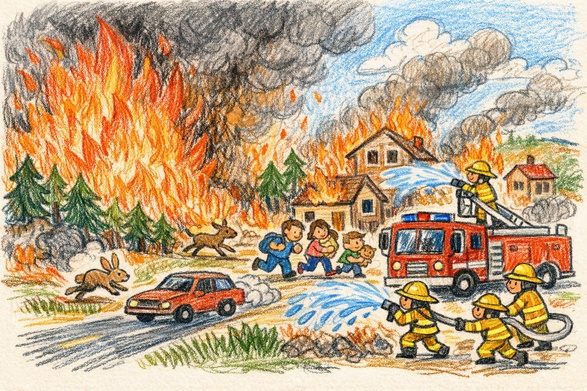
 | author: | Unknown | institution: | NPR | ¿porque no los dos? |
| tl;dr | An NPR “Picture Show” photo essay documents wildfires near Spokane, Washington, showing burned homes, heavy smoke, and emergency response activity. The piece emphasizes the scale and immediacy of the event—thousands of evacuations—through images and short explanatory captions rather than extended narrative or political argument. Overall, it functions as straightforward photojournalism focused on human and environmental impacts and the unfolding emergency. | ||||
| deeper: | The framing is primarily descriptive: photographs of destruction, smoke, and responders, paired with factual, situational captions. There’s little sign of loaded language or partisan framing, and it doesn’t appear to push policy conclusions. Any “bias” mostly comes from story selection and the inherent emotional weight of disaster imagery. Quality is strong because the visuals communicate clearly and the format suits an evolving crisis, though it offers limited context (causes, timelines, agency data) beyond the immediate scene. | ||||
media: | |||||
| gen: 2026/07/18:04:34 in 1 min 14.1 secbias: 6 (Center-Left) |
| type: eli5quality: 78 |
| pts: 0 |

 | author: | Unknown | institution: | The Conversation | ¿porque no los dos? |
| tl;dr | The article argues that the Trump administration’s 2019 rules weakening the Endangered Species Act (ESA) are unlikely to survive court challenges. It explains how the rules: remove default protections for newly listed “threatened” species, narrow the definition and reach of “take,” make it easier to consider economic impacts, limit how climate change and future habitat are weighed, and constrain critical habitat designations. The authors contend these moves conflict with the ESA’s text and Supreme Court precedents (e.g., TVA v. Hill and Sweet Home), and therefore are vulnerable under the Administrative Procedure Act. They predict injunctions and eventual reversals in federal court. | ||||
| deeper: | Content: Substantive, law-focused analysis of the 2019 ESA rule changes. It clearly describes several provisions (Section 4(d) default protections, economic considerations, critical habitat limits, climate-change-related forecasting) and connects them to statutory text and key precedents like TVA v. Hill (snail darter) and Babbitt v. Sweet Home. That legal grounding raises quality. Evidence: cites concrete rule changes and established case law, explaining why each could be struck down as arbitrary or contrary to the statute. However, it offers little space to the administration’s legal rationale beyond brief paraphrase, and the headline’s verb “gut” signals an advocacy stance. Tone: consistently critical of the rules and predictive about litigation outcomes; still, the arguments are reasoned and not conspiratorial. Overall: high informational value with moderate partisan tilt toward stronger environmental protections. | ||||
media: | |||||
| gen: 2026/07/11:15:27 in 1 min 18.7 sec (old)bias: 5 (Center-Left) |
| type: lolsquality: 76 |
| pts: 0 |
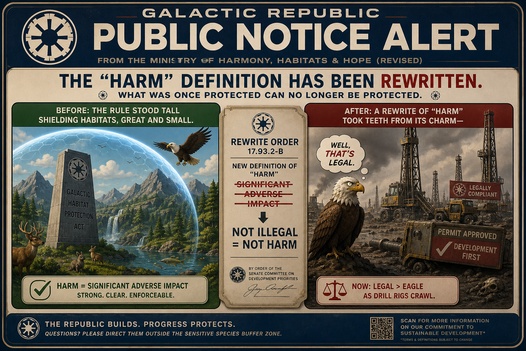
#environment#wildlife#policy#regulation#conservation#endangered speci#wildlife protect#trump administra#environmental la#interior departm#oil drilling and
 | author: | The Associated Press | institution: | NPR | ¿porque no los dos? |
| tl;dr | The article reports that the Trump administration finalized a rule narrowing the Endangered Species Act’s definition of “harm,” potentially allowing development in endangered species’ habitats as long as animals are not directly injured. It presents environmentalists’ warnings alongside administration and industry arguments about property rights, economic growth, and agency overreach. The article emphasizes the potential ecological consequences and frames the change as a rollback of wildlife protection. | ||||
| deeper: | The report is attributed to The Associated Press and includes perspectives from environmental advocates, Interior Secretary Doug Burgum, administration officials, industry-aligned Republicans, and the Center for Western Priorities. That gives it reasonable balance and factual context. However, the headline’s wording—“rolls back a key protection”—and the prominent placement of strongly charged environmental criticism give the article a clear tilt toward emphasizing ecological risks. The administration’s position is presented, but largely through official assertions rather than detailed legal or economic analysis. The visible article is also relatively brief, lacks links to the final rule or underlying studies, and contains a minor wording error (“and and other development”). | ||||
media: | |||||
| gen: 2026/07/11:14:38 in 43.7 sec (old)bias: 4 () |
| type: newsquality: |
| pts: 0 |


You made it to the bottom. Now dance!


owned and operated by: RPN Omnigalactic Insitutution as of: 2026/10/14: 04:25 in 0 ms
Enter Code
Login with Account