#military
| gen: 2026/10/07:16:31 in 33.5 sec (-7d)bias: 1 (Center) |
| type: newsquality: 35 |
| pts: 0 |
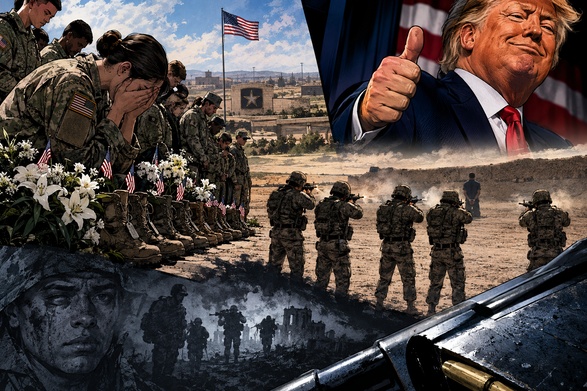
#politics#military#death penalty#crime#donald trump#fort hood#firing squad#military justice#2009 shooting
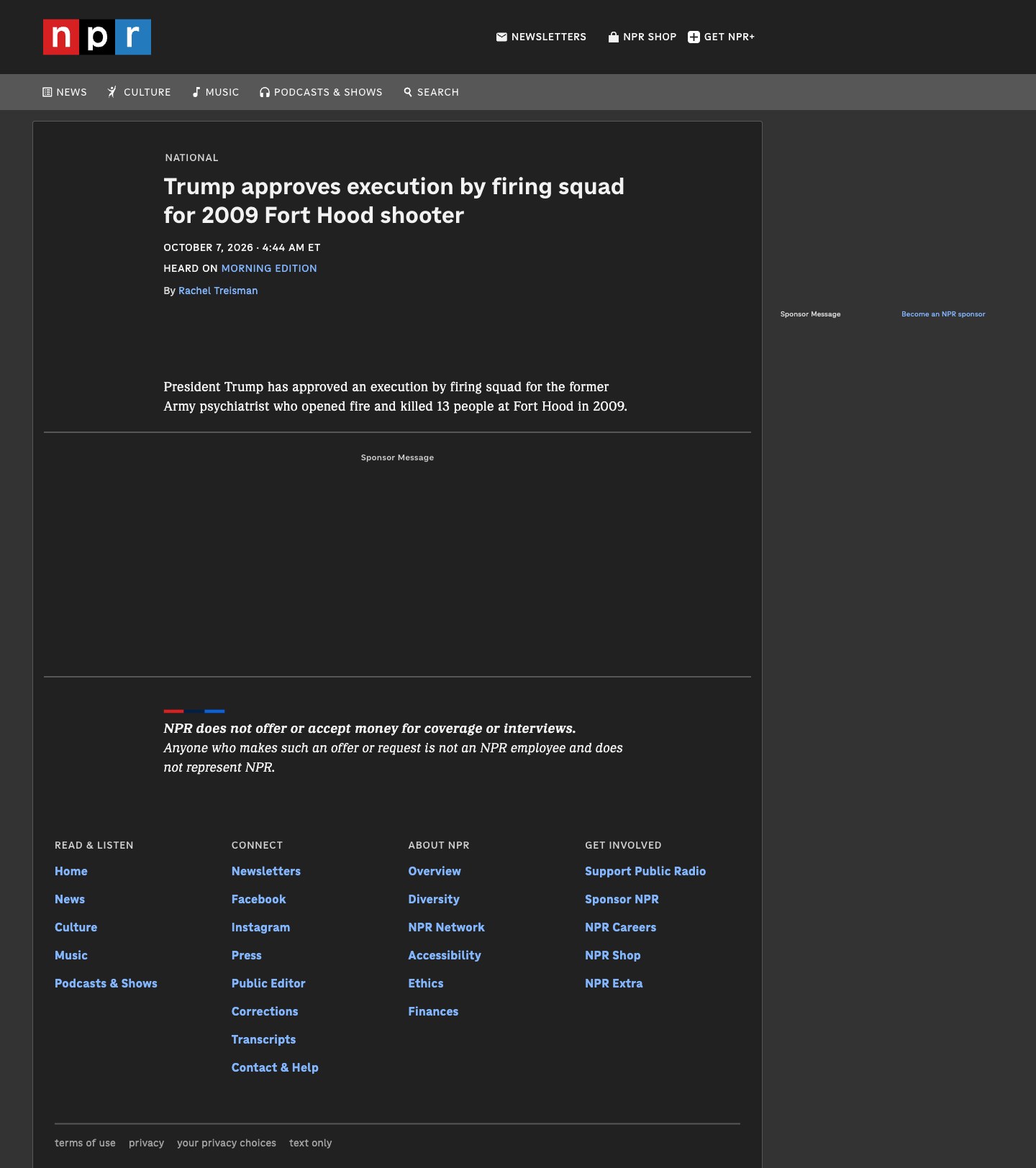 | author: | Rachel Treisman | institution: | NPR | ¿porque no los dos? |
| tl;dr | The displayed page says President Trump approved execution by firing squad for the former Army psychiatrist who killed 13 people at Fort Hood in 2009. Dated October 7, 2026, it contains only a headline and one-sentence news summary, without supporting sources, legal details, or an execution date. The screenshot alone does not establish the claim’s accuracy or the page’s authenticity. | ||||
| deeper: | The wording is straightforward and neither praises nor condemns Trump or capital punishment, providing little evidence of political bias. However, the visible report simply repeats its headline without identifying a source for the approval, explaining military execution rules, or discussing appeals. Its clarity is a strength, but the lack of supporting evidence and context limits its quality. This assessment covers only the displayed text, not any associated broadcast. | ||||
media: | |||||
| gen: 2026/09/30:20:51 in 27.1 sec (old)bias: 3 (Center) |
| type: newsquality: 77 |
| pts: 0 |
 | author: | Jane Arraf | institution: | NPR | ¿porque no los dos? |
| tl;dr | The article reports that U.S. forces have fully withdrawn from Iraq, with coalition headquarters moving to Jordan. Iraqi leaders celebrate sovereignty, while Kurdish leaders fear increased vulnerability to Iran-backed attacks. Iraq still faces ISIS sleeper cells, militia disarmament challenges and reliance on U.S. intelligence. The article also examines Iranian influence, Turkish military bases and the invasion’s human costs, ending with accounts of reconstruction and reconciliation. The reported withdrawal and accompanying official statements are not independently verified here. | ||||
| deeper: | The article emphasizes the invasion’s destructive legacy, but also credits U.S. contributions against ISIS and explains Kurdish dependence on American protection. Its competing Iraqi, U.S. and militia perspectives do not establish a clear partisan alignment. Named sources, historical context and detailed security coverage strengthen it. Weaknesses include heavy reliance on official statements, no directly quoted Kurdish leader, and sweeping claims about younger Iraqis. The civilian death figure needs a clearer timeframe and distinction between deaths during the occupation and subsequent violence. Screenshot links and contemporary claims cannot be authenticated here. | ||||
media: | |||||
| gen: 2026/09/28:05:22 in 25.0 sec (old)bias: 3 (Center) |
| type: newsquality: 66 |
| pts: 0 |
 | author: | Jane Arraf, Debbie Elliott | institution: | NPR | ¿porque no los dos? |
| tl;dr | The article reports that U.S. coalition forces are preparing to leave Iraq, presenting the withdrawal as a sovereignty milestone with significant security risks. It highlights Iraqi military capability gaps, Kurdish vulnerability, Iranian influence, and militias resisting disarmament. It also describes a U.S. shift toward economic relations and reviews the invasion’s civilian toll. Although the introduction suggests an uninterrupted military presence since 2003, the transcript acknowledges the 2011 withdrawal and 2014 return. | ||||
| deeper: | The report includes U.S., Kurdish, Iraqi government, and militia perspectives without a clear partisan prescription. Its emphasis on sovereignty and civilian harm is balanced by recognition of U.S. security contributions. Some sweeping judgments—Americans knowing little about Iraq and Iraq controlling its destiny—lack supporting detail. The introduction misleadingly implies continuous deployment. Iraq Body Count’s cumulative civilian deaths are also loosely presented as a civil-war total. Named sources and historical context help, but major contemporary claims cannot be independently verified from these screenshots. | ||||
media: | |||||
| gen: 2026/09/25:15:29 in 1 min 9.0 secbias: 5 (Center-Left) |
| type: eli5quality: 81 |
| pts: 0 |

#environment#health#history#military#community#guam#yigo#leevin camacho#dieldrin#water pollution#us military news
 | author: | Anita Hofschneider | institution: | Grist, in partnership with The Intercept | ¿porque no los dos? |
| tl;dr | The article follows Guam lawyer Leevin Camacho’s efforts to address contaminated drinking water and protect communities affected by U.S. military expansion. It connects pollution, land loss, habitat damage, housing costs, and threats to Indigenous cultural sites across Guam, Yap, and Palau. Residents and activists seek accountability and greater control over development. Military officials defend environmental compliance and missile-defense investments, while Guam’s governor emphasizes economic and security benefits. The source of Yigo’s dieldrin contamination remains under investigation; military responsibility is suspected, not established. | ||||
| deeper: | The article favors environmental justice, Indigenous rights, and community self-determination, supporting a center-left reading. Its sympathetic portrait of Camacho and phrases such as “Those injustices” sometimes adopt advocates’ judgments. Nevertheless, it includes substantial military responses, economic benefits, security concerns, and uncertainty about pollution sources. Named interviews, linked documents, historical context, and original photography strengthen the reporting. Missing contamination measurements and independent health expertise limit its treatment of risk; some broad climate and strategic claims need stronger support. Scores assess the supplied text, not independent verification of its links. | ||||
media: | |||||
| gen: 2026/09/23:04:47 in 36.5 sec (old)bias: 4 (Center) |
| type: lolsquality: 78 |
| pts: 0 |
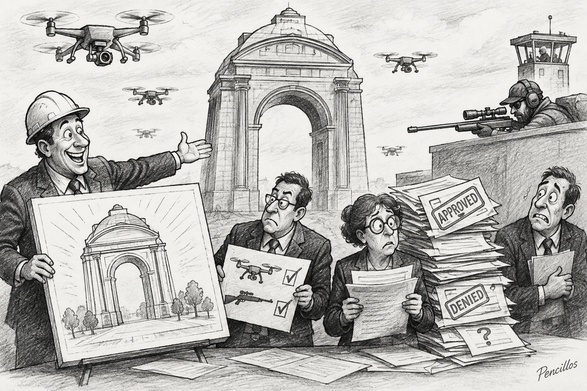
#politics#architecture#military#aviation#law#donald trump#washington dc#triumphal arch#military complex#drones#aviation safety
 | author: | Rachel Treisman | institution: | NPR | ¿porque no los dos? |
| tl;dr | The article reports that Trump wants his proposed 250-foot Washington-area triumphal arch to serve as a military complex housing drones, snipers and ammunition. It examines how that change could complicate preservation reviews, aviation assessments and ongoing litigation over congressional authorization. Preservation advocates, lawmakers and legal and military experts question the project's justification. The administration presents the arch as a national landmark and cites security needs, but provides little additional explanation in response to questions. | ||||
| deeper: | The article offers detailed procedural context, named sources, document links and administration responses, including the FAA's favorable finding. However, critics dominate, and language such as “Trump-packed” adds editorial judgment. The headline also presents a proposed military role more definitively than the body supports. Its emphasis on preservation, safety and congressional oversight does not establish a clear left-right ideology. Strong sourcing improves quality, but extended inflammatory quotations and limited independent examination of military requirements weaken balance. The screenshots alone cannot authenticate the reporting. | ||||
media: | |||||
| gen: 2026/09/21:17:46 in 35.3 sec (old)bias: 2 (Center) |
| type: newsquality: 42 |
| pts: 0 |

#politics#military#architecture#washington dc#donald trump#proposed arch#military complex#construction#snipers
 | author: | Franco Ordoñez, Steve Inskeep | institution: | NPR | ¿porque no los dos? |
| tl;dr | The displayed NPR item reports that President Trump says his proposed Washington, D.C., arch would also function as a military complex. Its headline mentions snipers and weaponry, while the brief description notes opposition to his construction projects in the capital. The supplied page contains only a headline and short summary, not a detailed report or interview transcript. | ||||
| deeper: | The wording attributes the central claim to Trump rather than presenting it as independently established. Highlighting snipers, weaponry, and pushback creates a dramatic frame, but there is no clear endorsement of a political ideology. Named journalists and a publication date provide accountability. However, the visible text supplies no supporting quotation, project details, explanation of the opposition, or corroboration. This score assesses the limited material shown; the screenshot alone cannot establish authenticity or accuracy. | ||||
media: | |||||
| gen: 2026/09/20:20:31 in 29.7 sec (old)bias: 3 (Center) |
| type: newsquality: 66 |
| pts: 0 |
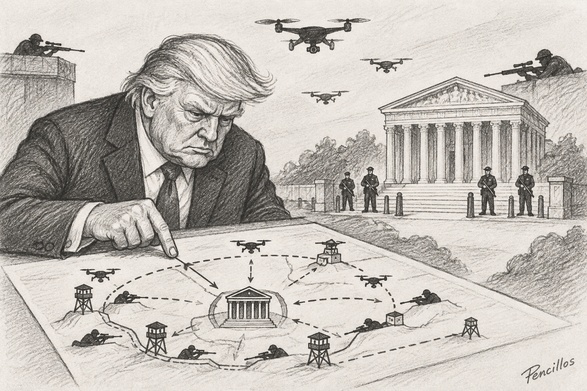
#politics#military#monuments#law#donald trump#washington dc#triumphal arch#national mall#national securit#military drones
 | author: | Kristin Wright | institution: | NPR | ¿porque no los dos? |
| tl;dr | The article reports that Trump wants his proposed 250-foot Washington, D.C., triumphal arch to double as a military facility housing drones, snipers and ammunition. It describes legal challenges, pending federal approvals and objections concerning nearby Arlington National Cemetery. It also connects the proposal to his national-security justification for a White House ballroom. These claims are attributed to social media posts and court actions; the screenshots alone do not establish their authenticity. | ||||
| deeper: | The language is mostly restrained, and the alarming headline reflects quotations attributed to Trump rather than editorial insults. Coverage emphasizes legal obstacles and opposition but includes the administration’s security rationale, without clearly endorsing a political ideology. Named sources, links and procedural detail strengthen the presentation. However, it offers no independent military assessment, leaves the sweeping claim about other cities’ arches unchecked, and does not clarify how many public comments opposed the project. Authenticity and linked evidence cannot be verified from screenshots. | ||||
media: | |||||
| gen: 2026/09/03:04:17 in 35.1 sec (old)bias: 6 (Center-Left) |
| type: newsquality: 78 |
| pts: 0 |

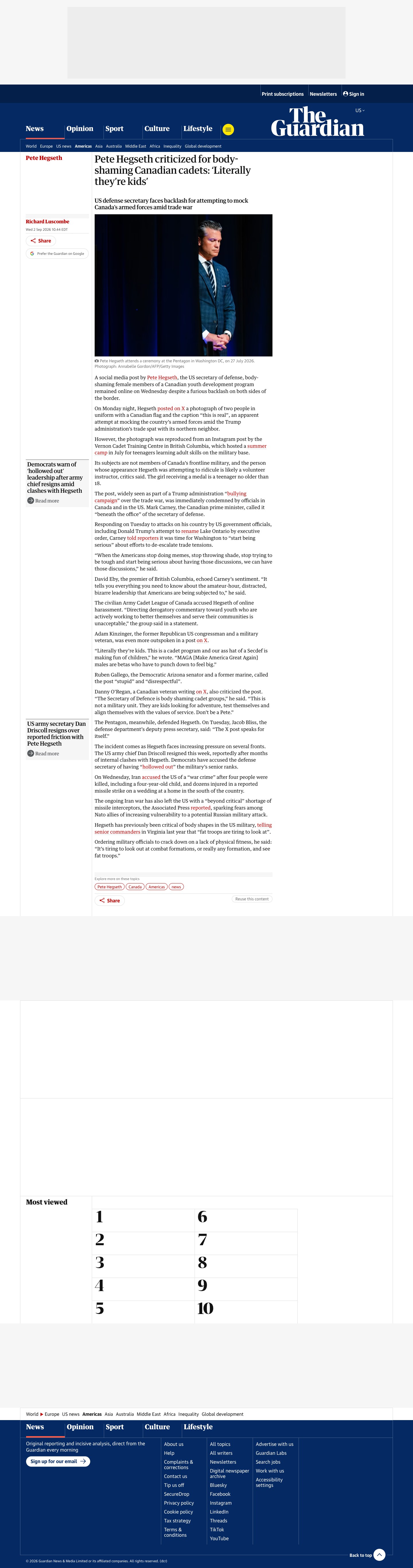 | author: | Richard Luscombe | institution: | The Guardian | ¿porque no los dos? |
| tl;dr | The article reports backlash after US defense secretary Pete Hegseth shared an X post mocking people in Canadian uniforms, which critics said amounted to body-shaming and targeting youths. The story says the photo actually came from a Canadian cadet/youth training program in British Columbia, not Canada’s frontline military. Canadian leaders including Prime Minister Mark Carney and BC premier David Eby condemned the post, as did US figures like Adam Kinzinger and Sen. Ruben Gallego. The Pentagon offered a minimal defense, saying the post “speaks for itself.” | ||||
| deeper: | The framing is strongly critical of Hegseth from the headline onward (“body-shaming”, “kids”) and foregrounds condemnations and harsh characterizations (“bullying campaign”, “amateur-hour”). It does include basic factual context (origin of the photo, cadet program) and a brief Pentagon response, but the balance of sourcing and tone leans toward amplifying criticism more than explaining Hegseth’s intent or providing fuller context about the trade dispute. Overall reporting is coherent and specific, with named sources and attributable quotes, but limited verification detail beyond the image provenance and reactions. | ||||
media: | |||||
| gen: 2026/08/25:21:21 in 2 min 25.3 sec (old)bias: 4 (Center-Left) |
| type: lolsquality: 78 |
| pts: 0 |

| gen: 2026/07/27:05:36 in 1 min 1.7 sec (old)bias: 4 (Center) |
| type: newsquality: 72 |
| pts: 0 |
 | author: | Scott Walterman | institution: | Voice of America (VOA) | ¿porque no los dos? |
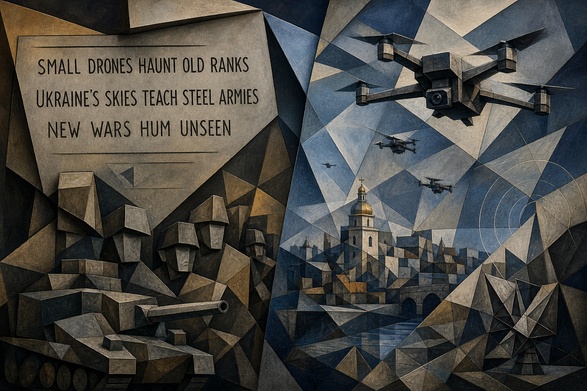
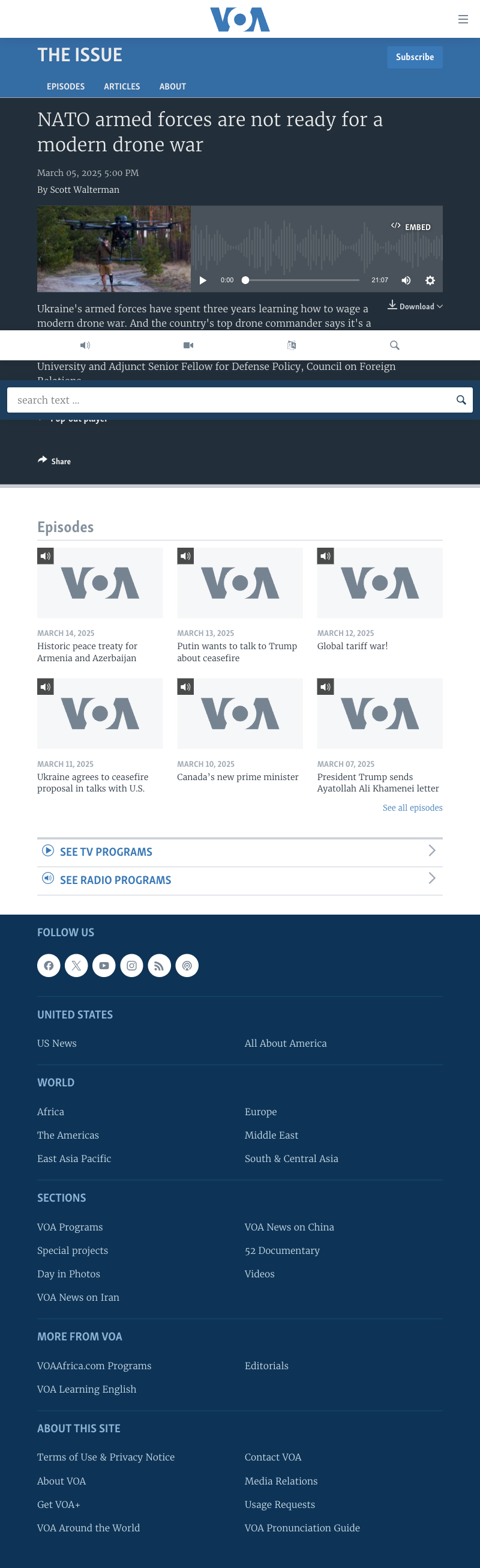
| tl;dr | A Voice of America “The Issue” episode/article titled “NATO armed forces are not ready for a modern drone war” argues that NATO militaries lag behind the realities of drone-centric combat, drawing lessons from Ukraine’s experience and expertise after years of large-scale war. The framing emphasizes capability gaps, adaptation needs, and operational lessons from Ukraine’s drone warfare practices, presented in a broadcast/podcast format with supporting context and related episodes listed on the page. | ||||
| deeper: | The headline is assertive (“not ready”), signaling a critical, agenda-setting frame focused on NATO preparedness. The page implies reliance on Ukrainian military perspectives and expert commentary, which can narrow viewpoint diversity if opposing or internal NATO counter-arguments aren’t equally featured. As a VOA program page, it appears professionally produced and timely, but the screenshot provides limited visible evidence of data, methodology, or multiple independent sources—so it reads more like analysis/interview than a fully evidenced report. | ||||
media: | |||||
| gen: 2026/07/23:02:38 in 55.9 sec (old)bias: 4 (Center) |
| type: newsquality: 74 |
| pts: 0 |
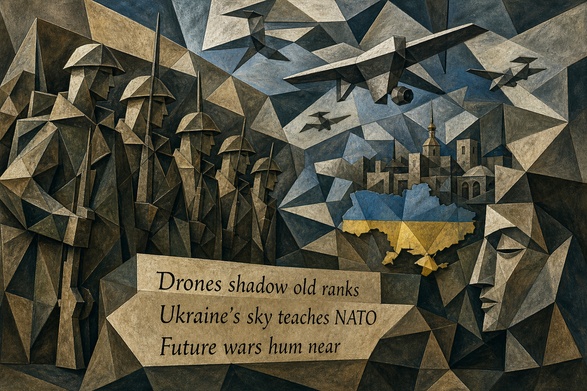
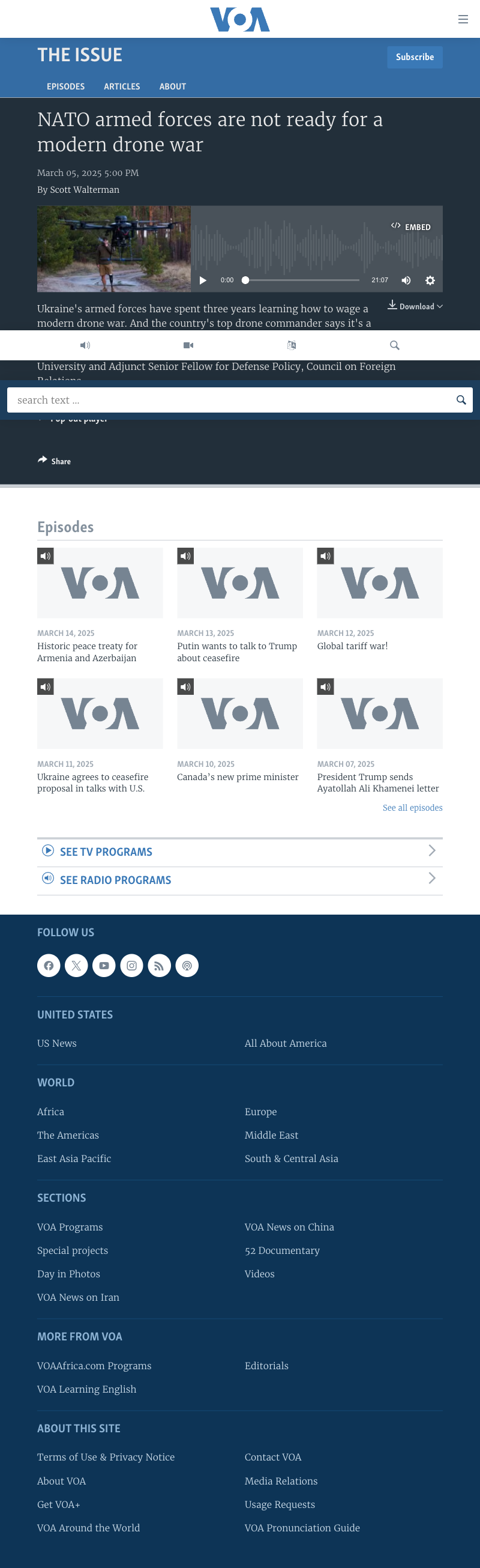 | author: | Scott Walterman | institution: | Voice of America (VOA) | ¿porque no los dos? |
| tl;dr | A Voice of America “The Issue” episode/article argues that NATO militaries are not adequately prepared for today’s drone-centric warfare, drawing on Ukraine’s three-year learning curve and commentary from Ukraine’s senior drone leadership to highlight gaps in doctrine, training, and readiness. | ||||
| deeper: | Content focus: The framing is a critical assessment of NATO readiness in the emerging “modern drone war,” using Ukraine’s battlefield experience as the key reference point. The headline is assertive (“are not ready”), which signals a strong thesis from the outset, but the topic is legitimate and newsworthy given the rapid evolution of drone tactics. Bias: The piece appears to privilege Ukraine’s lived combat lessons and likely adopts a reformist, capability-improvement stance toward NATO (i.e., urging adaptation). That is a perspective, but not inherently partisan; it becomes bias if countervailing NATO viewpoints, differing expert assessments, or evidence that some NATO units are adapting quickly are not included. From the screenshot alone, it’s not clear how much balancing material is provided, so bias is moderate rather than high. Quality: The presentation looks like an audio segment (about 21 minutes) with a byline (Scott Walterman) and date (March 5, 2025), which supports accountability. The quality would be higher if the piece clearly cites concrete metrics (procurement rates, training throughput, EW/drone defense performance, doctrine changes), includes multiple independent experts (beyond Ukrainian sources), and distinguishes among NATO members (readiness varies widely). Without the full transcript, the evidence density and balance can’t be fully verified; still, the premise is plausible and the sourcing appears at least partially expert-driven (Ukraine’s top drone commander). | ||||
media: No Media Preview | |||||
You made it to the bottom. Now dance!


owned and operated by: RPN Omnigalactic Insitutution as of: 2026/10/14: 16:18 in 0 ms
Enter Code
Login with Account