#peace
| gen: 2026/09/30:20:51 in 27.1 sec (old)bias: 3 (Center) |
| type: newsquality: 77 |
| pts: 0 |

 | author: | Jane Arraf | institution: | NPR | ¿porque no los dos? |
| tl;dr | The article reports that U.S. forces have fully withdrawn from Iraq, with coalition headquarters moving to Jordan. Iraqi leaders celebrate sovereignty, while Kurdish leaders fear increased vulnerability to Iran-backed attacks. Iraq still faces ISIS sleeper cells, militia disarmament challenges and reliance on U.S. intelligence. The article also examines Iranian influence, Turkish military bases and the invasion’s human costs, ending with accounts of reconstruction and reconciliation. The reported withdrawal and accompanying official statements are not independently verified here. | ||||
| deeper: | The article emphasizes the invasion’s destructive legacy, but also credits U.S. contributions against ISIS and explains Kurdish dependence on American protection. Its competing Iraqi, U.S. and militia perspectives do not establish a clear partisan alignment. Named sources, historical context and detailed security coverage strengthen it. Weaknesses include heavy reliance on official statements, no directly quoted Kurdish leader, and sweeping claims about younger Iraqis. The civilian death figure needs a clearer timeframe and distinction between deaths during the occupation and subsequent violence. Screenshot links and contemporary claims cannot be authenticated here. | ||||
media: | |||||
| gen: 2026/09/07:05:27 in 30.1 sec (old)bias: 3 (Center) |
| type: newsquality: 78 |
| pts: 0 |
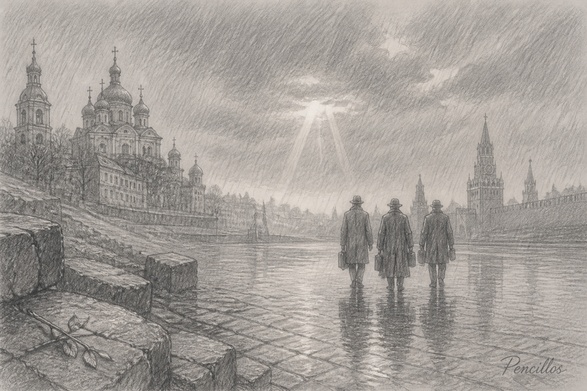
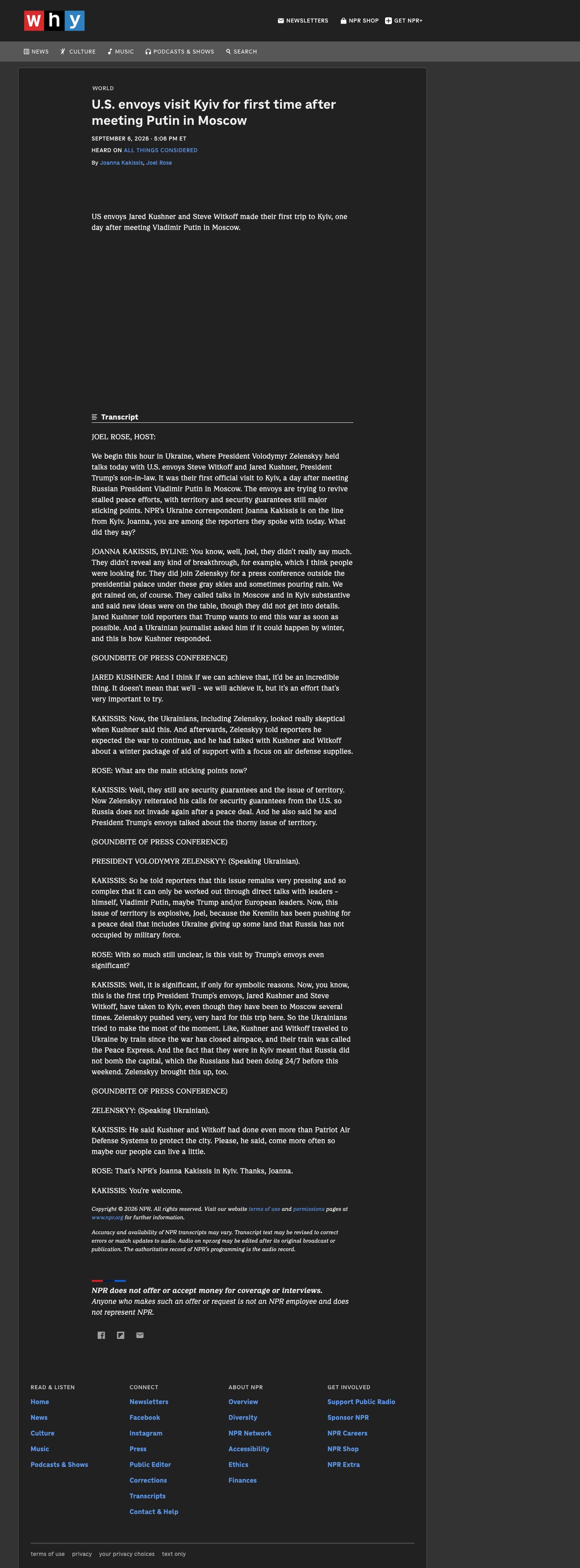 | author: | Joanna Kakissis, Joel Rose | institution: | NPR | ¿porque no los dos? |
| tl;dr | An NPR segment reports that U.S. envoys Jared Kushner and Steve Witkoff visited Kyiv for the first time, one day after meeting Vladimir Putin in Moscow, and held talks with President Volodymyr Zelenskyy. The envoys offered few specifics publicly, saying only that talks were “substantive” and that new ideas existed. Zelenskyy emphasized unresolved sticking points: U.S.-backed security guarantees to deter future Russian attacks and the territorial question, including claims Russia wants Ukraine to cede land beyond areas it controls. The visit is framed as symbolically important. | ||||
| deeper: | The piece is mostly straight reporting in transcript form, distinguishing between what was said publicly and what was not (“they didn’t really say much”). It includes direct quotes and clearly labels soundbites. Potential bias comes from limited space and sourcing: it leans heavily on the NPR correspondent’s on-scene interpretation and Ukrainian framing (skepticism, security needs) with little comparable Russian perspective or independent verification for claims like “bombing 24/7.” Overall quality is solid for a brief radio segment but lacks deeper context, data, and countervailing detail. | ||||
media: | |||||
| gen: 2026/07/24:13:07 in 1 min 29.7 sec (old)bias: 3 (Center) |
| type: newsquality: 74 |
| pts: 0 |

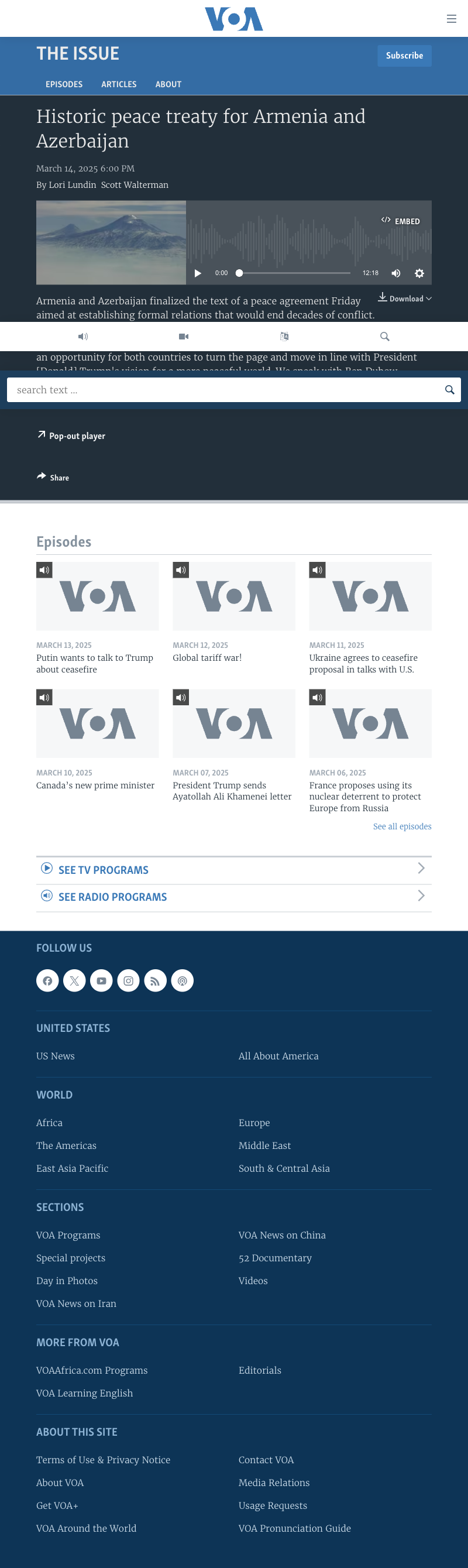 | author: | Lori Lundin; Scott Walterman | institution: | Voice of America (VOA) | ¿porque no los dos? |
| tl;dr | A Voice of America “The Issue” segment titled “Historic peace treaty for Armenia and Azerbaijan” (March 14, 2025) reports that Armenia and Azerbaijan finalized the text of a peace agreement intended to establish formal relations and end decades of conflict. The piece is framed as a major, positive diplomatic development and appears presented in an audio/news-program format. | ||||
| deeper: | Content/frame: The headline’s use of “Historic” signals an upbeat, significance-boosting frame before the audience hears the evidence. The brief visible teaser text emphasizes the peace agreement as a pathway to ending a long conflict—constructive, diplomacy-forward framing. Balance/omissions (based on what’s visible in the screenshot): The page view does not show detailed sourcing, countervailing perspectives, or specific points of contention (e.g., enforcement mechanisms, border delimitation, security guarantees, prisoners, displaced persons/return, or international monitoring). Without those elements visible, the piece risks simplifying a complex conflict into a “deal reached = problem solved” narrative. Bias assessment: The likely bias here is mild pro-agreement / pro-normalization optimism rather than partisan politics—subtle agenda-setting through word choice (“historic”) and emphasis on conflict resolution. No overt demonization of a side is apparent in the visible text. Quality assessment: Presentation is professional (clear headline, bylines, date/time, audio segment with download/embed). However, from the portion visible, the article page does not demonstrate deep evidentiary support (documents linked, direct quotations from both governments, independent analysts, or affected communities). If the audio includes those, quality would rate higher; as displayed, it’s solid but not richly substantiated. | ||||
media: | |||||
| gen: 2026/07/22:05:10 in 1 min 37.1 sec (old)bias: 4 (Center-Right) |
| type: lolsquality: 60 |
| pts: 0 |
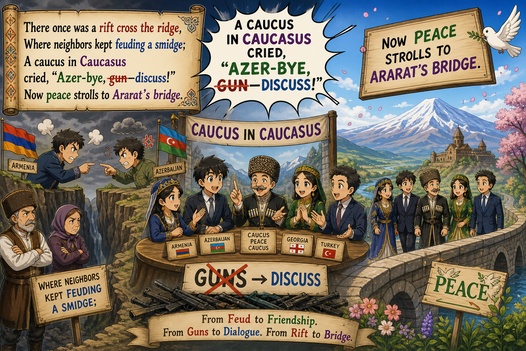
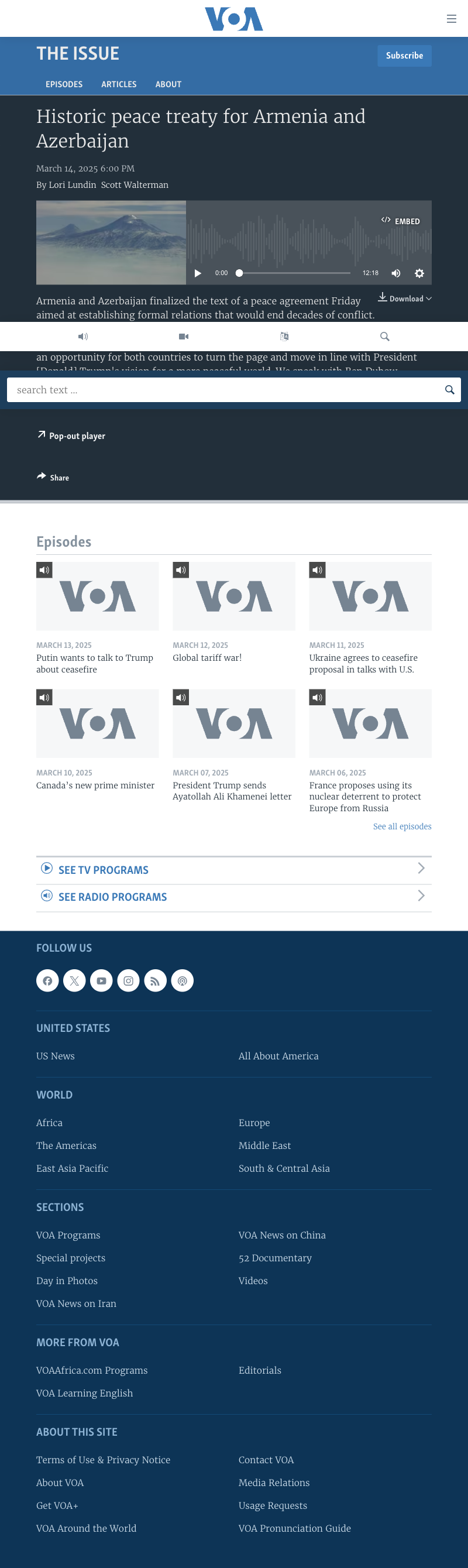 | author: | Lori Lundin; Scott Walterman | institution: | Voice of America (VOA) | ¿porque no los dos? |
| tl;dr | The page presents a VOA audio segment titled “Historic peace treaty for Armenia and Azerbaijan,” dated March 14, 2025. The lede says the two countries finalized the text of a peace agreement aimed at formal relations and ending decades of conflict. The brief visible copy frames the deal as an opportunity to “turn the page” and explicitly links it to President Trump’s vision for a more peaceful world. No concrete treaty provisions, verification mechanisms, or reactions from both sides are provided in the visible text. | ||||
| deeper: | The framing leans favorable to the sitting U.S. president by crediting the agreement to his “vision,” which nudges the piece toward a pro-administration slant. It lacks balancing language, independent sourcing, or critical context such as who mediated, what concessions were made, how Nagorno-Karabakh’s status and displaced populations are addressed, security guarantees, border demarcation steps, and enforcement or timelines. The item appears to be a short program blurb with an audio clip; as text, it is thin on facts, quotes, and documentation. Quality would improve with treaty details, statements from Armenian and Azerbaijani officials and opposition voices, independent experts, and regional implications involving Russia, Turkey, and the EU. | ||||
media: | |||||
You made it to the bottom. Now dance!


owned and operated by: RPN Omnigalactic Insitutution as of: 2026/10/16: 08:14 in 0 ms
Enter Code
Login with Account