#ukraine
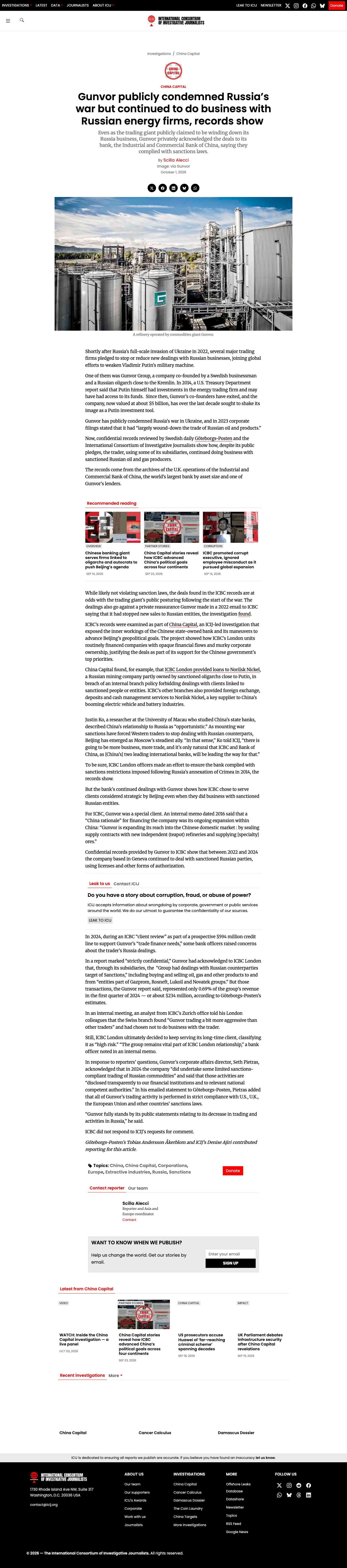
| gen: 2026/10/06:04:05 in 25.2 sec (old)bias: 3 (Center) |
| type: newsquality: 85 |
| pts: 0 |

| gen: 2026/09/20:20:37 in 24.4 sec (old)bias: 3 (Center) |
| type: newsquality: 77 |
| pts: 0 |
 | author: | Shaun Walker | institution: | The Guardian | ¿porque no los dos? |
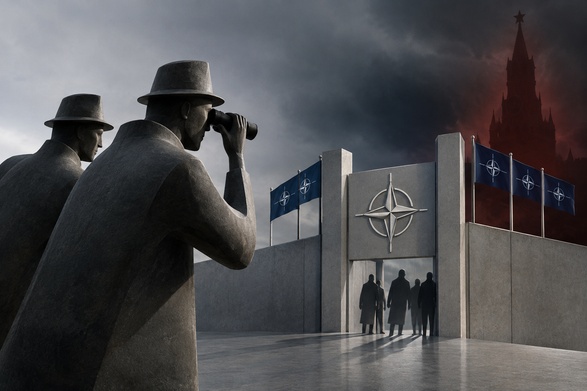
| tl;dr | European intelligence chiefs warn that Russia could intensify sabotage and potentially test Nato with limited military action within months. Baltic officials, however, report no signs of an imminent attack and caution that alarmist messaging could serve Moscow’s efforts to spread fear. Officials describe increasing threats to transport, defence industries and infrastructure supporting Ukraine. Russia denies planning an attack on Nato. The article also reports European doubts about Moscow’s commitment to peace negotiations, while acknowledging that the intelligence behind the warnings has not been disclosed. | ||||
| deeper: | The article prioritizes European security officials’ perspectives, but includes substantial disagreement, warnings against panic and Russia’s denial. Its framing does not clearly map onto left-right politics. Named interviews, direct quotations and historical context strengthen the reporting. However, the headline sounds more certain than the underlying assessments, and undisclosed intelligence prevents readers from testing the central claims. Some sweeping assertions, notably about destruction of Russian oil infrastructure, lack supporting figures. These scores assess the supplied text; the screenshot’s authenticity and reported events are not independently verified. | ||||
media: | |||||
| gen: 2026/09/19:21:49 in 26.0 sec (old)bias: 3 (Center) |
| type: newsquality: 68 |
| pts: 0 |

 | author: | Charles Maynes, Scott Simon | institution: | NPR | ¿porque no los dos? |
| tl;dr | European leaders warn of alleged Russian hybrid attacks, including sabotage, cyberattacks, election interference and drone incursions. The report explains Western intelligence claims linking these activities to Moscow, while acknowledging uncertainty and presenting Russian denials. It explores the theory that Russia seeks to weaken support for Ukraine without triggering NATO’s collective defense commitment. France and Poland favor tougher measures, contrasted with the Trump administration’s emphasis on engagement. The segment leaves open which approach would work better. | ||||
| deeper: | The report foregrounds European security concerns but asks directly about proof, includes Russian denials and avoids endorsing either sanctions or engagement. This supports a broadly centrist assessment rather than a clear partisan alignment. Phrases such as “the Russians are coming” and “death to Article 5 by a thousand cuts” heighten alarm. The explanation of hybrid warfare is accessible, but major incidents and intelligence claims lack specific sources or independently presented evidence. Commentary about Russian public attitudes is speculative. These limitations reduce the report’s evidentiary strength. | ||||
media: | |||||
| gen: 2026/09/13:15:19 in 31.6 sec (old)bias: 3 (Center) |
| type: newsquality: 77 |
| pts: 0 |

 | author: | DPA | institution: | dpa international | ¿porque no los dos? |
| tl;dr | The article reports a Russian strike on a Kyiv–Warsaw passenger train at Ukraine’s Yahodyn border station. Ukrainian Railways said passengers were evacuated without injuries; the train later continued with a delay exceeding six hours. Nearby strikes prompted Polish security monitoring and a crisis meeting, though Polish airspace was not violated. Ukrainian officials urged stronger consequences for Moscow. Russia’s Defence Ministry acknowledged attacks on western Ukrainian rail infrastructure, claiming it supported military shipments. | ||||
| deeper: | The report emphasizes Polish and Ukrainian concerns, including inflammatory but clearly attributed quotations. It also includes Russia’s stated military rationale and important limiting facts: nobody was injured and Polish airspace was not breached. There is no clear left–right political advocacy. Named officials and railway operators provide useful sourcing, but independent verification is absent. Russia’s acknowledgment of broader railway strikes does not specifically confirm the passenger-train attack, a distinction the headline could convey more carefully. | ||||
media: | |||||
| gen: 2026/09/11:15:43 in 31.8 sec (old)bias: 3 (Center) |
| type: newsquality: 68 |
| pts: 0 |

#europe#politics#elections#extremism#diplomacy#luc frieden#luxembourg#european union#ukraine#united states#diplomacy ha
 | author: | Armen Georgian | institution: | France 24 | ¿porque no los dos? |
| tl;dr | Luxembourg Prime Minister Luc Frieden warns about extremists winning European elections. In the visible interview excerpts, he supports Ukraine, argues that borders must not be changed by force, and advocates preserving economic and technological ties with the United States. The interviewer questions whether Washington treats Europe as a genuine diplomatic partner. Frieden calls for Europe's voice to be heard while maintaining transatlantic cooperation. Much of the article's middle section is obscured in the supplied images. | ||||
| deeper: | The visible text emphasizes European cooperation, multilateral diplomacy and transatlantic ties—positions spanning the political center. The emotionally charged headline is clearly attributed to Frieden rather than presented as the reporter's judgment. Direct quotations and a skeptical question provide useful firsthand reporting, but the excerpt largely conveys one leader's perspective without independent corroboration. A repeated attribution suggests minor editing weakness. These scores are provisional because substantial text is obscured and the video cannot be assessed from screenshots. | ||||
media: | |||||
| gen: 2026/09/07:05:27 in 30.1 sec (old)bias: 3 (Center) |
| type: newsquality: 78 |
| pts: 0 |

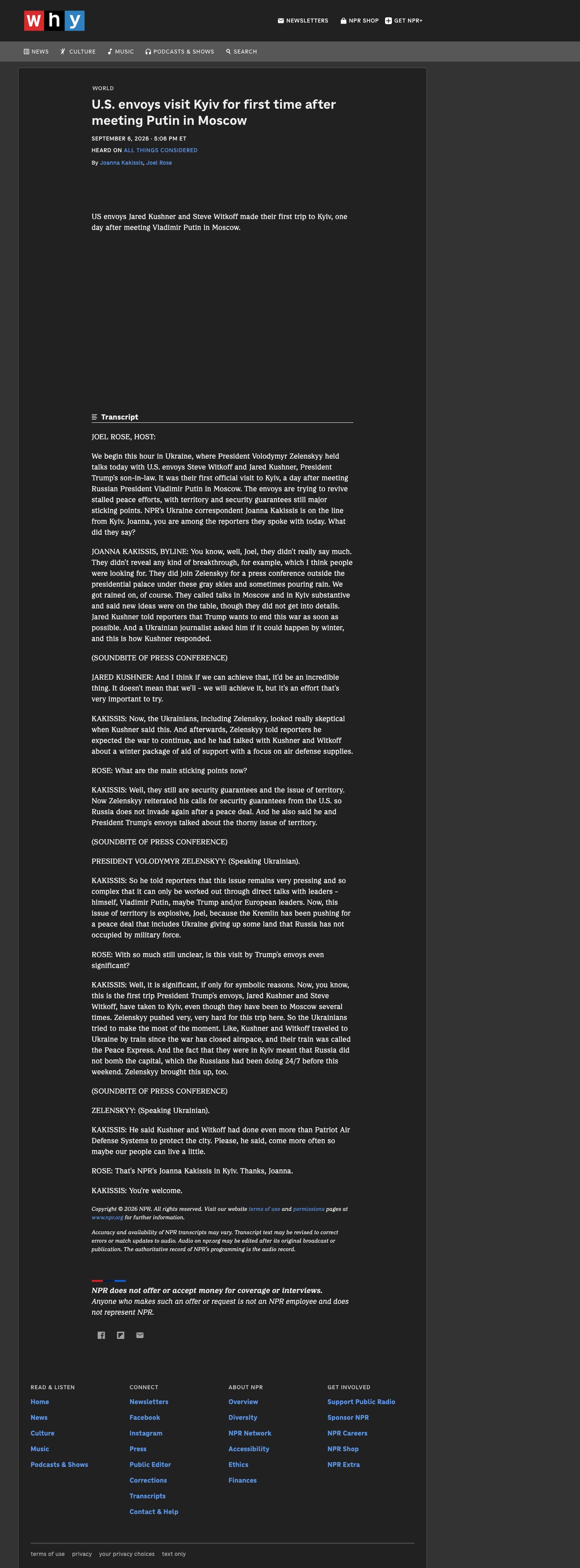 | author: | Joanna Kakissis, Joel Rose | institution: | NPR | ¿porque no los dos? |
| tl;dr | An NPR segment reports that U.S. envoys Jared Kushner and Steve Witkoff visited Kyiv for the first time, one day after meeting Vladimir Putin in Moscow, and held talks with President Volodymyr Zelenskyy. The envoys offered few specifics publicly, saying only that talks were “substantive” and that new ideas existed. Zelenskyy emphasized unresolved sticking points: U.S.-backed security guarantees to deter future Russian attacks and the territorial question, including claims Russia wants Ukraine to cede land beyond areas it controls. The visit is framed as symbolically important. | ||||
| deeper: | The piece is mostly straight reporting in transcript form, distinguishing between what was said publicly and what was not (“they didn’t really say much”). It includes direct quotes and clearly labels soundbites. Potential bias comes from limited space and sourcing: it leans heavily on the NPR correspondent’s on-scene interpretation and Ukrainian framing (skepticism, security needs) with little comparable Russian perspective or independent verification for claims like “bombing 24/7.” Overall quality is solid for a brief radio segment but lacks deeper context, data, and countervailing detail. | ||||
media: | |||||
| gen: 2026/09/01:15:54 in 46.4 sec (old)bias: 3 (Center) |
| type: newsquality: 82 |
| pts: 0 |

 | author: | The Associated Press | institution: | NPR | ¿porque no los dos? |
| tl;dr | The article reports that Russian jet-powered drone strikes around Kyiv have targeted warehouses and food distribution sites, contributing to empty supermarket shelves and heightened anxiety among Ukrainians. It describes frequent air raids, civilian casualties, school disruptions, and concerns about shortages as winter approaches. Ukrainian officials, including President Volodymyr Zelenskyy, say air defenses are struggling with new fast drones and that Ukraine is seeking improved counter-drone technology. Russia claims it is striking energy and military-related infrastructure. | ||||
| deeper: | The piece is largely straight news, attributing claims to identifiable sources (Ukrainian officials, Russia’s Defense Ministry) and emphasizing observable effects (damage, shortages, casualty counts). It leans toward the Ukrainian civilian-impact framing, using emotionally resonant details (empty shelves, schools, fear), while offering comparatively limited detail on Russia’s stated rationale beyond official claims. Quality is strong due to clear sourcing and specific examples, but would improve with more independent verification of strike targets and broader data on supply-chain impacts. | ||||
media: | |||||
| gen: 2026/08/29:16:13 in 37.4 sec (old)bias: 3 (Center) |
| type: newsquality: 82 |
| pts: 1 |
 | author: | The Associated Press | institution: | NPR | ¿porque no los dos? |
| tl;dr | The piece reports that a Russian strike near Kyiv killed at least 37 people and injured many others, describing it as among the deadliest attacks of the year. It recounts Ukrainian officials’ accounts of what was hit (including homes), details rescue efforts and damage, and situates the strike within a broader pattern of intensified Russian attacks. It also notes Ukraine’s stated intent to increase long-range strikes on Russian military targets and provides contextual updates about ongoing fighting and diplomatic positioning. | ||||
| deeper: | The article is largely straight, event-driven reporting: casualty figures, location, quotes from officials, and broader wartime context. It relies heavily on Ukrainian authorities for immediate details (common in breaking coverage), with limited direct Russian perspective beyond general claims/positioning, which can slightly tilt framing. Language is mostly neutral and specific, avoiding sensationalism. Quality is solid: clear structure, attribution, and context, though some claims are difficult to independently verify in real time and would benefit from more explicit verification/uncertainty framing. | ||||
media: | |||||
| gen: 2026/08/16:22:32 in 40.0 sec (old)bias: 3 (Center) |
| type: newsquality: 78 |
| pts: 0 |

 | author: | The Associated Press | institution: | NPR | ¿porque no los dos? |
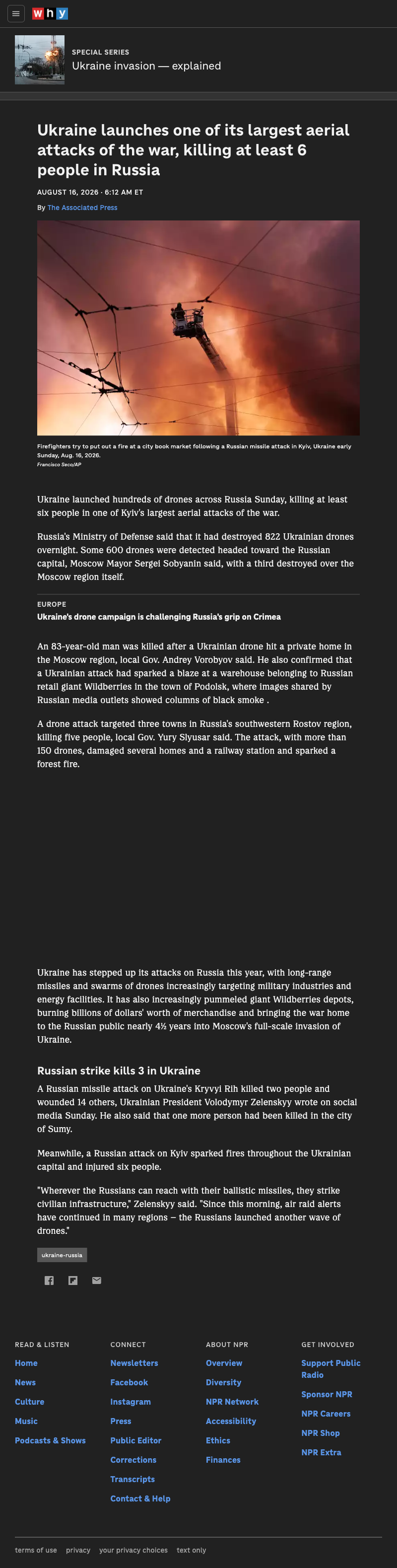
| tl;dr | The article reports that Ukraine launched one of its largest drone attacks of the war into Russia, with Russian officials claiming 822 drones were destroyed and at least six people were killed across affected regions. It describes strikes near Moscow and in the Rostov region, including damage to homes, infrastructure, and a warehouse fire. The piece also notes Russian missile attacks in Ukraine that killed and wounded civilians, quoting President Zelenskyy on continued air alerts and strikes on civilian infrastructure. | ||||
| deeper: | Language is largely factual and attribution-heavy, relying on official statements (notably Russian ministries, regional governors, and Moscow’s mayor) while also including Ukrainian accounts and a Zelenskyy quote about Russian strikes. The framing provides context about Ukraine escalating long-range strikes and mentions Russian attacks in Ukraine, which helps balance. Some figures (e.g., drones “destroyed”) are hard to independently verify in wartime, and the story leans on government sources without much third-party corroboration, but overall sourcing and structure are solid. | ||||
media: | |||||
| gen: 2026/08/13:04:37 in 2 min 51.8 sec (old)bias: 4 (Center) |
| type: lolsquality: 60 |
| pts: 0 |

| gen: 2026/08/13:04:31 in 2 min 30.8 sec (old)bias: 3 (Center) |
| type: lolsquality: 78 |
| pts: 0 |

 | author: | Unknown | institution: | Yahoo News | ¿porque no los dos? |
| tl;dr | A Yahoo News article (sourced from a wire service) reports that a major Russian grain export terminal was struck in a Ukrainian Black Sea port attack. The piece frames the event within the wider Russia–Ukraine war context, highlighting damage and disruption implications for grain exports and shipping. It relies on official/attributed statements and situational reporting rather than analysis or commentary. | ||||
| deeper: | The story is largely straight, event-driven reporting with a neutral news tone and attribution (typical of wire copy). Potential bias comes mainly from wartime information constraints and reliance on official claims that may be difficult to independently verify in real time. Quality is solid: clear headline, relevant context (war, ports, grain exports), and focus on verifiable elements (location, target, impact). It appears light on independent corroboration and on-the-ground detail, which is common for fast-moving conflict coverage. | ||||
media: | |||||
| gen: 2026/08/01:20:08 in 2 min 22.8 sec (old)bias: 2 (Center) |
| type: lolsquality: 78 |
| pts: 0 |

 | author: | Unknown | institution: | France 24 (with Reuters) | ¿porque no los dos? |
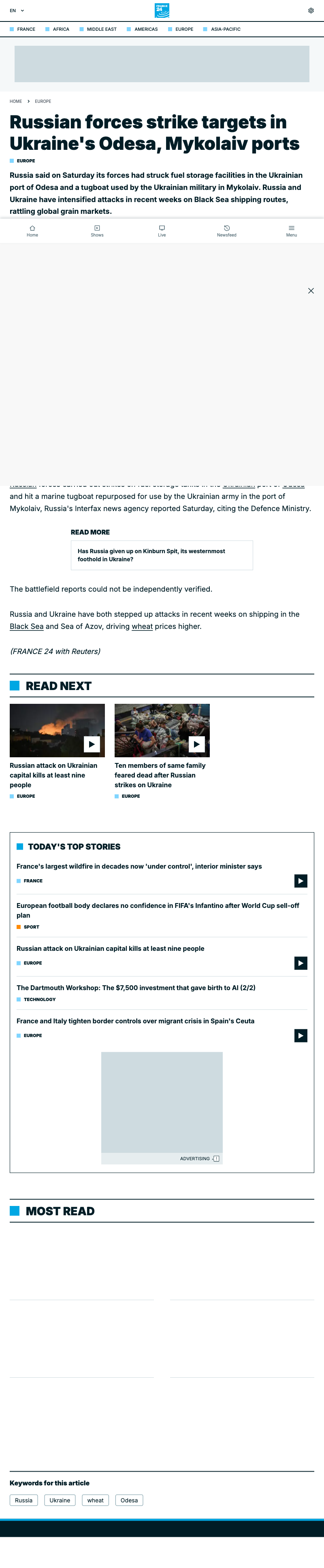
| tl;dr | The article reports Russia’s claim that it struck fuel storage facilities in Ukraine’s Odesa port and hit a tugboat used by the Ukrainian military in Mykolaiv. It situates the strikes within intensified attacks on Black Sea shipping routes, noting impacts on global grain markets (e.g., higher wheat prices). The report emphasizes attribution (“Russia said”) and includes a key caveat that battlefield details could not be independently verified. | ||||
| deeper: | The piece is largely straight-news and attribution-heavy, repeatedly framing key assertions as Russian claims and adding the important limitation that reports couldn’t be independently verified. Language is restrained and focused on observable consequences (shipping disruption, grain prices). Potential bias is low but present via reliance on one side’s official statements in a fast-moving conflict; it doesn’t add much Ukrainian or independent detail beyond the verification caveat. Overall quality is solid, typical of wire reporting: clear, cautious, and contextual but thin on sourcing depth. | ||||
media: No Media Preview | |||||
| gen: 2026/07/30:05:26 in 3 min 12.8 sec (old)bias: 3 (Center) |
| type: lolsquality: 78 |
| pts: 0 |
 | author: | Unknown | institution: | Yahoo News (via Reuters) | ¿porque no los dos? |
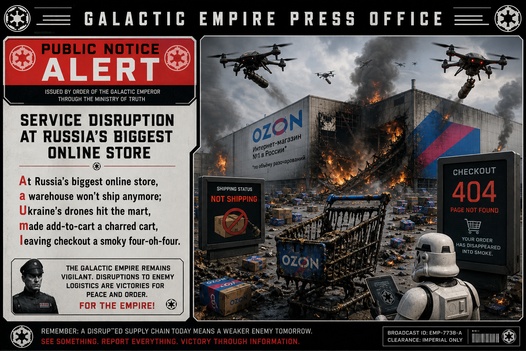
| tl;dr | A Yahoo News page summarizes a Reuters report that Ukraine struck a warehouse linked to Russia’s largest online retailer. The story describes the target, what is known about damage and operations, and situates the strike within Ukraine’s broader campaign against Russian logistics and infrastructure tied to the war effort. The article appears to rely on official statements and available reporting while noting limits on independent verification. | ||||
| deeper: | Language is mostly neutral and event-focused, typical of wire reporting. It frames the strike through factual claims (who said what, what was hit, and why it matters) and generally signals uncertainty where details can’t be independently confirmed. Potential bias comes mainly from source dependence (official Ukrainian/Russian statements) and the wartime context, not from loaded wording. Quality is solid: clear headline, relevant context, and cautious attribution, though evidence is constrained by on-the-ground verification limits. | ||||
| gen: 2026/07/27:05:36 in 1 min 1.7 sec (old)bias: 4 (Center) |
| type: newsquality: 72 |
| pts: 0 |
 | author: | Scott Walterman | institution: | Voice of America (VOA) | ¿porque no los dos? |
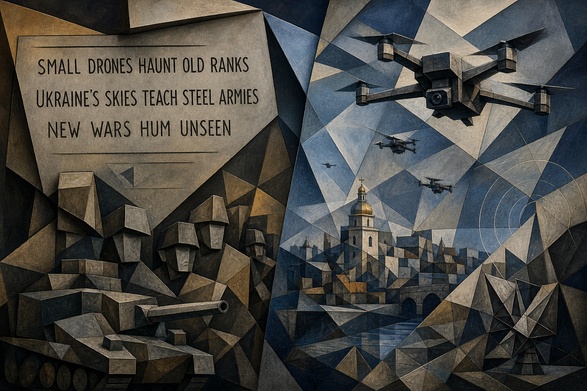
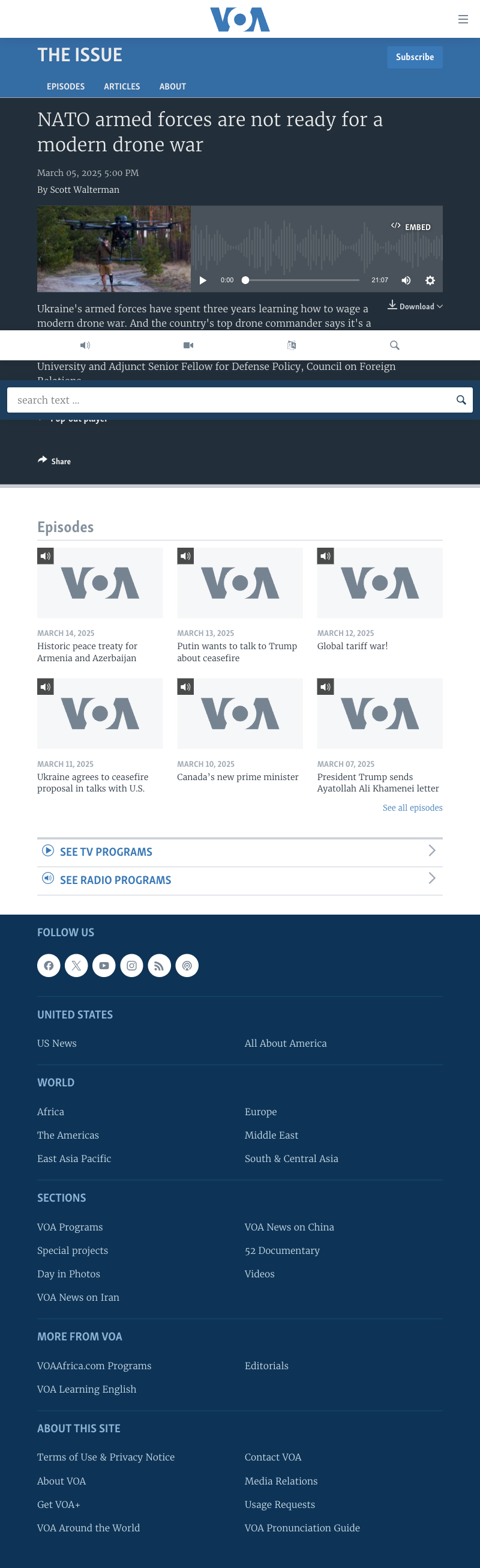
| tl;dr | A Voice of America “The Issue” episode/article titled “NATO armed forces are not ready for a modern drone war” argues that NATO militaries lag behind the realities of drone-centric combat, drawing lessons from Ukraine’s experience and expertise after years of large-scale war. The framing emphasizes capability gaps, adaptation needs, and operational lessons from Ukraine’s drone warfare practices, presented in a broadcast/podcast format with supporting context and related episodes listed on the page. | ||||
| deeper: | The headline is assertive (“not ready”), signaling a critical, agenda-setting frame focused on NATO preparedness. The page implies reliance on Ukrainian military perspectives and expert commentary, which can narrow viewpoint diversity if opposing or internal NATO counter-arguments aren’t equally featured. As a VOA program page, it appears professionally produced and timely, but the screenshot provides limited visible evidence of data, methodology, or multiple independent sources—so it reads more like analysis/interview than a fully evidenced report. | ||||
media: No Media Preview | |||||
| gen: 2026/07/23:02:38 in 55.9 sec (old)bias: 4 (Center) |
| type: newsquality: 74 |
| pts: 0 |
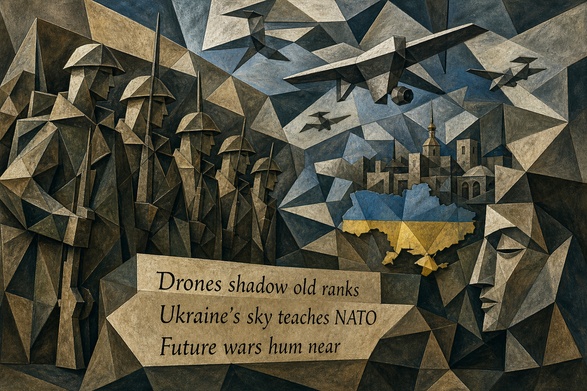
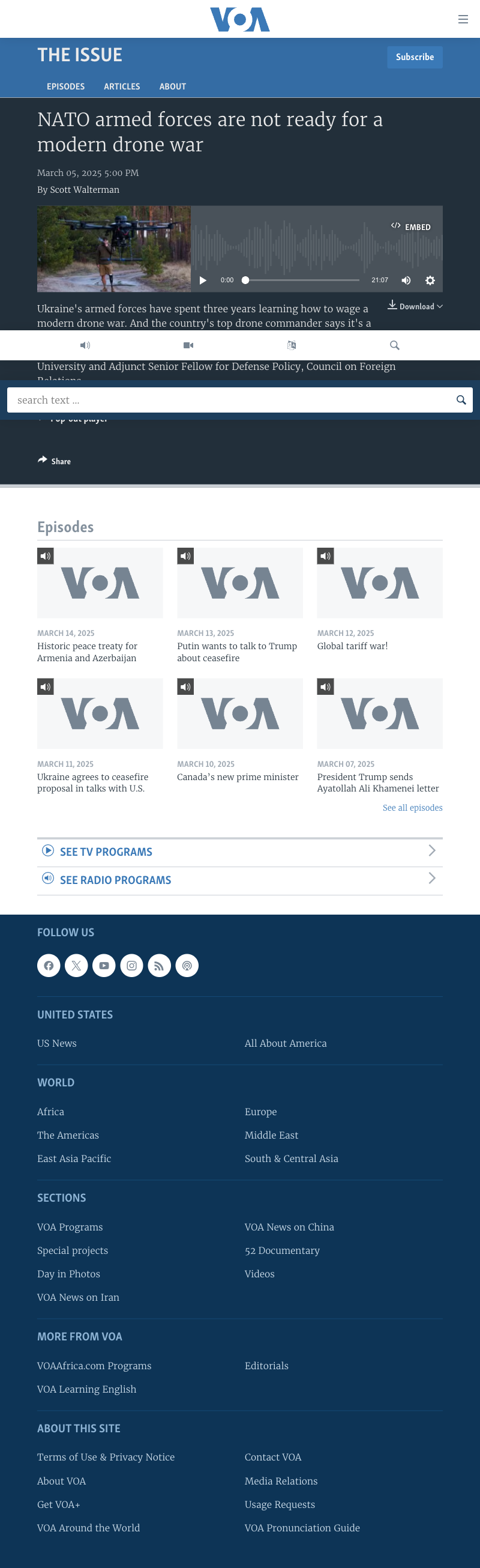 | author: | Scott Walterman | institution: | Voice of America (VOA) | ¿porque no los dos? |
| tl;dr | A Voice of America “The Issue” episode/article argues that NATO militaries are not adequately prepared for today’s drone-centric warfare, drawing on Ukraine’s three-year learning curve and commentary from Ukraine’s senior drone leadership to highlight gaps in doctrine, training, and readiness. | ||||
| deeper: | Content focus: The framing is a critical assessment of NATO readiness in the emerging “modern drone war,” using Ukraine’s battlefield experience as the key reference point. The headline is assertive (“are not ready”), which signals a strong thesis from the outset, but the topic is legitimate and newsworthy given the rapid evolution of drone tactics. Bias: The piece appears to privilege Ukraine’s lived combat lessons and likely adopts a reformist, capability-improvement stance toward NATO (i.e., urging adaptation). That is a perspective, but not inherently partisan; it becomes bias if countervailing NATO viewpoints, differing expert assessments, or evidence that some NATO units are adapting quickly are not included. From the screenshot alone, it’s not clear how much balancing material is provided, so bias is moderate rather than high. Quality: The presentation looks like an audio segment (about 21 minutes) with a byline (Scott Walterman) and date (March 5, 2025), which supports accountability. The quality would be higher if the piece clearly cites concrete metrics (procurement rates, training throughput, EW/drone defense performance, doctrine changes), includes multiple independent experts (beyond Ukrainian sources), and distinguishes among NATO members (readiness varies widely). Without the full transcript, the evidence density and balance can’t be fully verified; still, the premise is plausible and the sourcing appears at least partially expert-driven (Ukraine’s top drone commander). | ||||
media: No Media Preview | |||||
| gen: 2026/07/18:02:14 in 1 min 8.6 sec (old)bias: 4 (Center) |
| type: newsquality: 58 |
| pts: 0 |

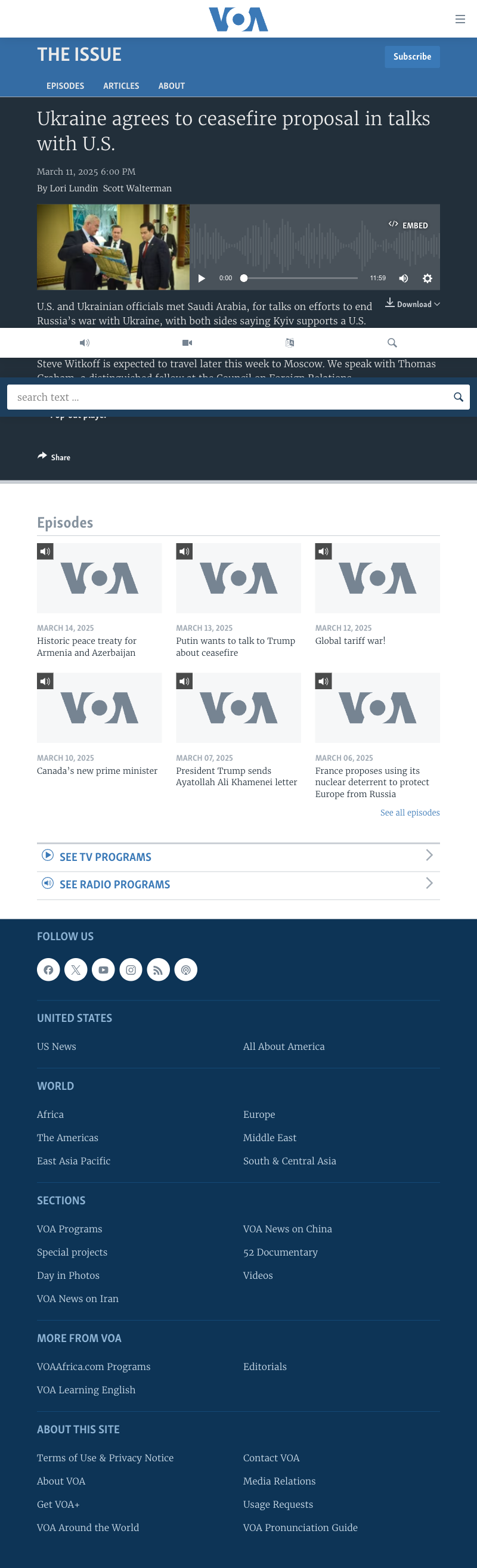 | author: | Lori Lundin; Scott Walterman | institution: | Voice of America (VOA) | ¿porque no los dos? |
| tl;dr | A VOA program page says Ukraine has agreed to a U.S.-backed ceasefire proposal following talks with the United States, reportedly held in Saudi Arabia. The page trails an audio segment featuring discussion of upcoming Moscow travel by a U.S. figure and commentary from a Council on Foreign Relations fellow. It links to related episodes on recent geopolitics. | ||||
| deeper: | The headline and blurb present a straightforward claim about a Ukraine ceasefire proposal without overtly loaded language, suggesting mild bias at most. However, the write‑up contains editing errors and an incomplete sentence (“met Saudi Arabia… with both sides saying Kyiv supports a U.S.”), which undermines clarity and precision. The piece relies on an audio segment for substance; the on‑page text offers little sourcing or detail about terms of the proposal, verification from Ukrainian officials, Russian reaction, or mediation context. Mentioning a think‑tank guest is standard but no competing viewpoints are summarized in text. Overall, middling quality due to sparse information and copy issues; neutrality appears intended but evidence and context are thin. | ||||
media: No Media Preview | |||||
| gen: 2026/07/17:05:31 in 1 min 6.0 sec (old)bias: 5 (Center-Left) |
| type: newsquality: 78 |
| pts: 0 |
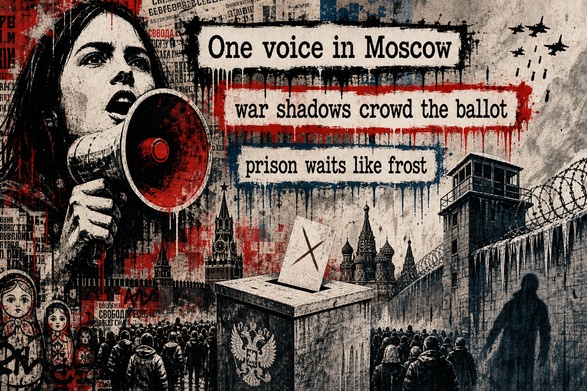
 | author: | Charles Maynes | institution: | NPR | ¿porque no los dos? |
| tl;dr | NPR’s Moscow correspondent profiles Boris Nadezhdin, a rare Russian politician publicly opposing the full‑scale invasion of Ukraine. Nadezhdin describes attempts to run for president on an anti‑war platform, the authorities’ rejection of his signatures, his recent “foreign agent” labeling and brief detention, and new charges tied to allegedly sharing links to extremist content. He frames himself as a moderate reformer, not a revolutionary, arguing Russia needs an electoral alternative advocating peace and normalization. The piece is largely a one‑on‑one interview; there is little on-the-record response from the Kremlin or election authorities. | ||||
| deeper: | The article centers on a single anti‑war opposition figure and takes his claims largely at face value, which tilts sympathetic to him and critical of the Kremlin. It lacks balancing quotes from Russian officials or independent legal experts on the charges and election rules, and provides minimal data on public opinion or the feasibility of his campaign—contributing to moderate bias. However, it is transparent about sourcing (direct interview, interpreter, archived sounds), provides timely, relevant facts (foreign‑agent designation, detention, signature drive), and avoids inflammatory language, supporting a solid overall quality score. | ||||
media: No Media Preview | |||||
| gen: 2026/07/16:14:35 in 1 min 16.5 sec (old)bias: 3 (Center-Left) |
| type: newsquality: 84 |
| pts: 0 |
 | author: | Joanna Kakissis | institution: | NPR | ¿porque no los dos? |
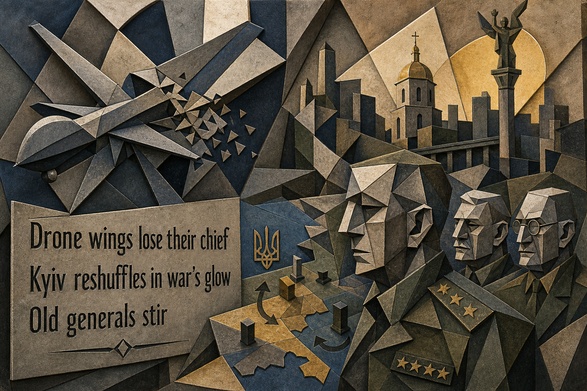
| tl;dr | The article reports that Ukrainian President Volodymyr Zelenskyy dismissed Defense Minister Mykhailo Fedorov as part of a government reshuffle. Fedorov, known for digitization reforms and an aggressive drone program that struck targets deep inside Russia, served six months and says he is proud of his team’s achievements. Parliament has already approved a new prime minister; lawmakers must still confirm Fedorov’s replacement. Supporters credit Fedorov with procurement transparency and adapting warfare with drones; critics say he clashed with traditional military leaders. The Kremlin downplays the dismissal and reiterates its war-end demands. No immediate comment from Zelenskyy’s office. | ||||
| deeper: | Reporting is largely fact-based with multiple on-record sources: Fedorov’s own comments, a pro-government lawmaker’s critique, and the Kremlin’s response. It provides concrete context (Ukraine’s drone strategy, strikes on refineries and logistics, defense industry share of GDP) and notes unknowns (no presidential comment, replacement under consideration). The tone favors Ukraine’s innovation and presents Fedorov positively with descriptors like “tech‑savvy,” “popular,” and “turned the tables,” which introduces mild pro-Ukraine framing. Russian perspective appears but is shorter and mostly reactive. Overall structure, sourcing, and clarity are strong, though some strategic claims (impact assessments, internal politics) rely on Ukrainian narratives without independent verification. | ||||
media: No Media Preview | |||||
| gen: 2026/07/15:04:18 in 1 min 18.4 sec (old)bias: 3 (Center-Left) |
| type: newsquality: 74 |
| pts: 0 |

 | author: | Daniel Ofman, Don Gonyea, Zephyr Weinreich, and Adam Raney | institution: | NPR | ¿porque no los dos? |
| tl;dr | An NPR interview with Seth Jones of the Center for Strategic and International Studies examines the implications of Ukraine receiving U.S. permission to produce Patriot air-defense interceptors. Jones says the arrangement could strengthen Ukraine’s long-term ability to defend its cities and military targets, reduce its dependence on limited U.S. supplies, and signal to Russia that Ukraine can sustain a prolonged war. However, production would likely take at least a year, possibly several years, because Patriot systems require complex components, specialized technology, and a large international supply chain. The interview also notes that licensing may not grant Ukraine access to every sensitive component. | ||||
| deeper: | The segment is focused, intelligible, and transparent about its central source: Seth Jones, a defense expert at CSIS. The host asks useful follow-up questions about capabilities, production timelines, licensing restrictions, supply shortages, and the war’s duration. The discussion includes meaningful limitations rather than presenting domestic production as an immediate solution. Its main weakness is that it relies almost entirely on one analyst and does not include Ukrainian, Russian, U.S. government, or independent manufacturing perspectives. Several claims—such as licensing details, interceptor inventories, and production timelines—are presented without supporting documents or additional verification. The framing is generally sympathetic to Ukraine’s defensive needs and emphasizes the benefits of continued Ukrainian resistance, giving it a mild Center-Left orientation, but it does not use strongly partisan language or conceal the practical obstacles. The displayed date, July 12, 2026, is also future-dated relative to the available context, so the underlying announcement cannot be independently assessed here. | ||||
media: No Media Preview | |||||
| gen: 2026/07/13:13:42 in 1 min 19.9 sec (old)bias: 3 (Center-Left) |
| type: lolsquality: 78 |
| pts: 0 |
 | author: | Daniel Ofman, Don Gonyea, Zephyr Weinreich, Adam Raney | institution: | NPR | ¿porque no los dos? |
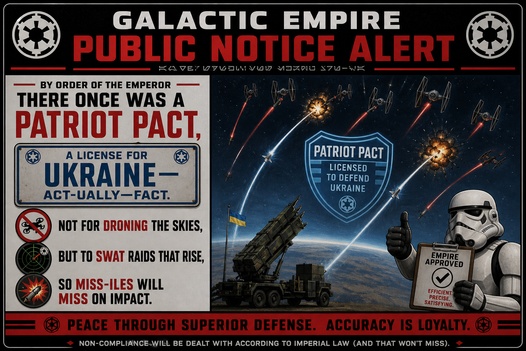
| tl;dr | NPR interviews Seth Jones of the Center for Strategic and International Studies about the implications of Ukraine receiving U.S. permission to produce Patriot missile interceptors. Jones says the arrangement could eventually strengthen Ukraine’s air defenses, reduce dependence on limited U.S. supplies, and demonstrate Ukraine’s ability to sustain a long war. However, production would likely take at least a year—and possibly two to three years for some interceptors—because the system depends on a complex international supply chain and sensitive U.S. technology. The interview does not claim that licensing will immediately end the war or guarantee that Ukraine can manufacture every component domestically. | ||||
| deeper: | The piece is a clearly identified interview and transcript rather than an investigative report, which makes its format transparent. It provides useful context about Patriot capabilities, production constraints, supply shortages, export licensing, and technology-transfer concerns. The expert explains both the potential benefits and the substantial obstacles, including the long timeline, expense, dependence on foreign suppliers, and risk of sensitive technology reaching Russia or China. Bias is relatively low, but the framing is generally sympathetic to Ukraine and emphasizes the strategic value of supporting Ukrainian defense. The interview relies primarily on one CSIS expert, offers no Ukrainian, Russian, Pentagon, defense-industry, or independent technical perspective, and does not provide links or detailed evidence for claims about interceptor inventories, production timelines, or the precise terms of the license. Some statements are broad and conversational—for example, describing Patriot as among the world’s most effective systems—without qualification about costs, interception limits, or battlefield performance. The displayed date is July 12, 2026, which is beyond the current date and would require future verification. | ||||
media: | |||||


owned and operated by: RPN Omnigalactic Insitutution as of: 2026/10/13: 17:53 in 0 ms
Enter Code
Login with Account