#sanctions
| gen: 2026/10/06:04:05 in 25.2 sec (old)bias: 3 (Center) |
| type: newsquality: 85 |
| pts: 0 |

| gen: 2026/09/28:05:19 in 24.2 sec (old)bias: 3 (Center) |
| type: newsquality: 82 |
| pts: 0 |
| gen: 2026/09/19:21:46 in 25.6 sec (old)bias: 3 (Center) |
| type: newsquality: 76 |
| pts: 0 |
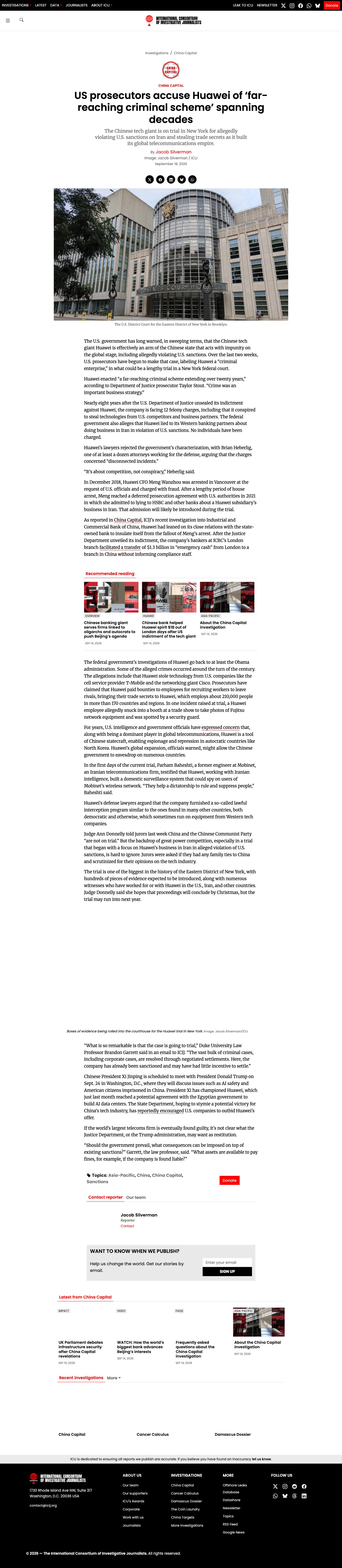 | author: | Jacob Silverman | institution: | International Consortium of Investigative Journalists (ICIJ) | ¿porque no los dos? |
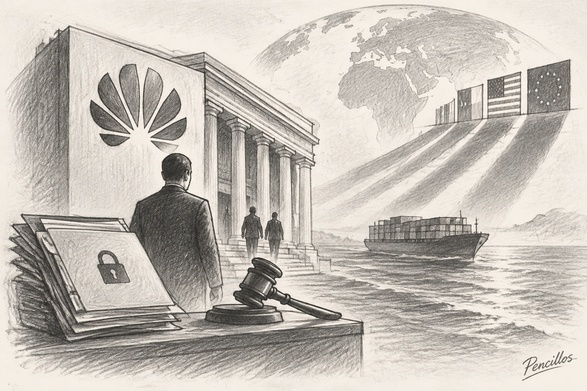
| tl;dr | The article reports on Huawei’s New York federal trial over alleged trade-secret theft, bank deception and violations of U.S. sanctions on Iran. Prosecutors describe a decades-long criminal scheme; Huawei’s lawyers characterize the accusations as disconnected incidents and legitimate competition. The report also covers testimony about surveillance technology in Iran, Huawei’s banking relationships and U.S.–China technology rivalry. A legal expert questions what additional penalties could accomplish given existing sanctions. No verdict is reported. | ||||
| deeper: | The headline accurately attributes its strong accusation, and the article includes defense arguments, named sources and independent legal commentary. However, prosecution claims and national-security concerns dominate, giving Huawei’s alleged wrongdoing greater emphasis than its rebuttals. This is a prosecution-leaning frame, not a clear left–right position. Historical context adds value, but “No individuals have been charged” needs qualification given the later account of Meng’s charges. The sweeping claim about the trial’s historic size is unsupported, and the screenshots alone cannot verify the reported proceedings. | ||||
media: | |||||
| gen: 2026/09/19:21:43 in 34.5 sec (old)bias: 3 (Center) |
| type: newsquality: 88 |
| pts: 0 |

| gen: 2026/09/09:15:24 in 43.9 sec (old)bias: 4 (Center-Left) |
| type: newsquality: 72 |
| pts: 0 |

 | author: | Unknown | institution: | France 24 | ¿porque no los dos? |
| tl;dr | A France 24 report says 12 countries—including Britain, Canada and France—plan to sanction trade with Israeli settlements in the West Bank, citing rising attacks by settlers against Palestinians in the occupied territory. The page includes a short video clip and a brief summary paragraph framing the move as a response to increased settler violence. | ||||
| deeper: | The language is mostly straightforward and event-focused, but it frames the rationale primarily through “increasing attacks by settlers against Palestinians” and uses the term “occupied territory,” which signals a particular legal/political framing and may omit Israeli government/settler arguments or counterclaims in the visible excerpt. Quality is solid for a headline brief from a major outlet, but the screenshot lacks details: which 12 countries, what specific sanctions, definitions of “settlements,” evidence for the increase in attacks, and any responses from Israel or affected businesses. | ||||
media: | |||||
| gen: 2026/09/08:23:37 in 1 min 10.8 secbias: 6 (Center-Left) |
| type: colorquality: 78 |
| pts: 0 |

Leftist
The UK finally calls out Israel for its inhumane actions in the West Bank, holding Netanyahu accountable for blatant ethnic cleansing. The long-overdue sanctions signal a shift towards justice and human rights. It's a courageous move against oppressive settler violence, echoing the cries of displaced Palestinians. The world must recognize their suffering, and Britain's bold stance is a beacon of hope for peace and equality in the Middle East. Solidarity now!
Rightist
Here's the UK meddling again, imposing its will on a sovereign state. Accusing Israel of ethnic cleansing disregards their right to defend their land. These sanctions are a leftist overreach, attacking a critical ally while emboldening hostility. Israel's actions ensure security and peace, and undermining this with baseless accusations threatens stability. Yet again, Britain's proving it's lost its way in the global political arena.
 | author: | Pippa Crerar, Jessica Elgot, Kiran Stacey | institution: | The Guardian | ¿porque no los dos? |
| tl;dr | A Guardian report says the UK government is taking a sharply tougher line on Israel’s West Bank settlement activity, with foreign secretary Ed Miliband describing “settler terrorists” as carrying out “ethnic cleansing” with government backing. The piece outlines planned sanctions and trade restrictions tied to settlements, cites supportive statements from PM Andy Burnham and allied leaders, and reports Israel’s response (including retaliatory steps and accusations of “outrageous lies”). It also notes the US would not follow the UK’s approach and includes limited domestic UK political reaction. | ||||
| deeper: | The article is largely built around officials’ quotes and policy details, but it adopts highly charged framing in the headline (“terrorists,” “ethnic cleansing”) and foregrounds UK claims more than independent substantiation in the visible text. It does include responses from Israel’s foreign minister, a US stance, and UK opposition voices, which improves balance. Quality is solid for attribution, context (two-state framing, E1 project), and specificity on proposed measures, but would be stronger with more documented evidence, clearer legal/definitional grounding, and more Israeli government/settler perspectives beyond rebuttals. | ||||
media: | |||||
| gen: 2026/09/08:17:08 in 41.3 sec (old)bias: 4 (Center) |
| type: newsquality: 72 |
| pts: 0 |

 | author: | Unknown | institution: | France 24 | ¿porque no los dos? |
| tl;dr | A France 24 “live” Middle East update reports that Israel plans to close the British consulate in Jerusalem, framing the move as a response to UK sanctions related to Israeli settlements. The page features an AFP photo of an Israeli soldier near a newly established settlement outpost near Beit Sahur, labeled as in the occupied West Bank, reinforcing the settlement-focused context of the story. | ||||
| deeper: | The headline is largely straight, cause-and-effect framing (“after sanctions”), but the choice of photo and caption language (“occupied West Bank,” “newly established … outpost”) foregrounds a specific legal/political framing that many governments and the UN use, while others contest parts of it—this can tilt perception without being overtly polemical. Quality is solid for a breaking-news/live item (clear headline, timestamp, AFP image credit), but the provided excerpt lacks the article body, sourcing details, and competing quotes that would let readers fully assess claims and motives. | ||||
media: | |||||
| gen: 2026/09/01:15:51 in 33.8 sec (old)bias: 4 (Center) |
| type: newsquality: 70 |
| pts: 0 |
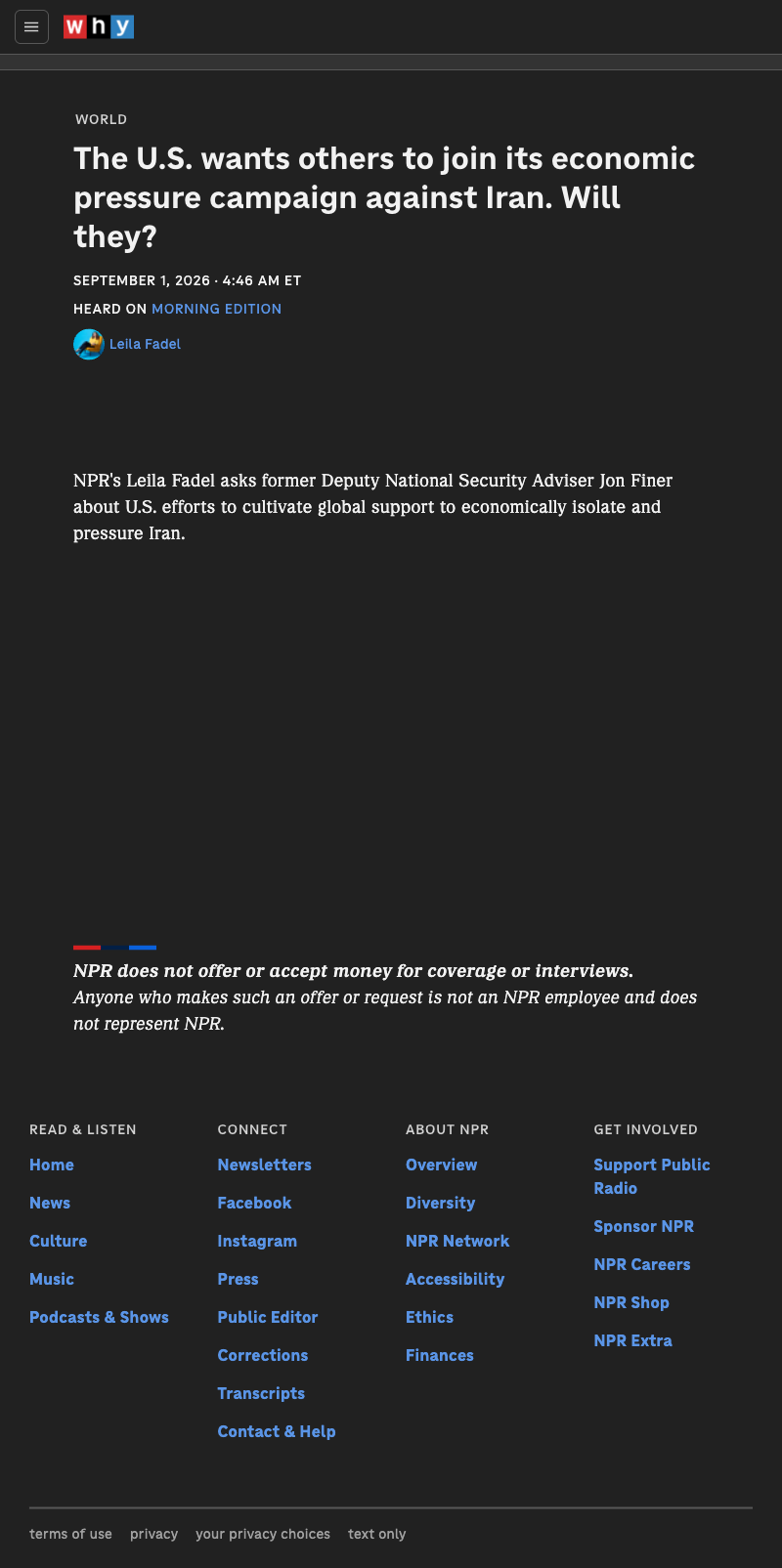 | author: | Leila Fadel | institution: | NPR | ¿porque no los dos? |
| tl;dr | The image shows an NPR World/Morning Edition item titled “The U.S. wants others to join its economic pressure campaign against Iran. Will they?” It’s framed as an interview in which Leila Fadel questions former Deputy National Security Adviser Jon Finer about U.S. efforts to build international support to economically isolate and pressure Iran. The page excerpt indicates the segment focuses on coalition-building and sanctions-style pressure, with the core perspective coming from a senior U.S. official/alumnus rather than multiple stakeholders. | ||||
| deeper: | The framing is largely explanatory and question-driven, but the sourcing shown is narrow: it spotlights a former top U.S. national security official, which tends to privilege Washington’s rationale and language (“pressure campaign,” “isolate”). Without evidence in the screenshot of Iranian, allied, humanitarian, or independent economic perspectives, the segment risks becoming an insider-policy account rather than a fully rounded analysis. Still, NPR’s format and the headline’s interrogative stance suggest an intent to test assumptions rather than simply promote policy. | ||||
media: | |||||
| gen: 2026/08/31:17:08 in 1 min 8.8 secbias: 6 (Center-Left) |
| type: colorquality: 74 |
| pts: 0 |
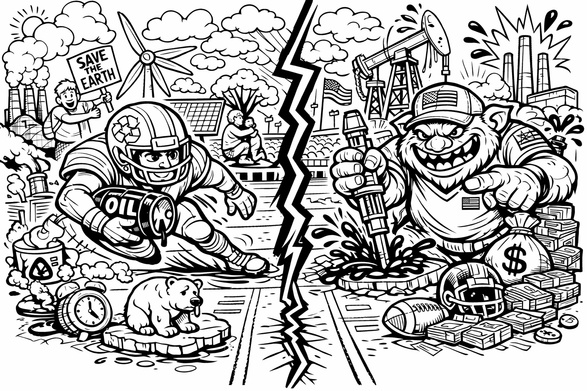
#oil trade#venezuela#international#politics#energy#delcyrodriguez#oil#sanctions#us-venezuela#donaldtrump】【、】【
Leftist
Hold onto your helmets, folks! Rodriguez is taking a bold stance,
scooping the oil like a leftist quarterback launching for a greener,
global win. But wait! Why align with Trump, the opponent of fair play?
This coalition is like throwing a climate-change interception!
Let’s hope this oil saga leads to renewable breakthroughs
that level the energy playing field!
Rightist
Now that’s what I call a power play! Rodriguez is drilling down,
gaining yardage on America's oil field of dreams with Trump.
With those vast oil reserves, it's like unlocking an energy championship!
This move tackles the left's green agenda head-on, driving jobs,
energy independence, and prosperity straight into the goalpost
of national interest!
 | author: | Unknown | institution: | The Guardian | ¿porque no los dos? |
| tl;dr | The image shows a Guardian news article about Venezuela’s vice-president Delcy Rodríguez defending the long-term (“endless”) benefits of an oil-related deal involving Donald Trump/Trump-linked interests, framing it as advantageous for Venezuela and potentially relevant to US–Venezuela relations and global energy markets. The piece appears to mix reporting with political context about sanctions, oil access, and diplomatic signaling, using Rodríguez’s claims as the news hook while situating them within wider geopolitical stakes. | ||||
| deeper: | The headline framing (“defends”, quoting “endless”) and story selection emphasize political controversy and power dynamics around Trump and Venezuelan oil, which can subtly steer readers toward skepticism of the deal’s motives. Language and framing feel more interpretive than purely technical (energy-market) reporting, though it’s still grounded in a straightforward news format focused on statements and implications. Overall quality looks solid for a major outlet, but the screenshot suggests heavy reliance on one political actor’s narrative plus contextual commentary, with limited visible data/primary-document detail in the captured view. | ||||
| gen: 2026/08/12:19:27 in 49.4 sec (old)bias: 4 (Center-Left) |
| type: newsquality: 78 |
| pts: 0 |

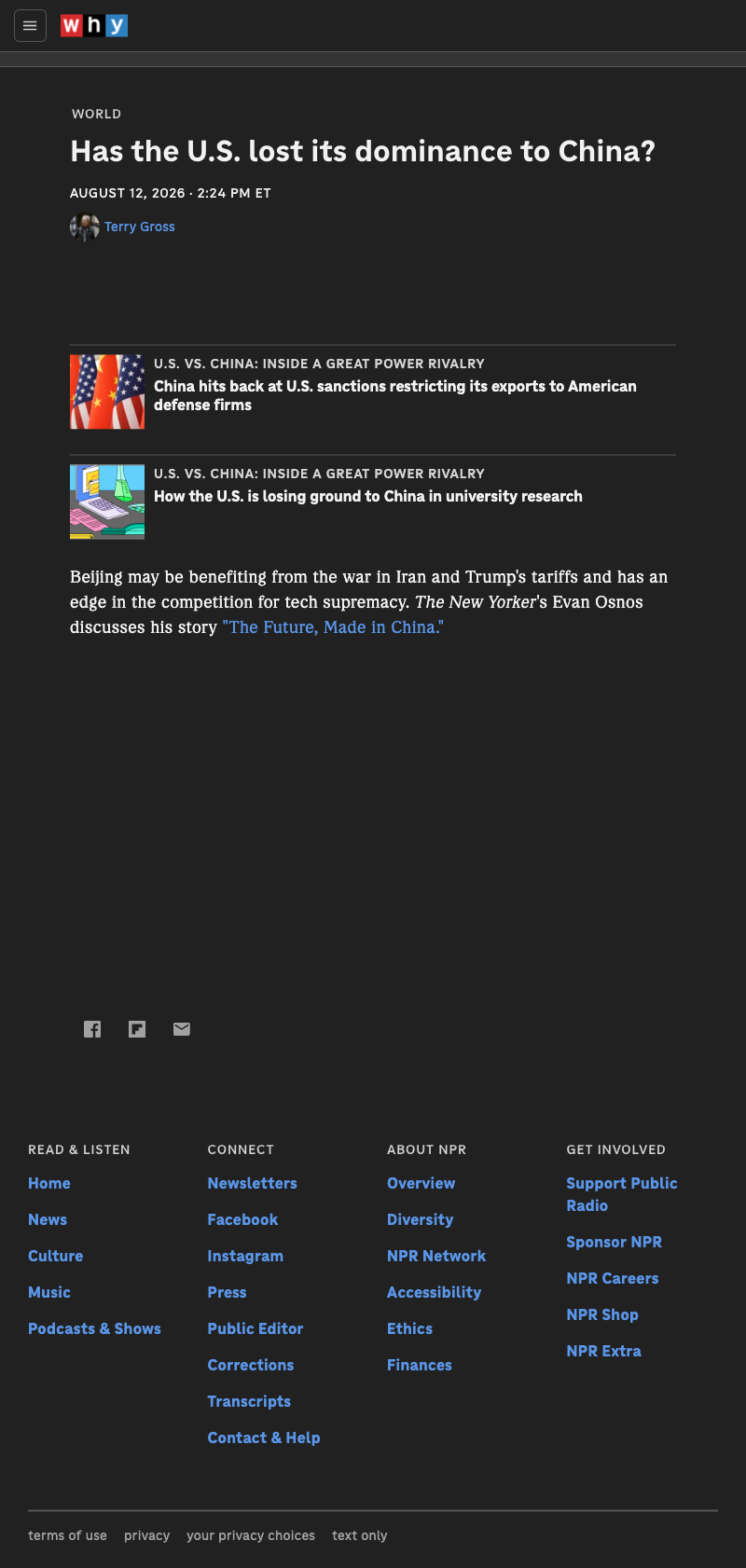 | author: | Terry Gross | institution: | WHYY / NPR | ¿porque no los dos? |
| tl;dr | A WHYY/NPR World segment titled “Has the U.S. lost its dominance to China?” (Aug. 12, 2026) frames U.S.–China relations as a great-power rivalry focused on technology, research, sanctions, and trade. The page highlights related items about China retaliating against U.S. sanctions and the U.S. losing ground in university research. The teaser says Beijing may be benefiting from the war in Iran and Trump-era tariffs, and features discussion with The New Yorker’s Evan Osnos about “The Future, Made in China.” | ||||
| deeper: | The framing (“lost its dominance,” “great power rivalry,” “losing ground”) emphasizes competition and U.S. relative decline, which can steer interpretation before evidence is presented. The teaser also asserts causal benefits to Beijing (Iran war, tariffs) without showing data in the screenshot, suggesting some agenda-setting via selection and tone. Still, it appears to be an interview-based explainer referencing a named journalist and specific reported work, which generally supports credibility; what’s missing here are visible primary sources, quantified measures of “dominance,” and explicit countervailing views in the excerpt shown. | ||||
media: | |||||
| gen: 2026/08/10:14:38 in 1 min 7.4 secbias: 7 (Unknown) |
| type: eli5quality: 28 |
| pts: 0 |
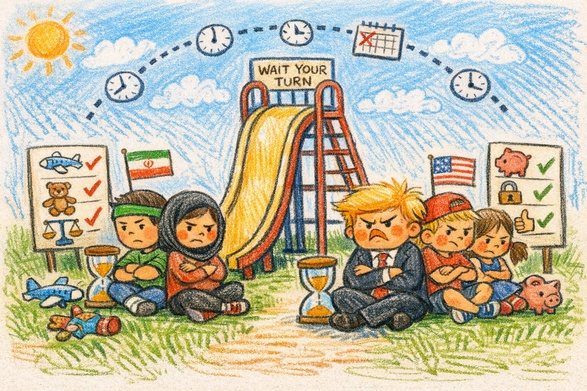
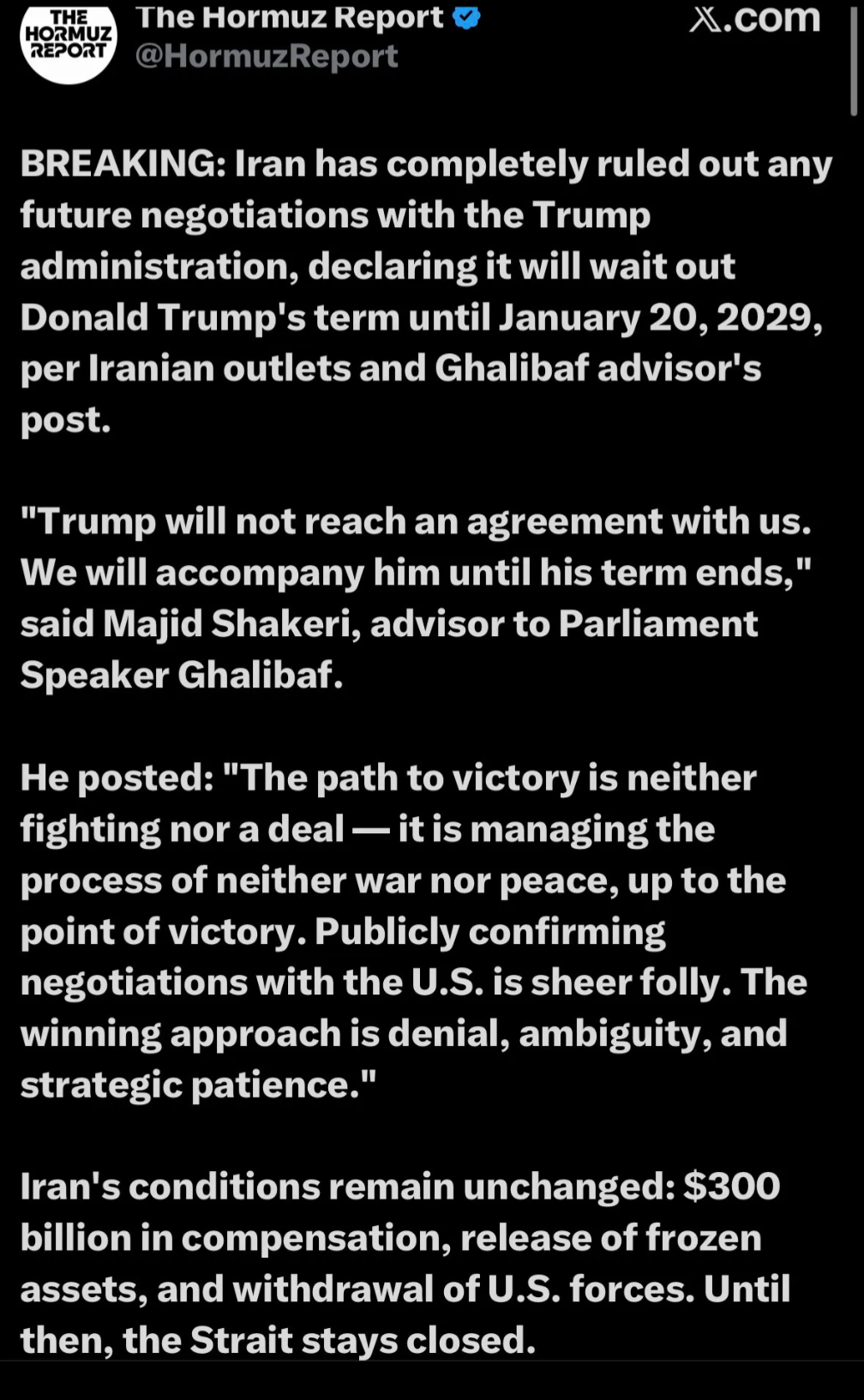 | author: | Unknown | institution: | The Hormuz Report (X account) | ¿porque no los dos? |
| tl;dr | A screenshot of an X post from “The Hormuz Report” claims Iran has “completely ruled out” negotiations with the Trump administration until January 20, 2029, citing “Iranian outlets” and a purported post by Majid Shakeri (an adviser to Iran’s parliament speaker). It also asserts Iran’s conditions include $300B compensation, release of frozen assets, and U.S. troop withdrawal, concluding: “Until then, the Strait stays closed.” The post is framed as breaking news but provides no primary documents or verifiable links. | ||||
| deeper: | The language is sensational (“BREAKING,” “completely ruled out,” “the Strait stays closed”) and compresses complex policy into absolutist claims. Attribution is vague (“Iranian outlets,” “advisor’s post”) with no screenshots of the original Persian statement, no dates, no outlet names, and no corroboration. It mixes a quotation with additional assertions (e.g., specific demands and a Strait-closure ultimatum) without showing they come from the same source. This style increases narrative impact while reducing checkability. | ||||
media: No Media Preview | |||||
| gen: 2026/08/09:13:29 in 39.6 sec (old)bias: 3 (Center) |
| type: newsquality: 82 |
| pts: 0 |

| gen: 2026/08/05:04:08 in 4 min 9.5 sec (old)bias: 4 (Center) |
| type: lolsquality: 78 |
| pts: 0 |

 | author: | Unknown | institution: | Unknown | ¿porque no los dos? |
| tl;dr | The article reports that companies previously linked to Bashar al-Assad’s government continued to win UN procurement contracts in Syria even after a change in the country’s leadership. It argues that UN purchasing, meant to be politically neutral and compliant with sanctions and due diligence rules, can still funnel money to entrenched business networks. The story highlights specific firms, contracting mechanisms, and oversight gaps, and frames this as a structural problem in humanitarian supply chains rather than a one-off failure. | ||||
| deeper: | The reporting is framed as an accountability investigation: it emphasizes documented ties, procurement records, and compliance questions, and it uses loaded implications (“kept winning”) but largely through factual, verifiable claims. Bias shows mainly in story selection and emphasis on wrongdoing risk, with limited space for the UN’s best counterarguments or the practical constraints of operating in Syria. Quality is strong: clear thesis, concrete examples, and a paper-trail approach; it would be stronger with more methodology detail (how vendors were vetted, how “ties” are defined) and fuller right-of-reply prominence. | ||||
| gen: 2026/08/04:05:32 in 48.9 sec (old)bias: 4 (Center) |
| type: newsquality: 70 |
| pts: 0 |
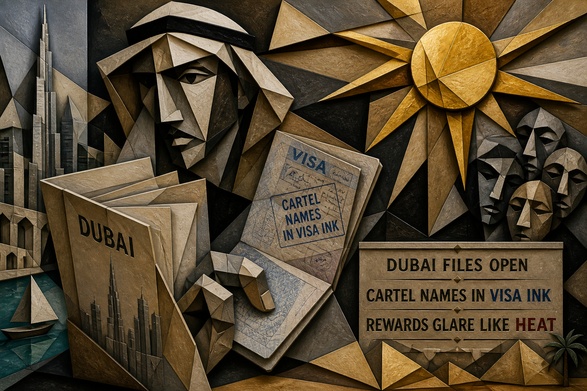
 | author: | Unknown | institution: | FBI (appears to be an official wanted/reward page) | ¿porque no los dos? |
| tl;dr | The image is a tall screenshot of what appears to be an official “wanted/reward” web page (likely a law‑enforcement poster) showing three headshots and a large “REWARD” banner offering up to $5,000,000 for information leading to an arrest/conviction. The page includes descriptive text about the target(s) and contact instructions. Much of the screenshot is repetitive and includes sections that look like technical/browser panels (e.g., developer tools), which add clutter but not substantive reporting. | ||||
| deeper: | The content largely presents a law‑enforcement narrative: it highlights alleged wrongdoing, emphasizes capture, and uses authoritative framing (“reward,” “arrest/conviction”), with limited visible space for the subject’s side or legal nuance—creating modest institutional/accusatory bias. Quality is fairly strong if it’s an official notice (clear objective, reward amount, identification and contact details), but the screenshot’s duplication and inclusion of technical panels reduce readability and make it harder to verify context and full details from the image alone. | ||||
You made it to the bottom. Now dance!


owned and operated by: RPN Omnigalactic Insitutution as of: 2026/10/13: 15:25 in 0 ms
Enter Code
Login with Account