#data centers
| gen: 2026/09/30:20:56 in 27.3 sec (old)bias: 3 (Center-Left) |
| type: newsquality: 78 |
| pts: 0 |

#nuclear energy#data centers#public lands#utah#environment#valar atomics#project beehive#nuclear power#utahுட
 | author: | Geoff Brumfiel | institution: | NPR | ¿porque no los dos? |
| tl;dr | Valar Atomics proposes building Project Beehive near Price, Utah, with 456 small nuclear reactors powering data centers on more than 9,000 acres of federal land. The article reports a planned 9.6-gigawatt output, initial reactor operations in 2028 and possible completion by 2032. Environmental advocates raise public-land and oversight concerns. Federal officials confirm an application is under review and promise public input. The report also describes the company's technological milestones, ties to regulatory reforms and arguments for building reactors in phases. | ||||
| deeper: | The article mildly favors public-land conservation and regulatory oversight, giving environmental advocates prominent space and opening with a politically charged founder quote. It nevertheless includes federal officials' responses, earlier company assurances and potential benefits of modular reactors. Documents, named sources and numerical context strengthen the reporting. Limitations include little independent technical or financial assessment and an unexplained difference between 456 25-megawatt units and the stated 9.6-gigawatt output. The supplied text ends mid-quotation, so this assessment covers only the visible material. | ||||
media: | |||||
| gen: 2026/09/21:17:40 in 33.8 sec (old)bias: 3 (Center) |
| type: newsquality: 80 |
| pts: 0 |
#data centers#politics#community#technology#ai#local politics#loudoun county#virginia#maryland prefect
 | author: | Scott Neuman | institution: | NPR | ¿porque no los dos? |
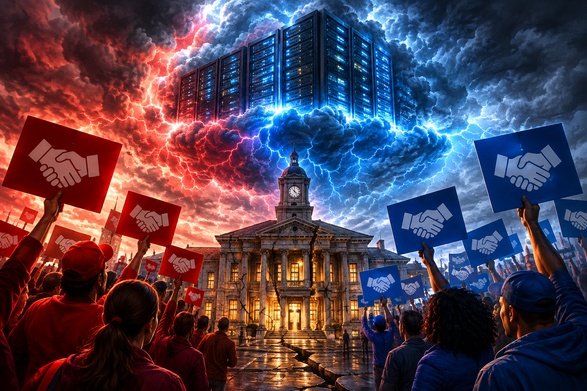
| tl;dr | The article describes how opposition to data centers is uniting residents across party lines and disrupting local politics. Noise, electricity and water demands, and confidential development deals are fueling distrust and prompting restrictions. Examples center on Virginia and Maryland, with additional cases nationwide. The reporting also acknowledges substantial tax revenue, construction jobs and other economic benefits, and includes industry responses. Its central argument is that community concerns and demands for transparency increasingly outweigh traditional party loyalties. | ||||
| deeper: | The article favors residents’ perspectives through protest imagery, extensive activist quotations and dramatic language about political upheaval. However, its emphasis on transparency and local accountability is not distinctly partisan, and it includes industry responses and concrete tax benefits. Named sources, linked studies, polling and multiple local examples strengthen the reporting. Weaknesses include limited explanation of polling and movement-count methodology, little quantified comparison of environmental costs and benefits, and a sweeping national thesis supported largely by selected communities. The screenshots alone do not independently verify the linked claims. | ||||
media: | |||||
| gen: 2026/08/10:22:47 in 4 min 38.7 sec (old)bias: 4 (Center) |
| type: lolsquality: 72 |
| pts: 0 |

 | author: | Unknown | institution: | Yahoo Finance | ¿porque no los dos? |
| tl;dr | A Yahoo Finance news article reports Nvidia is working with major financial firms and banks to raise up to $500bn to fund AI infrastructure—especially large-scale data centers and power/compute buildouts. The piece cites Nvidia CEO Jensen Huang and names partners/investors such as BlackRock, Microsoft, and others, framing the effort as meeting surging demand for AI computing and energy. It emphasizes the scale of capital needed, the strategic importance of “AI factories,” and potential economic productivity gains, with limited discussion of risks or constraints. | ||||
| deeper: | The reporting is mostly straightforward and attribution-heavy (named companies, executive quotes, and a clear description of the funding goal). Bias shows up as a mildly boosterish framing: it largely accepts industry narratives about AI infrastructure necessity and economic benefits, while giving less space to counterpoints like grid constraints, environmental impacts, demand uncertainty, or financial risk. Quality is solid for a business brief, but it leans on corporate statements and big numbers without much independent validation or detailed deal structure (e.g., terms, timelines, binding commitments). | ||||
media: | |||||
| gen: 2026/07/25:14:15 in 53.3 sec (old)bias: 4 (Center) |
| type: newsquality: 72 |
| pts: 0 |
 | author: | Unknown | institution: | Yahoo Finance | ¿porque no los dos? |
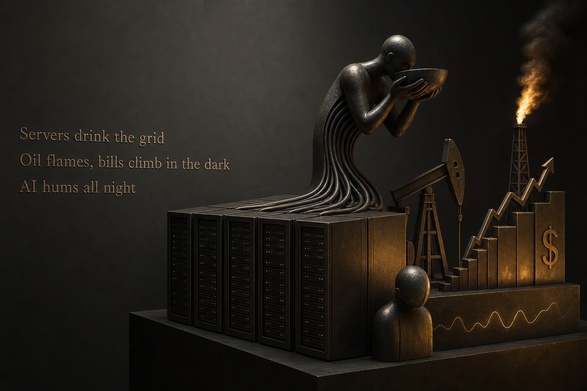
| tl;dr | The piece argues that rapid growth in U.S. data centers (driven by cloud computing and especially AI) is a major, underappreciated driver of rising electricity demand and grid strain—more so than geopolitical events like Iran-related oil shocks. It suggests the “energy crisis” is being built domestically through load growth, slow grid build-out, and lagging generation/transmission additions, and it warns consumers may face higher power prices and reliability risks if infrastructure and policy don’t keep pace. | ||||
| deeper: | The headline is provocative (“Not Iran”) and frames the issue as a corrective to a popular narrative, which adds some rhetorical bias. The argument itself is broadly plausible and consistent with current load-growth discussions (AI/data centers, grid congestion, permitting delays), but the screenshot doesn’t show strong quantification transparency, clear sourcing hierarchy, or robust counterarguments (e.g., regional variation, efficiency gains, planned capacity, demand response). Overall: solid explanatory take with some sensational framing. | ||||
media: | |||||
You made it to the bottom. Now dance!


owned and operated by: RPN Omnigalactic Insitutution as of: 2026/10/14: 14:19 in 0 ms
Enter Code
Login with Account