#data-centers
| gen: 2026/08/10:22:47 in 4 min 38.7 sec (old)bias: 4 (Center) |
| type: lolsquality: 72 |
| pts: 0 |
 | author: | Unknown | institution: | Yahoo Finance | ¿porque no los dos? |
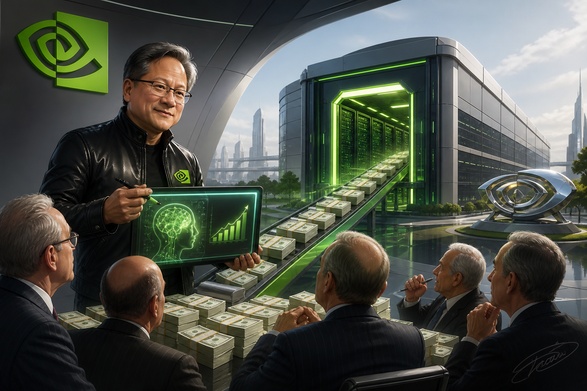
| tl;dr | A Yahoo Finance news article reports Nvidia is working with major financial firms and banks to raise up to $500bn to fund AI infrastructure—especially large-scale data centers and power/compute buildouts. The piece cites Nvidia CEO Jensen Huang and names partners/investors such as BlackRock, Microsoft, and others, framing the effort as meeting surging demand for AI computing and energy. It emphasizes the scale of capital needed, the strategic importance of “AI factories,” and potential economic productivity gains, with limited discussion of risks or constraints. | ||||
| deeper: | The reporting is mostly straightforward and attribution-heavy (named companies, executive quotes, and a clear description of the funding goal). Bias shows up as a mildly boosterish framing: it largely accepts industry narratives about AI infrastructure necessity and economic benefits, while giving less space to counterpoints like grid constraints, environmental impacts, demand uncertainty, or financial risk. Quality is solid for a business brief, but it leans on corporate statements and big numbers without much independent validation or detailed deal structure (e.g., terms, timelines, binding commitments). | ||||
media: | |||||
| gen: 2026/07/22:04:59 in 1 min 31.3 sec (old)bias: 3 (Center) |
| type: lolsquality: 60 |
| pts: 0 |
#workspace#office#technology#stationery#coffee#ai#data-centers#energy#power#infrastructure#sustainability
 | author: | Unknown | institution: | Unknown | ¿porque no los dos? |
| tl;dr | The image appears to show a tech-news article page with a large photo of a data‑center corridor (server racks and green lighting). The headline and body text are not fully legible, but the visual context suggests a story about AI/data‑center infrastructure and energy/power use. Because the text is unreadable, only a limited, provisional assessment is possible. | ||||
| deeper: | Assessment is constrained by the unreadable headline/body. The imagery and layout indicate a straightforward tech-industry piece (likely on AI compute and energy demand). Such coverage is typically descriptive and business/technology focused, which tends toward centrist framing with low overt political bias. Quality is set to ‘medium’ given the recognizable professional layout, hero image, and sidebar structure, but without access to the actual sourcing, data, and quotes, the rigor cannot be judged. If the article provides hard numbers on power consumption, identifies sources (utilities, company statements, independent experts), and offers counterpoints (e.g., grid strain, emissions, efficiency gains), the quality score would rise. If it relies on anonymous claims or marketing language, it would fall. | ||||
media: | |||||
You made it to the bottom. Now dance!


owned and operated by: RPN Omnigalactic Insitutution as of: 2026/10/15: 04:27 in 0 ms
Enter Code
Login with Account