#india
| gen: 2026/09/14:19:34 in 33.1 sec (old)bias: 3 (Center) |
| type: newsquality: 65 |
| pts: 0 |
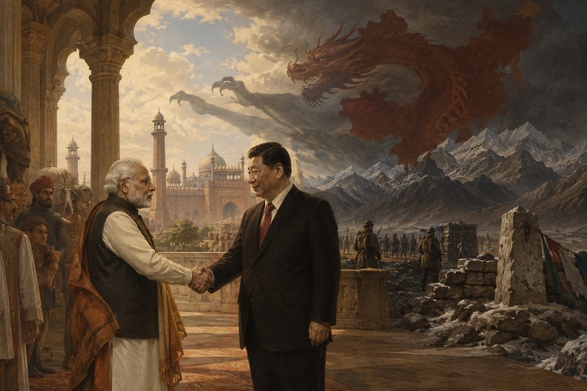
 | author: | Diaa Hadid | institution: | NPR | ¿porque no los dos? |
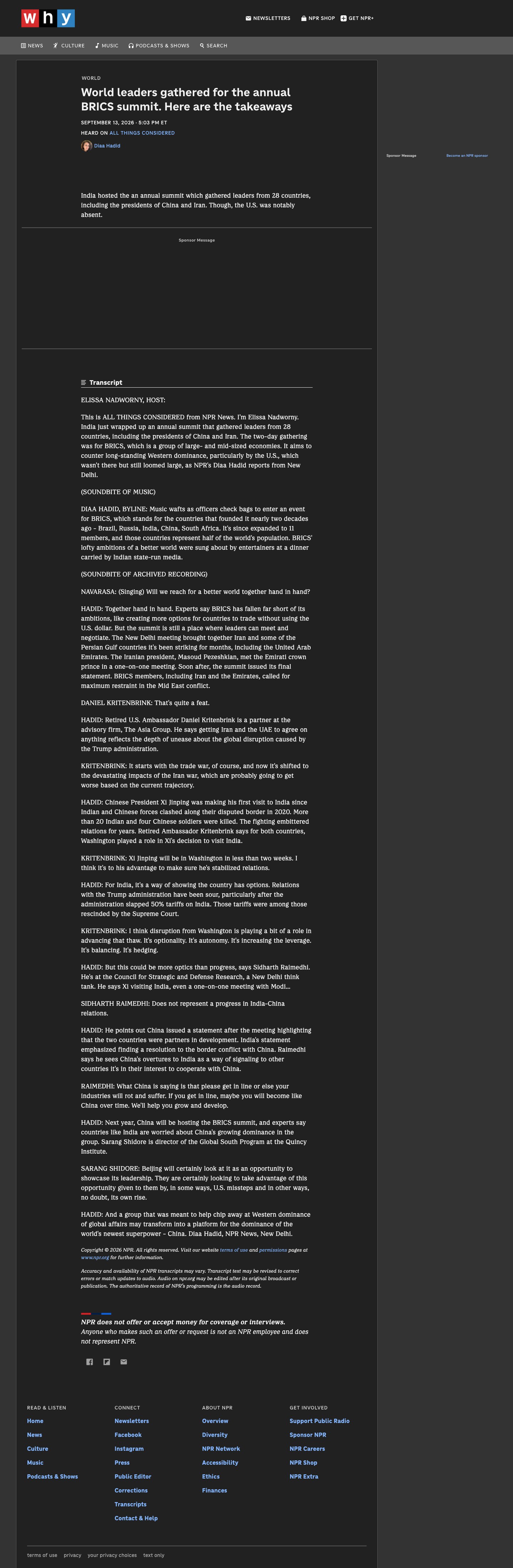
| tl;dr | The article reports that India hosted a BRICS summit focused on diplomacy amid trade tensions and Middle East conflict. It highlights an Iran–UAE meeting, renewed India–China engagement, and calls for restraint. Analysts suggest U.S. policies are encouraging countries to seek alternatives, while unresolved border disputes limit India–China cooperation. The report concludes that China could increasingly dominate BRICS, despite the group’s limited progress toward goals such as reducing reliance on the U.S. dollar. | ||||
| deeper: | The report includes named experts, historical context, and skepticism about BRICS’ achievements. Its geopolitical outlook does not clearly favor a left- or right-wing agenda. However, repeated emphasis on U.S. disruption and China’s dominance narrows the framing, with little direct response from those governments. Some dramatic interpretations receive limited scrutiny. There are factual imprecisions: South Africa joined later rather than founding the original group, and the established Indian death toll in the 2020 border clash was 20, not more than 20. The screenshot alone cannot authenticate its major event claims. | ||||
media: | |||||
| gen: 2026/09/13:15:25 in 41.5 sec (old)bias: 3 (Center) |
| type: newsquality: 57 |
| pts: 0 |
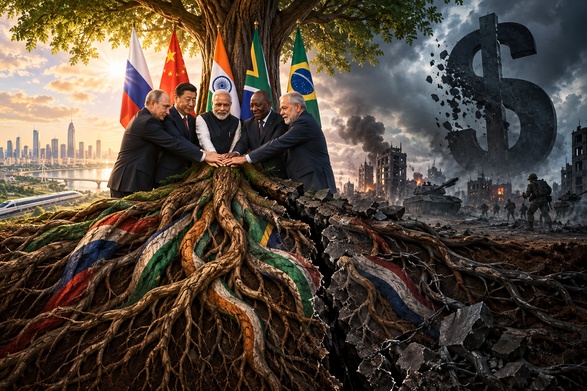
 | author: | Diaa Hadid, Scott Simon | institution: | NPR | ¿porque no los dos? |
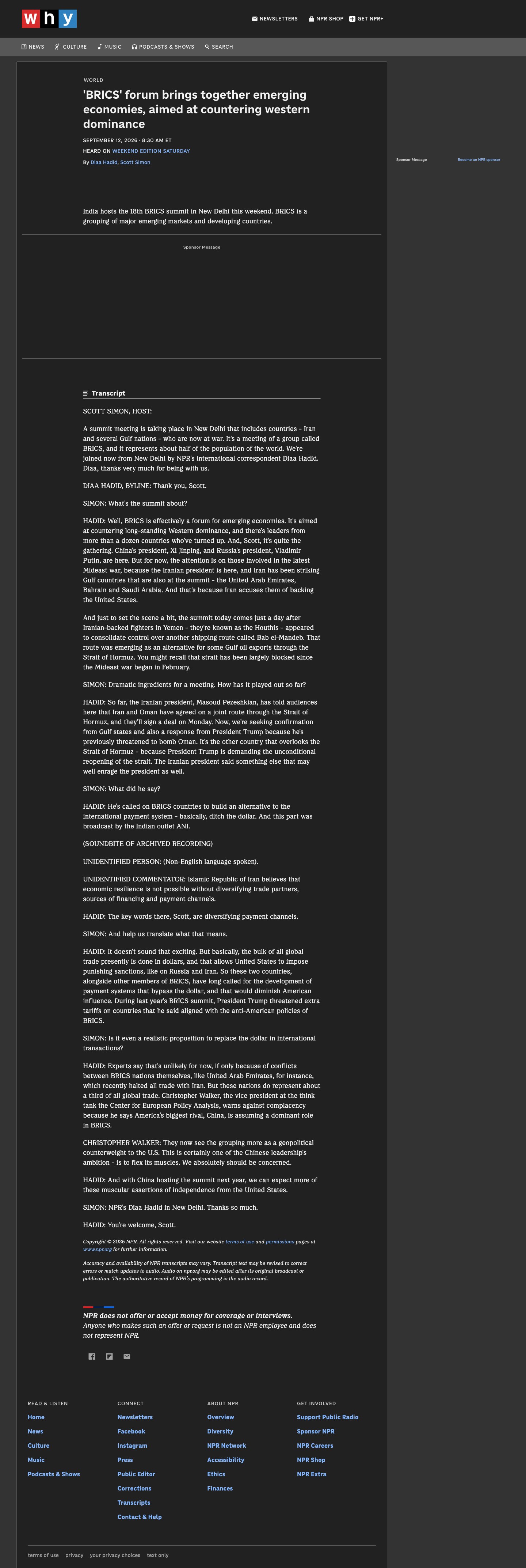
| tl;dr | The article describes a BRICS summit in New Delhi focused on Middle East conflict and efforts to reduce reliance on the U.S. dollar. It reports Iran’s announcement of a proposed shipping arrangement with Oman and calls for alternative payment channels. Internal disputes among BRICS members are presented as obstacles to replacing the dollar, while an analyst warns of China’s growing influence. Significant claims about warfare, shipping disruptions and U.S. threats are presented but cannot be independently verified from the screenshots. | ||||
| deeper: | The report explains financial issues accessibly, attributes Iran’s proposed deal and acknowledges that confirmation is pending. However, major claims about attacks, trade restrictions and threats to bomb Oman lack supporting evidence in the text. Its U.S.-centered framing and closing warning about China favor a security-threat perspective, without a clear left/right agenda. Phrases such as “enrage the president” introduce speculation. One analyst supplies the main outside assessment, and “ditch the dollar” oversimplifies the quoted call to diversify payment channels. | ||||
media: | |||||
| gen: 2026/08/11:02:40 in 53.8 sec (old)bias: 5 (Unknown) |
| type: newsquality: 25 |
| pts: 0 |

 | author: | Unknown | institution: | Unknown | ¿porque no los dos? |
| tl;dr | The provided image is a very low-resolution, tall screenshot of a dark-themed news page labeled “INDIA,” showing multiple story blocks and photos, but the article text is not legible enough to reliably extract the main claims, evidence, or framing. Because the actual wording and specifics can’t be read, only limited analysis is possible beyond noting the layout and use of multiple images and short story sections. | ||||
| deeper: | The screenshot resolution is too low to read headlines, quotes, numbers, sourcing, or even clearly identify a single “main” article versus several items. Without legible text, it’s not possible to judge whether the reporting uses loaded language, omits key context, or relies on strong evidence. The page appears to be a multi-story section (not one clearly dominant article), which further limits assessment. Share a higher-resolution image or the URL for a meaningful bias/quality review. | ||||
media: | |||||
| gen: 2026/08/09:13:26 in 49.0 sec (old)bias: 3 (Center-Left) |
| type: newsquality: 82 |
| pts: 0 |


| gen: 2026/07/18:14:59 in 48.0 sec (old)bias: 2 (Center) |
| type: newsquality: 88 |
| pts: 0 |
 | author: | Reuters | institution: | ABC News (Australia) | ¿porque no los dos? |
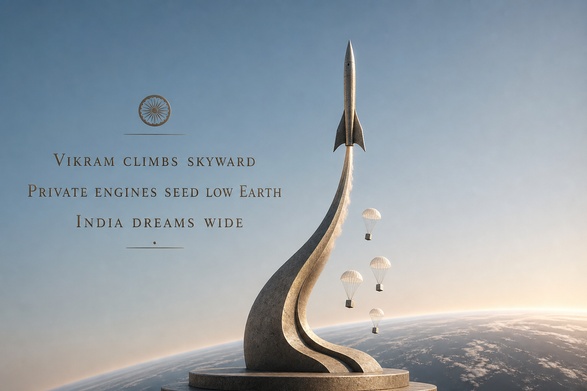
| tl;dr | A Reuters-sourced ABC News piece reports that Indian startup Skyroot Aerospace launched its Vikram‑1 rocket, marking India’s first private orbital rocket mission. The four-stage solid-fuel launcher lifted off from the Satish Dhawan Space Centre, aiming to place small satellites into low Earth orbit and signaling India’s opening to private participation in space since 2020. The article outlines Skyroot’s background, the mission’s objectives, and the broader implications for India’s commercial space sector. | ||||
| deeper: | The tone is straight newswire: factual, restrained, and focused on verifiable events (launch details, company background, sector context). It avoids loaded language and offers no partisan framing, hence low bias and Center direction. Quality is high due to clear sourcing (Reuters via ABC), specific technical/contextual details (private-sector opening in 2020, solid-fuel stages, intended orbit, company founders/investors), and absence of speculation beyond stated goals. Minor gaps include limited independent technical verification (typical for breaking launch coverage) and sparse discussion of payload customers and post-launch confirmation, which keeps it short of top-tier depth. | ||||
media: | |||||
You made it to the bottom. Now dance!


owned and operated by: RPN Omnigalactic Insitutution as of: 2026/10/14: 06:50 in 0 ms
Enter Code
Login with Account