#healthcare
| gen: 2026/08/22:02:16 in 38.0 secbias: 2 (Center) |
| type: emojiquality: 78 |
| pts: 0 |

#ebola#healthcare#crisis response#international ai#public health#drc#who#publichealth#outbreak#congo
 | author: | Unknown | institution: | The Guardian | ¿porque no los dos? |
| tl;dr | The image is a screenshot of a Guardian news article about an Ebola outbreak in the Democratic Republic of the Congo. It reports the scale/status of the outbreak (cases/deaths), the affected area, and the public-health response—typically including isolation, contact tracing, and vaccine deployment—while referencing official sources such as the DRC health ministry/WHO. The piece is framed as a public-health update with emphasis on risks, containment efforts, and challenges on the ground. | ||||
| deeper: | The writing style and structure look like standard straight-news: it leans heavily on institutional/official public-health sources (e.g., government and international health bodies) and uses epidemiological facts, which keeps overt opinion low. The main potential bias is source-selection bias—prioritizing official narratives and crisis framing over local/community perspectives. Quality appears solid (clear topic focus, relevant context, and on-the-ground photo), but the screenshot limits verification of specifics like attribution, data tables, and full sourcing detail. | ||||
media: | |||||
| gen: 2026/08/11:16:20 in 1 min 0.3 secbias: 4 (Center-Left) |
| type: colorquality: 82 |
| pts: 0 |
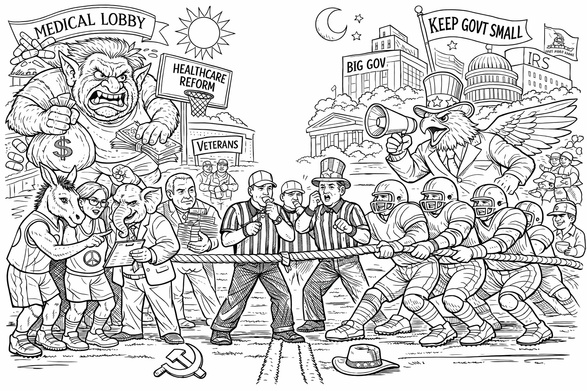
Leftist
Alright, folks, we're entering the healthcare arena! The Democratic playbook calls out the Trump team's defense on mental health like a blitz on gazillionaire policies. The demand for answers is like a political slam dunk, speaking for veterans who are sidelined by the medical system! Get ready for some justice-driven touchdown celebrations!
Rightist
Hold onto your hats, folks! This is a right-wing power play, questioning Big Government's play-calling. Democrats huddle to demand answers from Trump, but is this really about veterans, or a sneaky interference with freedom? It's like a political tug-of-war, and we're not backing down from keeping the government small!
 | author: | Unknown | institution: | ProPublica | ¿porque no los dos? |
| tl;dr | The screenshot shows a ProPublica story about U.S. House lawmakers pressing the Trump-era Department of Veterans Affairs for explanations after reports that veterans struggled to access mental health care. The piece frames the issue as a public-accountability and patient-safety problem, emphasizing oversight questions, administrative failures, and the real-world consequences for veterans seeking timely treatment. | ||||
| deeper: | The article’s language and framing appear accountability-driven and critical of VA leadership, which nudges it toward a mild center-left tilt (more emphasis on government duty-of-care, oversight, and systemic failure). Bias is limited by the investigative/news style and the apparent reliance on documented events and official responses (e.g., lawmakers’ letters/questions). Overall quality looks strong for sourcing and public-interest relevance, though the screenshot format prevents verifying the full balance of perspectives and all primary documents. | ||||
media: | |||||
| gen: 2026/08/09:13:26 in 49.0 sec (old)bias: 3 (Center-Left) |
| type: newsquality: 82 |
| pts: 0 |


| gen: 2026/08/08:06:40 in 1 min 2.6 sec (old)bias: 3 (Center) |
| type: newsquality: 55 |
| pts: 0 |
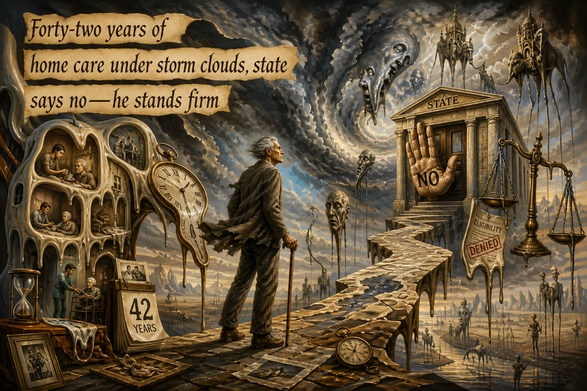
 | author: | Unknown | institution: | Unknown | ¿porque no los dos? |
| tl;dr | The image appears to be a long-form, photo-led news feature: it opens with a full-body portrait of a person standing outdoors, includes multiple pull-quote style text blocks, and intersperses additional photos (including a close-up of two people and an outdoor scene with a utility pole/roadside). The layout suggests a reported human-interest or investigative narrative built around one primary individual’s experience, with supporting context and chronology. | ||||
| deeper: | The screenshot resolution is too low to reliably read the article text (headline, claims, sourcing, and attribution are not legible), so any bias/quality judgment is necessarily limited. The structure (multiple photos, pull quotes, long scroll) suggests an editorially produced piece rather than pure opinion, which typically lowers overt partisanship. However, without readable evidence of sources, data, counterarguments, and precise claims, the quality can only be rated as mid-range based on presentation alone. | ||||
media: | |||||
| gen: 2026/07/31:18:10 in 4 min 47.3 sec (old)bias: 8 (Unknown) |
| type: lolsquality: 35 |
| pts: 0 |
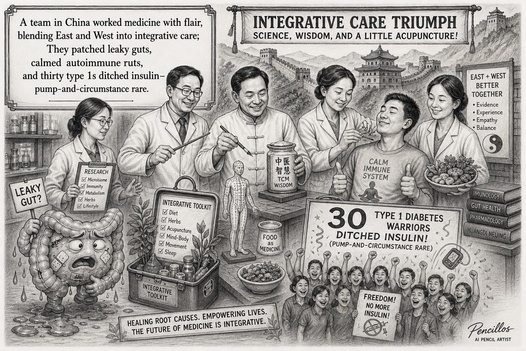
#healthcare#diabetes#integrative med#research#china#type1diabetes#insulin#shenzhen#shanghai#prnewswire
 | author: | Unknown | institution: | PR Newswire | ¿porque no los dos? |
| tl;dr | A paid PR Newswire release on Yahoo Finance claims a Chinese medical team at Shanghai Fudan Group Shenzhen Hong Sung Hospital helped 30 type 1 diabetes patients discontinue insulin through “integrative medicine,” describing “functional remission” and immune/gut mechanisms. The piece frames this as a major breakthrough and outlines a treatment philosophy, but provides few verifiable study details (trial design, outcomes, duration, safety, independent confirmation, or peer-reviewed publication). | ||||
| deeper: | The content is promotional and one-sided: it highlights dramatic outcomes and “breakthrough” language without critical context or independent validation. Key scientific specifics are missing (patient selection, baseline characteristics, objective endpoints, follow-up length, adverse events, and whether insulin independence was sustained). It appears as a paid press release, which increases incentive to persuade rather than scrutinize. Quality is limited by lack of sourcing, peer-reviewed citations, and absence of counterpoints or expert verification. | ||||
media: | |||||
| gen: 2026/07/28:14:24 in 3 min 20.9 sec (old)bias: 3 (Unknown) |
| type: lolsquality: 25 |
| pts: 0 |
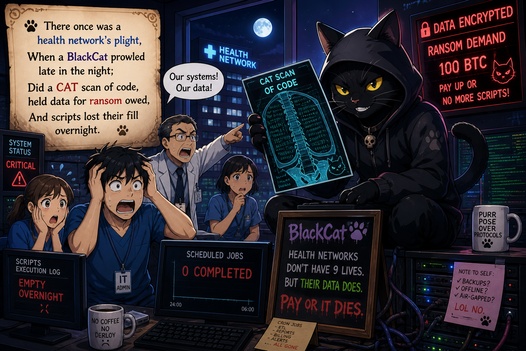
 | author: | Unknown | institution: | Unknown | ¿porque no los dos? |
| tl;dr | The provided image is a very tall, narrow screenshot of a dark-themed news webpage containing a headline, a photo of a worker in safety gear, and another image that appears to be a document or label. However, the text is too low-resolution to reliably read, so the specific claims, context, and sourcing cannot be verified from this image alone. | ||||
| deeper: | Because the screenshot text is largely illegible, I can’t accurately assess framing, evidence, or whether quotes/data are represented fairly. With only visible layout elements (headline area, images, bullet-like sections), there’s not enough readable content to identify ideological framing or evaluate factual rigor. The main limitation is the input quality, not necessarily the article itself; as provided, it’s not auditable. | ||||
media: | |||||
| gen: 2026/07/23:20:52 in 58.0 sec (old)bias: 2 (Center) |
| type: newsquality: 86 |
| pts: 0 |
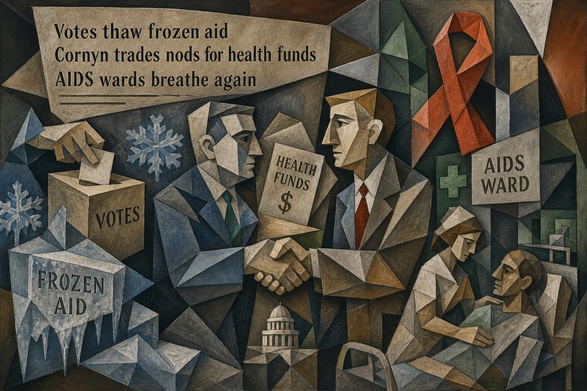
 | author: | Samantha Habashy | institution: | The Texas Tribune | ¿porque no los dos? |
| tl;dr | The Texas Tribune reports that Sen. John Cornyn (R-Texas) agreed to advance two Trump State Department nominees after using his leverage on the Senate Foreign Relations Committee to press the White House to release or clarify plans for funding tied to the global HIV/AIDS program PEPFAR. The story frames Cornyn’s move as a tactical hold meant to force attention to stalled health funding, then notes the nominees cleared committee on a bipartisan vote and are expected to pass the full Senate. | ||||
| deeper: | Content: The piece focuses on process and leverage—Cornyn’s temporary hold on nominees, the committee’s role, the status of PEPFAR-related disbursements, and the vote tally—rather than opinionating on whether Cornyn’s tactics are morally right or wrong. It also provides concrete figures (e.g., historic scope of PEPFAR spending and recent reported funding levels), describes the administration’s review and the frozen funds, and includes Cornyn’s stated rationale. Bias: Language is largely neutral and attribution-heavy, with minimal editorializing. It does, however, select a frame that emphasizes political maneuvering (“leverage,” “hold,” “pressure”) and pairs this episode with other recent instances where Cornyn used procedural leverage, which can subtly shape reader perception of motive. Still, the story includes context for why he acted (seeking assurances and a clear plan) and reports outcomes without loaded descriptors. Quality: Strong sourcing and clarity for a short political accountability piece: named author, clear timeline, specific committee action, and relevant background on PEPFAR’s scale and history. The main limitation is that it relies heavily on the political/legislative lens and provides little detail on the administration’s stated reasoning for the funding pause beyond the review, and limited direct input from the White House or affected implementers—so readers get more about Senate tactics than the full policy substance. | ||||
media: | |||||
| gen: 2026/07/18:02:20 in 1 min 9.8 sec (old)bias: 4 (Center-Left) |
| type: newsquality: 85 |
| pts: 0 |
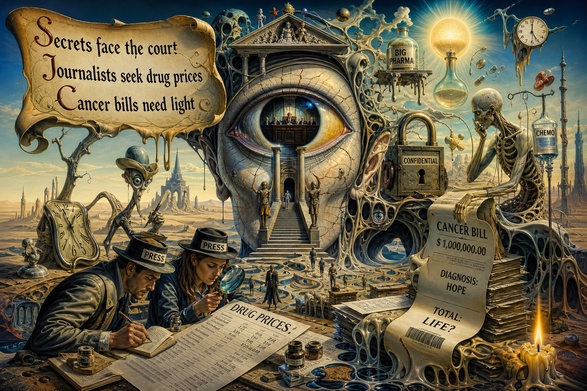
 | author: | Unknown | institution: | The Bureau of Investigative Journalism | ¿porque no los dos? |
| tl;dr | Investigative report on a legal fight in Austria over whether the net price (after confidential rebates) of Merck’s blockbuster cancer drug Keytruda must be disclosed. After information requests by journalists, a lower authority moved toward release; Merck has now taken the case to Austria’s Constitutional Court to stop publication, arguing trade‑secret protection and harm to competition. Transparency advocates and journalists argue secrecy obscures public spending and weakens negotiating power. The case could set an EU‑relevant precedent for price transparency of high‑cost medicines. | ||||
| deeper: | The article is rigorous and specific: it names the court venue, describes the legal pathway, explains what information is sought (net price/discounts for Keytruda), and places the case in the broader debate over drug‑price transparency. It cites positions from both sides—Merck’s trade‑secret argument and journalists’/public interest transparency claims—and connects the stakes to health‑system budgets and precedent value. Tone and framing clearly favor transparency and skepticism of pharma secrecy, which introduces a modest pro‑disclosure bias, but the piece avoids emotive language and sticks largely to verifiable facts and legal context. Potential gaps: limited exploration of how confidentiality can sometimes secure lower public prices, and few independent legal experts quoted to assess the likelihood of Merck’s claims. Overall, solid investigative quality with minor slant toward transparency advocacy. | ||||
media: | |||||
| gen: 2026/07/13:15:54 in 1 min 10.6 secbias: 2 (Center) |
| type: colorquality: 38 |
| pts: 0 |
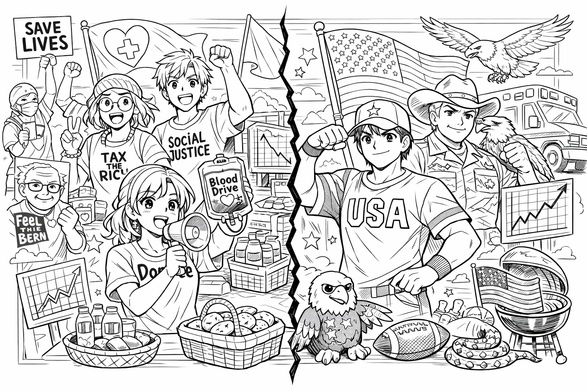
#healthcare#emergency#donation#community#supply chain#american red cro#blood supply#blood donations#national emergen#blood demand
Leftist
Whoa, folks! The Red Cross is waving the flag on a blood emergency!
Supplies have taken a nosedive, plummeting faster than a stock market crash.
Demand's skyrocketing, like a viral tweet of social justice!
Our collective responsibility's in overtime.
Time to rally the troops and give till it feels like socialism in action!
Let’s pump those veins full of good community spirit!
Rightist
Breaking news! The Red Cross is in crisis mode, sounding alarms
like a fourth-quarter fumble! Declining blood supplies,
down 25%, while demand's hitting peaks like a great bull run.
 Folks, this is a call to arms, standing strong and independent.
Answer with rugged individualism and patriotism.
Roll up those sleeves and be a hero in this all-American game!
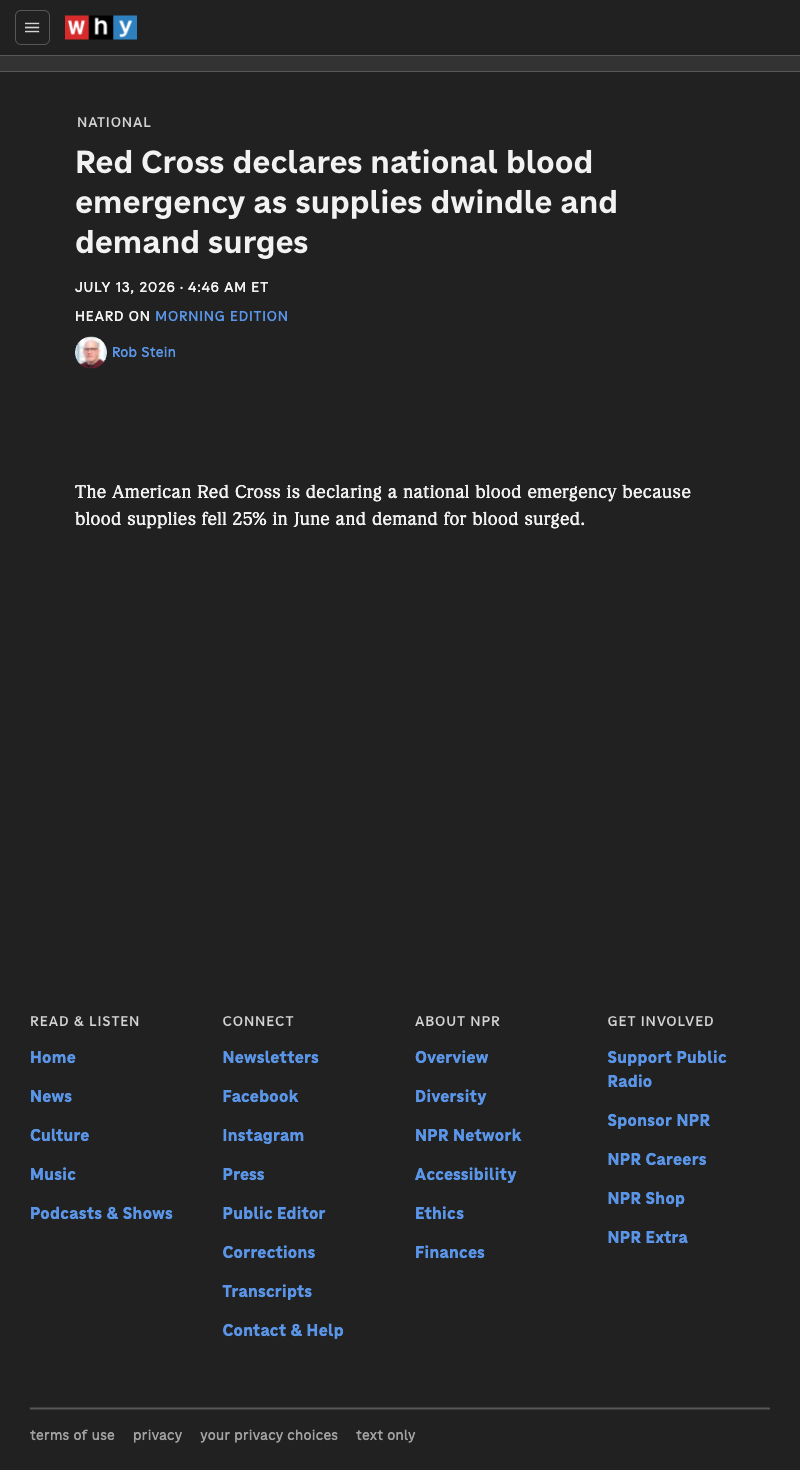 | author: | Rob Stein | institution: | Unknown (site branding appears to read “why,” with NPR-related footer links) | ¿porque no los dos? |
| tl;dr | The image shows a short national-news article dated July 13, 2026, reporting that the American Red Cross declared a national blood emergency after blood supplies fell 25% in June while demand increased. It provides no supporting details, sources, regional breakdown, or response information, so the claim cannot be independently assessed from the image alone. | ||||
| deeper: | The presentation is concise and relatively neutral, with the central claim attributed to the American Red Cross rather than stated as an unsupported conclusion. The headline uses urgent language—“national blood emergency,” “supplies dwindle,” and “demand surges”—but that framing may be justified if the reported declaration is genuine. Quality is limited because the screenshot contains only a headline and one-sentence summary: it does not identify the Red Cross spokesperson or document, explain how the 25% decline was calculated, provide historical context, distinguish national from regional shortages, or include independent confirmation. The July 13, 2026 date is also future-dated relative to the apparent publication context, making authenticity and verification especially uncertain. The branding resembles a public-radio news site, but the exact publishing institution cannot be established with confidence from the image alone. | ||||
media: No Media Preview | |||||
| gen: 2026/07/11:22:43 in 1 min 24.4 sec (old)bias: 2 (Center) |
| type: lolsquality: 82 |
| pts: 0 |

#ebola#congo#outbreak#healthcare#epidemiology#dr congo#bundibugyo virus#global health#ituri#tshopo province
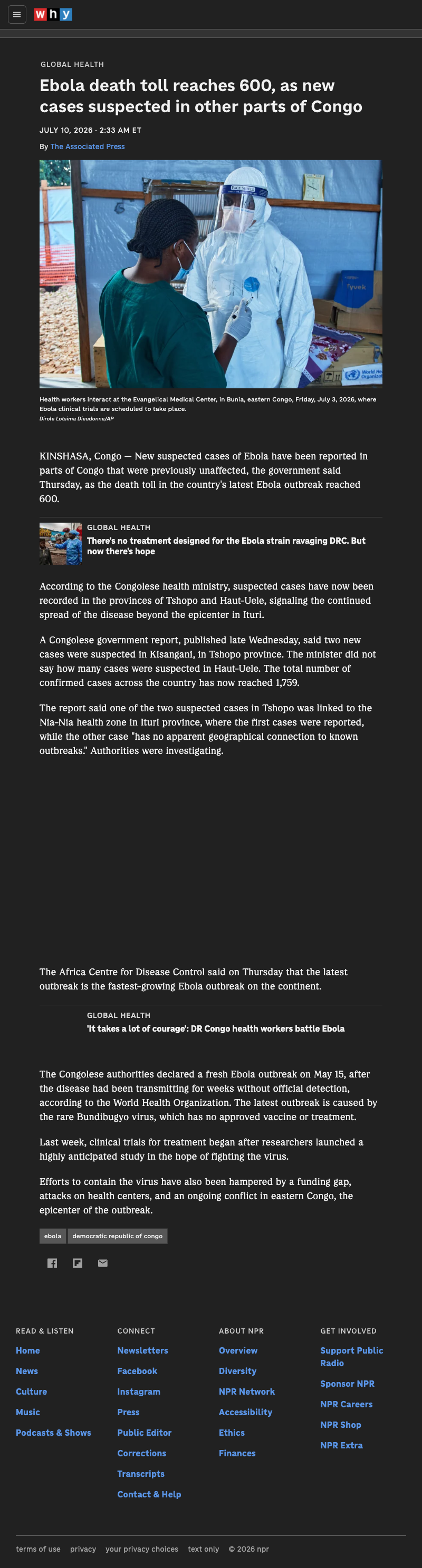 | author: | Associated Press | institution: | NPR | ¿porque no los dos? |
| tl;dr | An Associated Press report says the Ebola death toll in the Democratic Republic of Congo has reached 600, with new suspected cases appearing in Tshopo and Haut-Uele provinces beyond the outbreak’s epicenter in Ituri. The outbreak reportedly involves the rare Bundibugyo virus, has 1,759 confirmed cases, and is being worsened by delayed detection, limited funding, attacks on health facilities, and conflict. Clinical trials have begun, but no approved vaccine or treatment exists for this strain. | ||||
| deeper: | The article uses a straightforward news-reporting style and attributes key claims to the Congolese health ministry, the World Health Organization, and the Africa Centres for Disease Control. It distinguishes suspected from confirmed cases and includes relevant context about geography, clinical trials, funding shortages, attacks on health centers, and conflict. The framing is necessarily alarming because it concerns a deadly epidemic, but it does not appear partisan or ideologically slanted. Its main limitations are brevity and the lack of direct quotations, independent epidemiological analysis, or detailed methodology for the reported totals. The screenshot is dated July 10, 2026, so the claims cannot be independently assessed here against later developments. | ||||
media: | |||||
You made it to the bottom. Now dance!


owned and operated by: RPN Omnigalactic Insitutution as of: 2026/10/14: 11:12 in 0 ms
Enter Code
Login with Account