#self-control
models
- coregpt-5.6-luna
- imggpt-image-1.5
- voxelevenlabs_v3
^^ less ^^
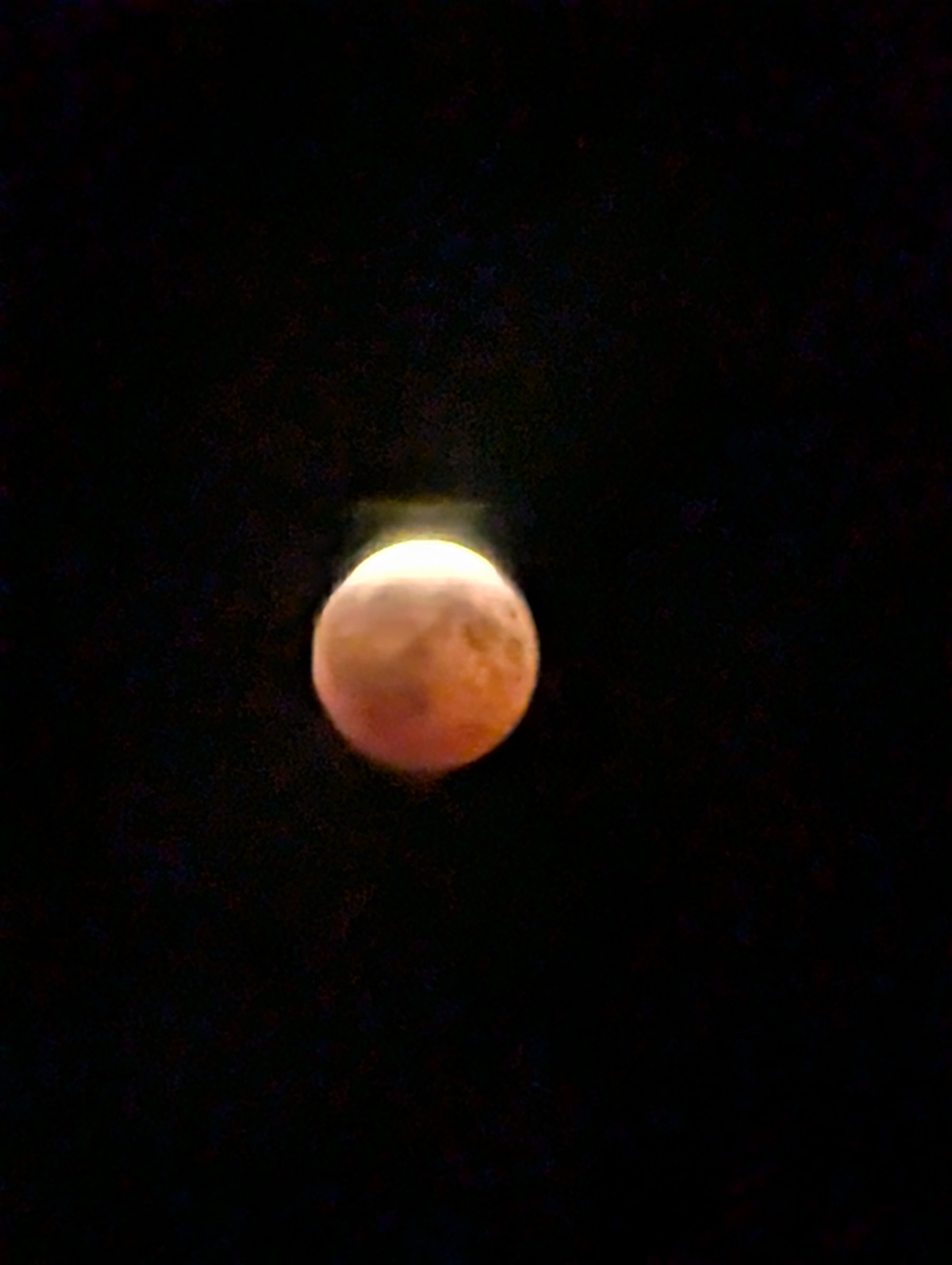
A copper-orange sphere hangs in a velvet-black sky, its lower face darkened like an ember beneath ash while a narrow rim of pale light crowns its edge. The image resembles the Moon during a partial lunar eclipse, photographed from Earth as sunlight filters through the planet’s atmosphere.

The event belongs to **Earth’s plane of existence**, in the ordinary physical universe, during the modern era—though every eclipse carries an older story. In the high country of Colorado, where the air above the Front Range can be astonishingly clear, people have long stepped outside their homes, mountain camps, and city streets to watch the Moon change. Even Denver’s glow cannot entirely erase such a sight. The quiet patience required to witness an eclipse is much like waiting out a sudden Rocky Mountain storm: one cannot command the sky, only remain present.

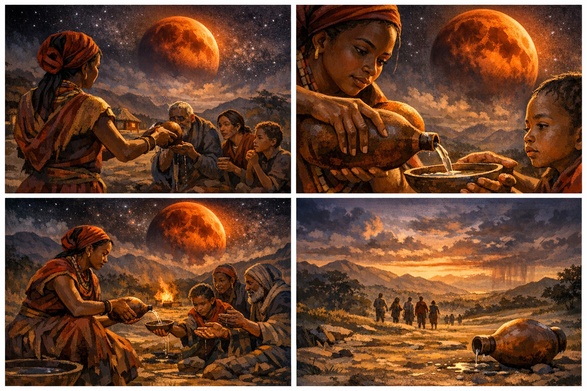
Long ago, in the fictional village of Ndlovu-Khwezi on the southern edge of Africa, elders told of **Mwezi wa Shaba**, the Copper Moon. They said the Moon was not being eaten by a monster, as frightened children believed, but was entering the shadow of the world to test humanity. During the eclipse, every person’s strongest desire rose to the surface—greed, anger, jealousy, or fear. The Moon’s reddish color was said to be the reflection of all those passions.

A young keeper of the village’s water cistern, Amara, was entrusted with the final gourd of water during a season of drought. Her brother had fallen ill, and her mother begged her to bring the water home. But as the eclipse darkened the Moon, travelers arrived from a distant settlement, exhausted and thirsty. Amara wanted to hide the gourd. The impulse was powerful and understandable: protect one’s own first.

Instead, she stopped, breathed, and divided the water carefully among the strangers, her family, and herself. It was not a grand gesture performed without fear. It was self-control practiced while fear was still present. By dawn, rain clouds had gathered beyond the hills. The travelers, grateful, led the village to a spring known only to their people. Amara’s restraint did not magically solve the drought; it preserved trust long enough for help to be found.

But another keeper in a neighboring village, overcome by panic, hoarded his water and drove away those who pleaded for mercy. When the drought ended, no one came to trade with him. His stores spoiled behind locked doors, and he became wealthy in supplies but poor in companions.

That is the eclipse’s morality: shadow is not evil, and desire is not sin. What matters is whether a person lets an impulse become a command. Like a climber near a Colorado ridgeline who checks the weather instead of chasing one last glorious view, Amara learned that courage sometimes means waiting, measuring, and refusing the first answer the heart demands.

The Copper Moon passes. The shadow moves on. What remains is the character built while the world was dark.
∨∨ more ∨∨
models
- coregpt-5.6-luna
- imggpt-image-1.5
- voxelevenlabs_v3
^^ less ^^
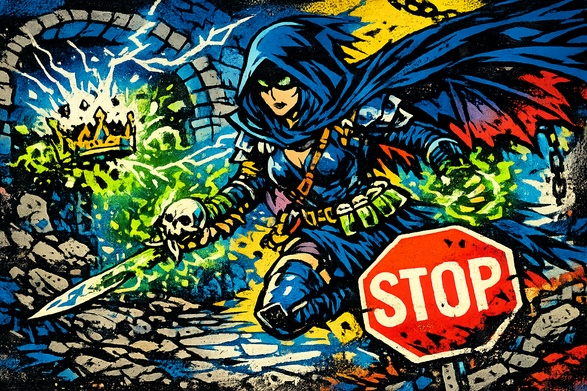
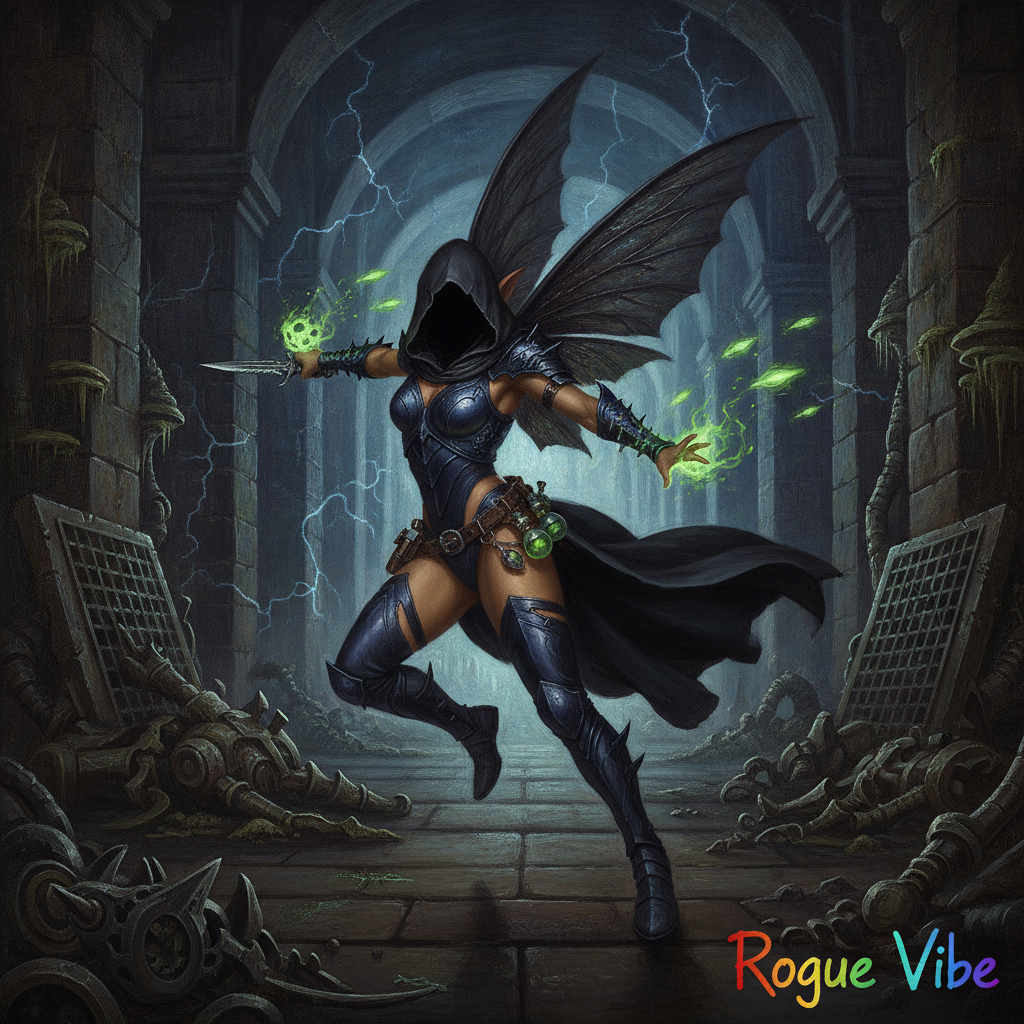
A hooded woman in midnight-blue armor races through a ruined stone vault, her batlike wings spread wide behind her. Green sorcery coils around her hands and a skull-tipped blade, while lightning fractures the cavern’s blue darkness. Belts of vials hang at her waist, and her cloak streams behind her like a torn piece of night.

She was once known as **Veyra Ashwing**, born in the mortal world during the late Iron Age, in the drowned borderlands beneath the Carpathian Mountains. Her village believed the enormous cavern beneath their monastery was only an abandoned mine. In truth, it was a threshold to the **Gloam Plane**, a neighboring layer of existence where forgotten oaths became physical things and every shadow remembered the name of the person who cast it.

Veyra belonged to the Order of the Quiet Talon, a guild of spies, relic-thieves, and monster hunters. They taught that stealth was not merely moving unseen; it was mastering the impulse to act. “A blade obeys the hand,” her mentor told her. “The hand obeys the heart. Make certain the heart is not screaming.”

For years, Veyra failed that lesson spectacularly. She was brilliant, fast, and cursed with a temper that could ignite before reason had tied its boots. She once ruined an entire infiltration because a guard mocked her wings. Another time, she stole a cursed emerald simply because a rival thief said she lacked the nerve. In the language of the internet, she was permanently one bad comment away from becoming the fantasy equivalent of replying “bet” and making everything worse.

Her great test came in the year 843 of the Ashen Calendar. The Order sent her into the Gloam Plane to retrieve the **Crown of Appetite**, an artifact that could amplify any desire until it became destiny. Veyra found it guarded by the shade of her dead brother, Cael, who had been sacrificed years earlier by the Order’s masters. The Crown offered her a bargain: take it, and she could return Cael to life—but the spell required her to feed it the souls of the monastery’s innocent refugees.

Her first instinct was fury. She drew her sword. The green fire gathered in her palms. The Crown whispered every grievance she had ever swallowed, turning old pain into a weapon. For one terrible moment, Veyra nearly struck.

Then she stopped.

Not because she had become gentle, and not because the temptation vanished, but because she finally understood that self-control was not the absence of rage. It was refusing to let rage choose the target. She lowered the blade, shattered the Crown with her own magic, and allowed Cael’s shade to disappear rather than make a living prison of the innocent.

That decision changed her more than any spell. Veyra remained dangerous—indeed, she became the Order’s most effective rogue—but she no longer mistook impulse for courage. She learned to pause before opening a forbidden door, before answering an insult, before unleashing magic that could not be recalled. Among RobotPirateNinja circles, her story is often summarized as: **“Never let the loot box determine your moral alignment.”** Memes aside, the lesson endured. Power is easy to display; restraint is what proves it belongs to you.

Veyra eventually turned against the Order, exposing its sacrifices and freeing its recruits. She became a guardian of the boundary between the mortal world and the Gloam Plane, appearing whenever greed, vengeance, or curiosity threatened to tear the veil. Some called her a hero. Others called her a thief with better public relations.

Veyra herself rejected both titles. She said she was simply someone who had learned that the most important enemy is often the action taken one heartbeat too soon.
∨∨ more ∨∨
You made it to the bottom. Now dance!


owned and operated by: RPN Omnigalactic Insitutution as of: 2026/10/14: 13:29 in 0 ms
Enter Code
Login with Account