| gen: 2026/10/14:15:18 in 58.8 sec (-1d)bias: 4 (Center-Left) |
| type: eli5quality: 78 |
| pts: 0 |
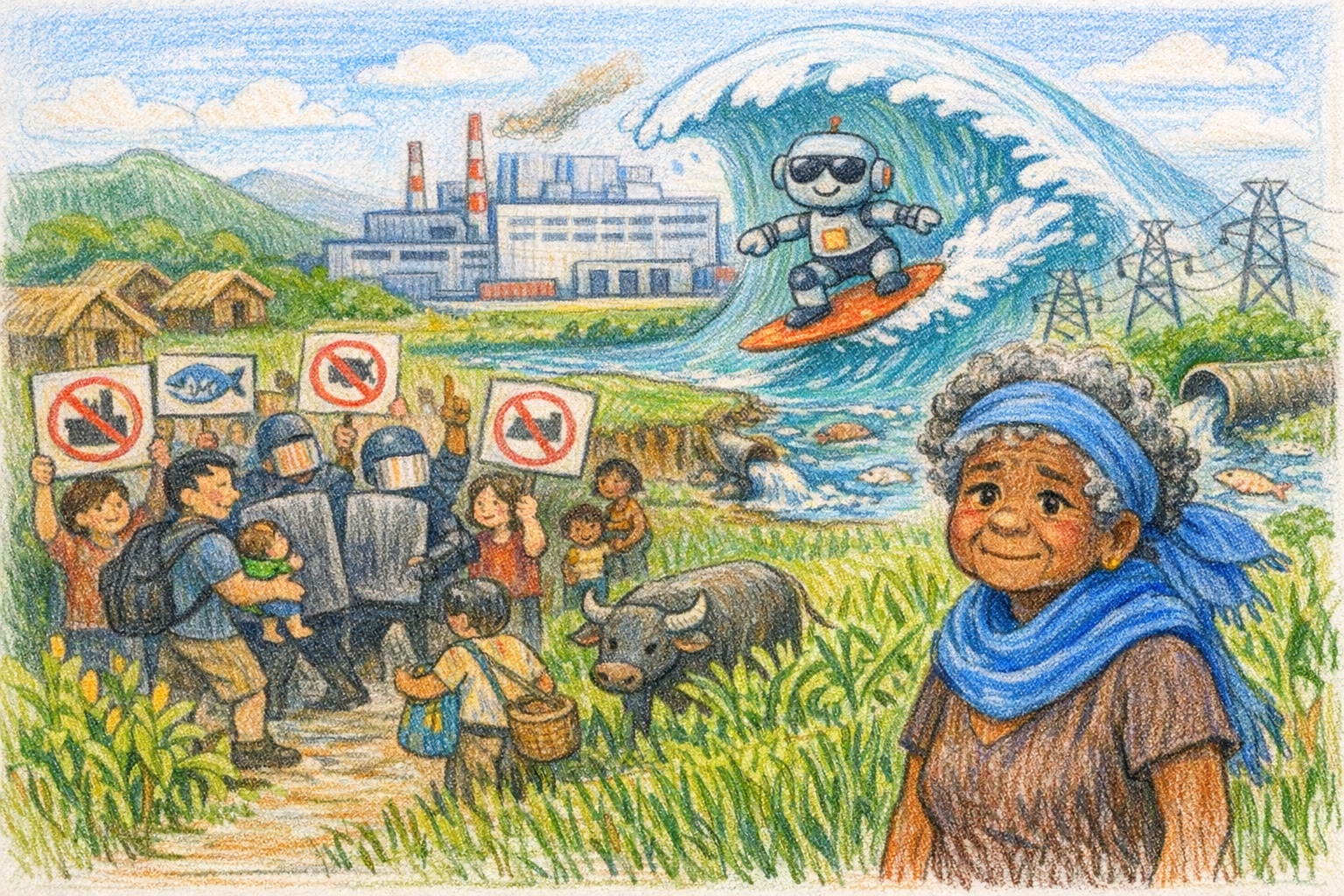
Leaders in the Philippines and the United States want to build a huge place for making tiny computer parts, including ones used for AI—computers that learn patterns. The plan is part of **Pax Silica**. Leaders say it could help the country earn money.

But Aeta families, whose ancestors lived on this land long ago, worry about losing their homes and farms. Gloria, an elder wearing a bright blue scarf in a green field, says families have already been told to leave. Officials say nobody will have to move.

The factories would need lots of water and electricity. People worry there may not be enough for farms and homes, and that factory waste could harm nature. Hundreds protested, and some people were hurt during clashes with police.

“Ride the AI wave” means joining the excitement about AI—not surfing on a real wave!
 | author: | Michael Beltran | institution: | Mongabay; republished by Grist through the Indigenous News Alliance | ¿porque no los dos? |
| tl;dr | The article examines a planned U.S.-linked technology hub in the Philippines under Pax Silica. Officials promote investment and semiconductor development, while Indigenous Aeta communities and environmental advocates fear displacement, heavy water and electricity demand, and pollution. Reporting contrasts government assurances with residents’ testimony and research on overlapping ancestral land claims. It also describes protest clashes, uncertainty about the project’s infrastructure, and decades-long obstacles to securing Indigenous land titles. | ||||
| deeper: | The article prioritizes Indigenous land rights, environmental protection, and community welfare, giving it a center-left emphasis. Critics receive more space and the emotionally forceful closing quotation, but officials’ economic arguments and denials are included. Named interviews, linked sources, historical context, and quantified resource estimates strengthen the reporting. Limitations include little independent technical scrutiny of projected resource demands, limited analysis of economic benefits, and an oversimplified explanation of Indigenous land rights. The screenshots alone do not independently verify the reported events. | ||||
media: | |||||
Please log in to comment