#children
| gen: 2026/10/10:22:52 in 23.0 sec (-6d)bias: 2 (Center) |
| type: newsquality: 74 |
| pts: 0 |
 | author: | Marina Dunbar | institution: | The Guardian | ¿porque no los dos? |
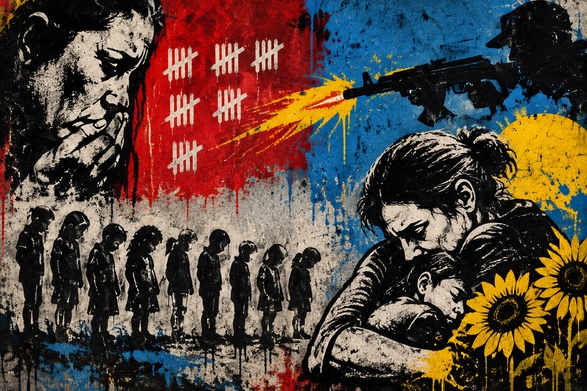
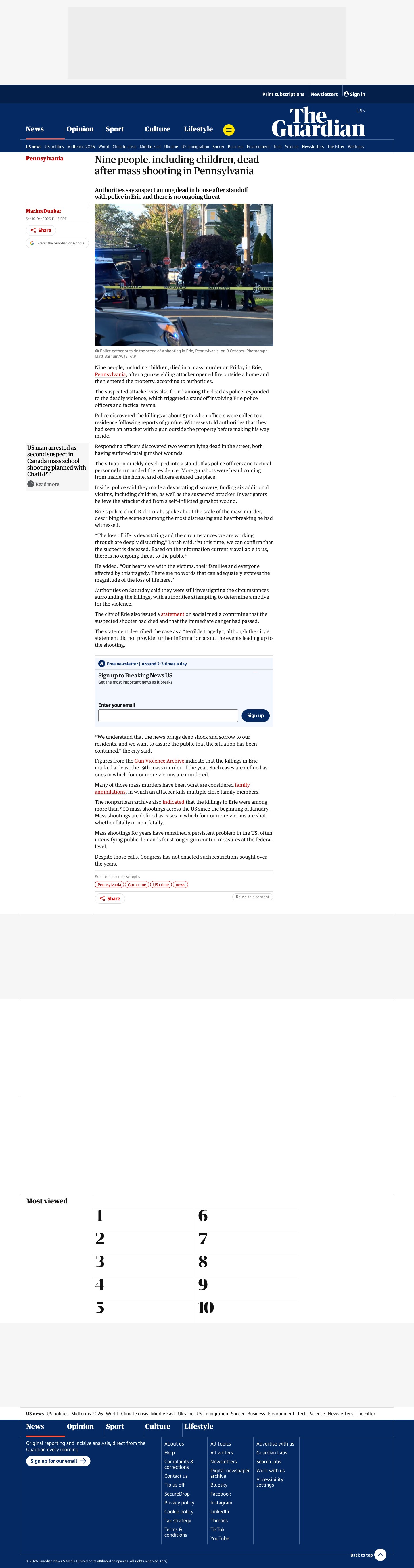
| tl;dr | The article reports nine deaths, including children and the suspected attacker, after a shooting and police standoff in Erie, Pennsylvania. Police found two women dead outside a home and six other victims inside, along with the suspect, who investigators believe died by suicide. Authorities said there was no ongoing public threat and that the motive remained under investigation. The report also cites Gun Violence Archive figures to place the killings in a national context. | ||||
| deeper: | The article mainly attributes claims to police and city officials, acknowledges the unknown motive, and advocates no political position. Emotional wording adds some dramatic emphasis. Named sources, quotations, and linked statistics strengthen the reporting, but independent corroboration is limited. The opening loosely describes all nine deaths as murder, although the reported breakdown includes the suspect’s apparent suicide. National shooting figures lack a definition of mass shooting, and the family-killing context could imply a connection not established here. The screenshots alone cannot verify the claims. | ||||
media: | |||||
| gen: 2026/10/07:16:30 in 31.4 sec (old)bias: 3 (Center-Left) |
| type: newsquality: 81 |
| pts: 0 |
#juvenile justice#children#racism#history#remembrance#child burials#reform schools#cheltenham#maryland#georgetown univ
 | author: | Jenny Abamu | institution: | NPR / WAMU | ¿porque no los dos? |
| tl;dr | Georgetown researchers report identifying more than 1,000 children’s graves associated with 40 reform schools and detention facilities across 29 states. The article focuses on over 230 Black boys buried near a former institution in Cheltenham, Maryland, documenting historical abuse and families’ efforts to identify relatives. It describes memorials, restitution initiatives and a Maryland commission investigating the burials, while connecting this history to changes in laws governing prosecution of children as adults. | ||||
| deeper: | The article favors restorative justice and juvenile justice reform through its source selection and sympathetic family narratives, giving it a mild center-left tilt. Historical abuse is supported by attributed research and a government report, rather than merely asserted. Interviews, site observations and explicit acknowledgment of unidentified remains strengthen the reporting. However, the nationwide count’s methodology and causes of death receive little explanation. The headline also omits the historical timeframe, and the connection to present-day prosecution policy is presented mainly through a reform advocate. | ||||
media: | |||||
| gen: 2026/08/20:15:15 in 34.7 sec (old)bias: 5 (Unknown) |
| type: newsquality: 20 |
| pts: 0 |
 | author: | Unknown | institution: | Unknown | ¿porque no los dos? |
| tl;dr | The provided image appears to be a long, dark-mode screenshot of a web article with a headline, an introductory section, and multiple subheadings/paragraph blocks. However, the text is too low-resolution to read reliably, so I can’t accurately summarize the article’s claims, evidence, or conclusions without risking inventing details. | ||||
| deeper: | Because the text isn’t legible at this resolution, any specific assessment of framing, sourcing, factuality, or loaded language would be guesswork. I’m assigning a middle bias score (unknown direction) and a low quality score based solely on the inability to audit the content. If you upload a higher-resolution screenshot or paste the article text/link, I can provide a grounded bias/quality/content analysis. | ||||
media: | |||||
| gen: 2026/08/20:15:13 in 47.1 sec (old)bias: 5 (Unknown) |
| type: newsquality: 20 |
| pts: 0 |

| gen: 2026/08/20:05:02 in 32.5 sec (old)bias: 5 (Unknown) |
| type: newsquality: 35 |
| pts: 0 |
 | author: | Unknown | institution: | Unknown | ¿porque no los dos? |
| tl;dr | The provided image appears to be a tall, low-resolution screenshot of a long-form web article with multiple subheads and at least one repeated header image (a flat-lay photo featuring a smartphone/desk items). However, the text is too small/blurry to read accurately, so I can’t reliably summarize the article’s claims, evidence, or conclusions without risking fabrication. If you share a higher-resolution image or the article URL/text, I can produce a precise content and bias/quality assessment. | ||||
| deeper: | Because the body text and headline are not legible at this resolution, any specific description of the story would be guesswork. The only observable features are presentation-level signals: a structured long-form layout with subheads and a stock-style hero image, which is common across outlets of varying rigor. With content unreadable, bias direction can’t be determined; a mid bias score reflects uncertainty rather than a finding. Quality is scored low-to-mid due to inability to verify sourcing, factual claims, or context from the image provided. | ||||
media: | |||||
| gen: 2026/08/04:14:55 in 3 min 55.6 sec (old)bias: 3 (Unknown) |
| type: lolsquality: 35 |
| pts: 0 |

#news article#street scene#checkpoint#children#data charts#localnews#roadsafety#incident#dataviz#heatmap#map
 | author: | Unknown | institution: | Unknown | ¿porque no los dos? |
| tl;dr | The image appears to be a long screenshot of a news-style webpage featuring a lead photo (people standing near a roadway/sidewalk with debris or damaged ground) and multiple paragraphs of text, plus at least one map/heatmap-style graphic mid-article. However, the text is too low-resolution to read reliably, so the article’s exact claims, evidence, and framing cannot be verified from this image alone. | ||||
| deeper: | Because the body text is unreadable at this resolution, I can’t accurately assess whether the writing uses loaded language, cherry-picks evidence, or omits key context—so bias direction is indeterminate. The layout looks like a standard reported piece (photo + narrative + a data visualization), which suggests an attempt at explanation, but the provided image prevents fact-checking, source evaluation, and quote verification. Quality is therefore limited by the artifact, not necessarily the original reporting. | ||||
media: | |||||
You made it to the bottom. Now dance!


owned and operated by: RPN Omnigalactic Insitutution as of: 2026/10/16: 02:42 in 0 ms
Enter Code
Login with Account