#gardening
| gen: 2026/09/23:15:14 in 52.1 secname: Oregon grape |
| type: thingscientific name: Mahonia aquifolium |
| pts: 0confidence level: 93% |
models
- coregpt-6-astra
- imggpt-image-2
- voxelevenlabs_v3
^^ less ^^
It is a Oregon grape.

Scientific name: Mahonia aquifolium.

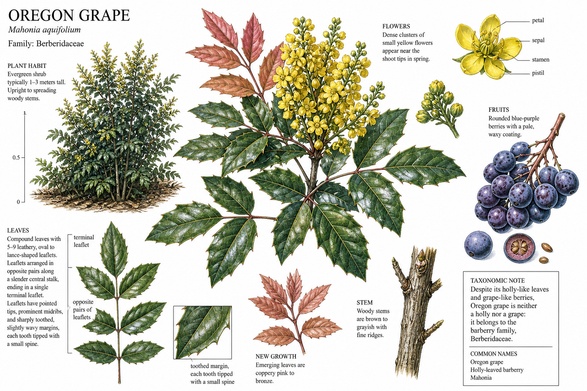
An evergreen shrub typically 1–3 meters tall, with upright to spreading woody stems and compound leaves. Each leaf usually consists of 5–9 leathery, oval to lance-shaped leaflets arranged in opposite pairs along a slender central stalk, ending in a single terminal leaflet. Leaflets have pointed tips, prominent midribs, and sharply toothed, slightly wavy margins, each tooth tipped with a small spine. Mature foliage is glossy dark green, while emerging growth is coppery pink to bronze. Dense clusters of small yellow flowers appear near the shoot tips in spring, followed by rounded blue-purple berries with a pale, waxy coating..

Despite its holly-like leaves and grape-like berries, Oregon grape is neither a holly nor a grape: it belongs to the barberry family, Berberidaceae..

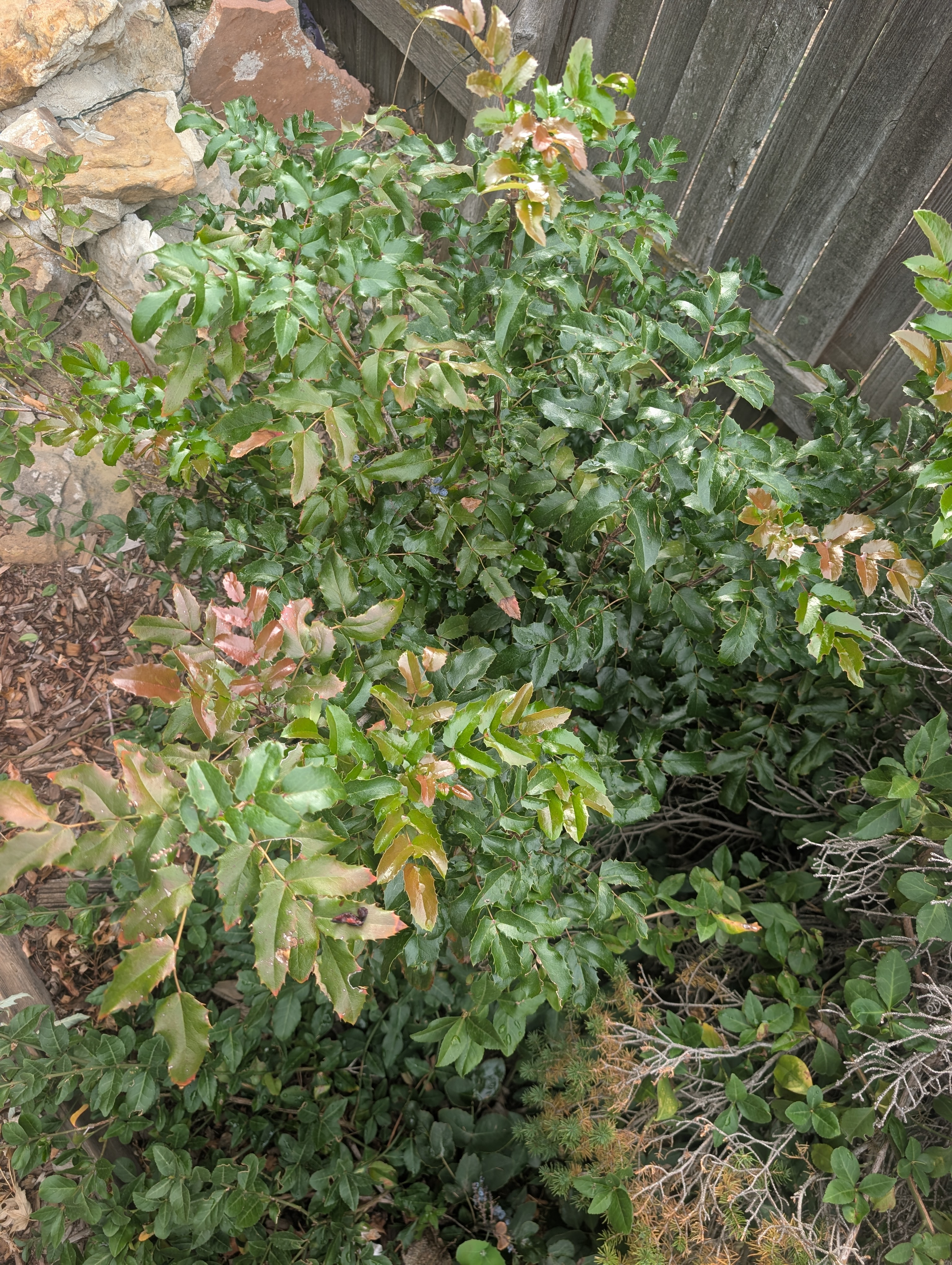
The dominant shrub has pinnately compound leaves with paired, glossy, holly-like leaflets and distinctly spiny margins. The copper-colored new growth and small bluish fruits visible within the foliage also support Oregon grape. The relatively elongated, shiny leaflets and upright, bushy growth favor Mahonia aquifolium over the generally lower-growing, duller-leaved creeping Oregon grape. Related species and garden hybrids can look similar, so exact species identification is slightly less certain than identification as an Oregon grape.
∨∨ more ∨∨
| gen: 2026/09/06:17:15 in 49.7 secname: Coriander (cilantro) |
| type: thingscientific name: Coriandrum sativum |
| pts: 0confidence level: 97% |
models
- coregpt-6-astra
- imggpt-image-2
- voxelevenlabs_v3
^^ less ^^
It is a Coriander (cilantro).

Scientific name: Coriandrum sativum.

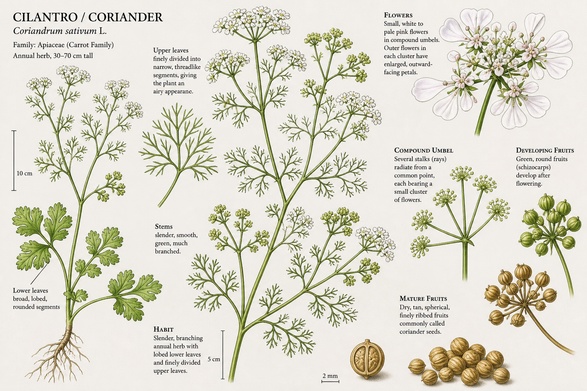
A slender, branching annual herb typically 30–70 cm tall, with smooth green stems. Lower leaves are broad and lobed, while upper leaves are finely divided into narrow, threadlike segments, giving the flowering plant an airy appearance. Small white to pale pink flowers grow in compound umbels: several stalks radiate from a shared point, each supporting a small flower cluster. Flowers around the outside of each cluster have noticeably enlarged, outward-facing petals. The fruits mature into round, tan, finely ribbed structures commonly called coriander seeds. The photograph shows the finely divided upper foliage, open white flowers, and green developing flower clusters..

Cilantro and coriander come from the same plant: in North American usage, cilantro refers to the leaves, while coriander usually refers to the dried fruits used as a spice. The broad leaves become much more finely divided as the plant begins flowering..

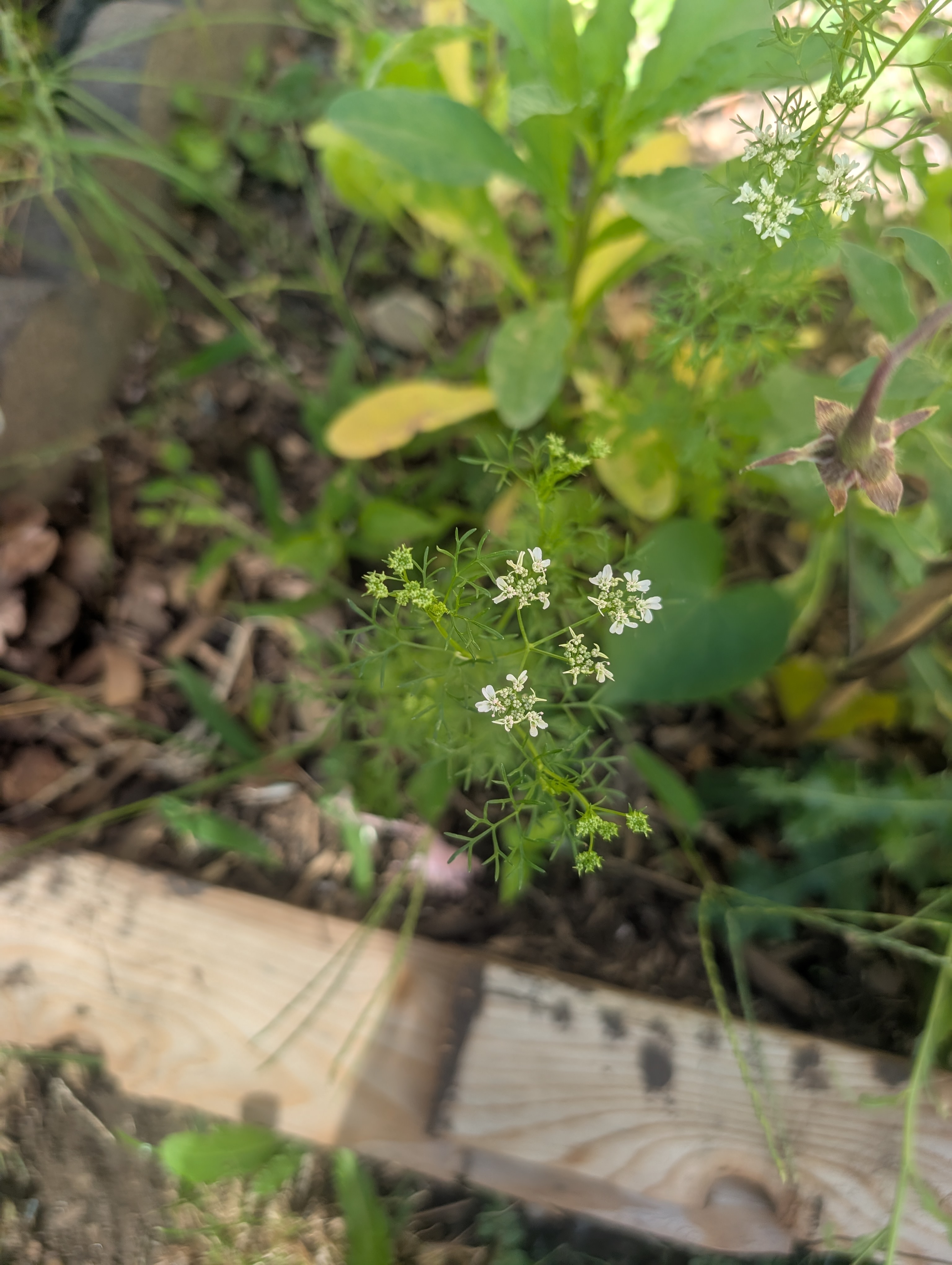
The foreground plant has finely dissected upper leaves and small compound umbels of white flowers, characteristic of the carrot family, Apiaceae. The particularly distinctive feature is the uneven petal size: outer flowers have enlarged white petals facing away from the center of each cluster. Combined with the relatively few umbel rays and delicate, narrow leaf segments, this strongly supports coriander. The broad leaves and large hanging structure in the background appear to belong to other plants.
∨∨ more ∨∨
| gen: 2026/08/29:21:14 in 48.4 secname: Common zinnia |
| type: thingscientific name: Zinnia elegans |
| pts: 0confidence level: 88% |
models
- coregpt-5.5
- imggpt-image-2
- voxelevenlabs_v3
^^ less ^^
It is a Common zinnia.

Scientific name: Zinnia elegans.

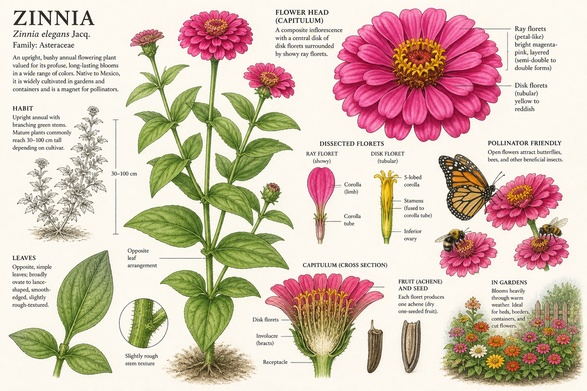
An upright annual flowering plant with branching green stems and opposite, simple leaves. The leaves are broadly ovate to lance-shaped, smooth-edged, slightly rough-textured, and arranged in pairs along the stem. The flower head is a composite inflorescence: a rounded central disk of small yellow to reddish disk florets, surrounded by showy petal-like ray florets. In the pictured form the ray florets are bright magenta-pink and layered in a semi-double to double arrangement, giving the head a full, rounded, daisy-like appearance. Mature plants commonly reach about 30–100 cm tall depending on cultivar, with solitary flower heads held above the foliage..

Zinnias are excellent pollinator plants; their open flower heads attract butterflies, bees, and other beneficial insects, and they are often used in gardens because they bloom heavily through warm weather..

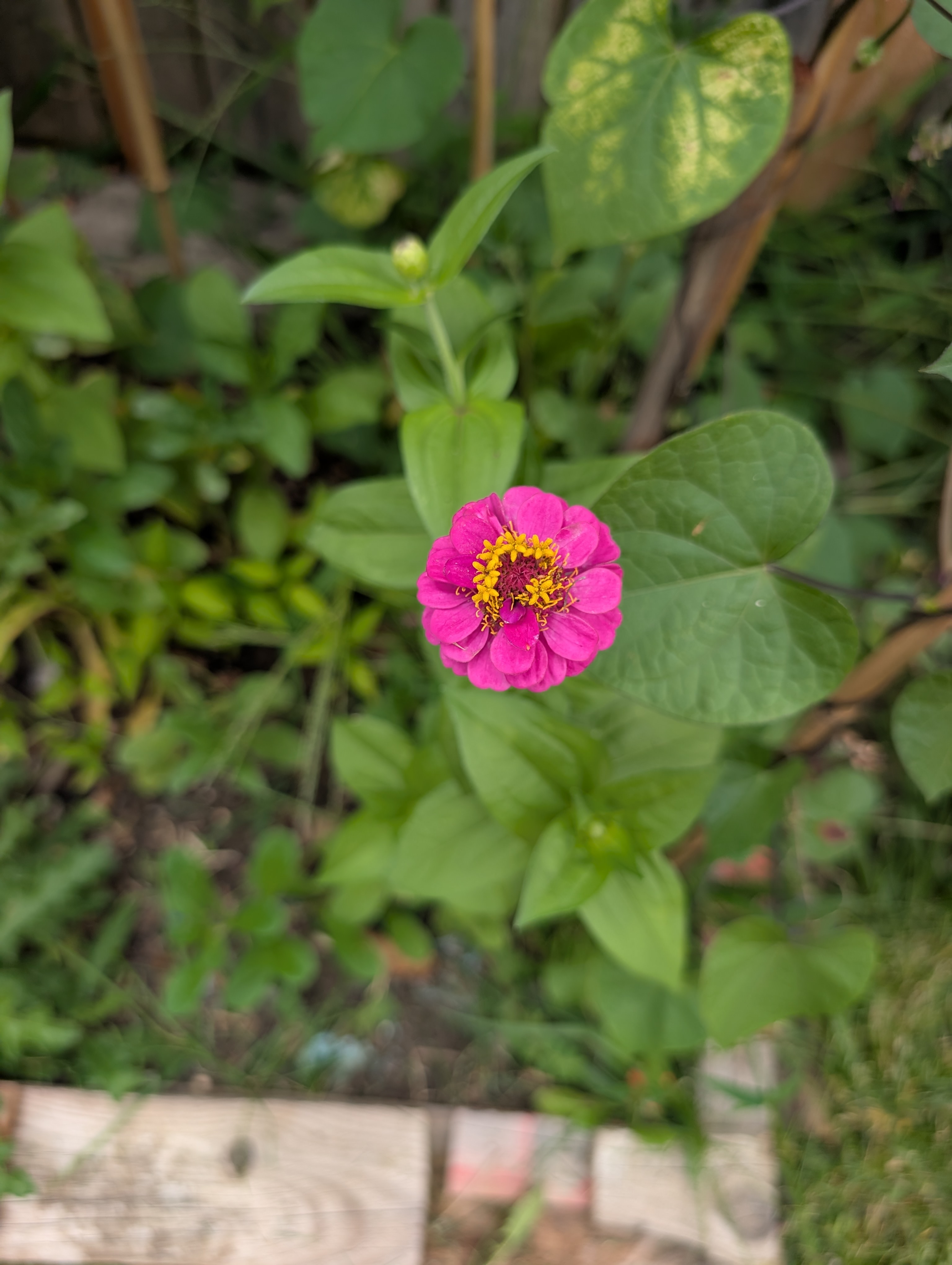
The visible flower has the classic zinnia structure: a bright pink composite head with many broad ray florets, a yellow central ring of disk florets, and a deeper reddish central disk. The surrounding foliage shows opposite, simple, entire leaves that are typical of Zinnia elegans. The garden setting and presence of a rounded green flower bud also fit cultivated zinnia. The image is somewhat blurred and only part of the flower is visible, so cultivar-level identification is not possible, but the plant is very likely a common garden zinnia.
∨∨ more ∨∨
You made it to the bottom. Now dance!


owned and operated by: RPN Omnigalactic Insitutution as of: 2026/10/13: 18:50 in 0 ms
Enter Code
Login with Account