#botany
| gen: 2026/09/23:15:14 in 52.1 secname: Oregon grape |
| type: thingscientific name: Mahonia aquifolium |
| pts: 0confidence level: 93% |
models
- coregpt-6-astra
- imggpt-image-2
- voxelevenlabs_v3
^^ less ^^
It is a Oregon grape.

Scientific name: Mahonia aquifolium.

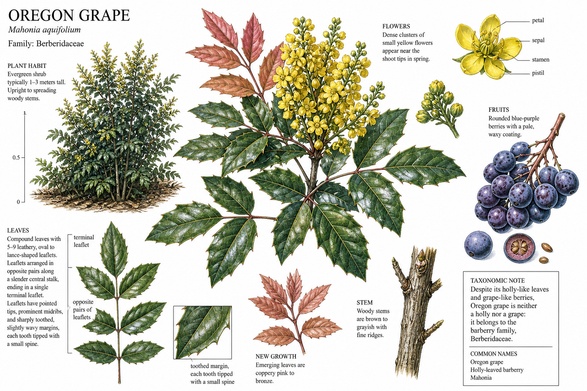
An evergreen shrub typically 1–3 meters tall, with upright to spreading woody stems and compound leaves. Each leaf usually consists of 5–9 leathery, oval to lance-shaped leaflets arranged in opposite pairs along a slender central stalk, ending in a single terminal leaflet. Leaflets have pointed tips, prominent midribs, and sharply toothed, slightly wavy margins, each tooth tipped with a small spine. Mature foliage is glossy dark green, while emerging growth is coppery pink to bronze. Dense clusters of small yellow flowers appear near the shoot tips in spring, followed by rounded blue-purple berries with a pale, waxy coating..

Despite its holly-like leaves and grape-like berries, Oregon grape is neither a holly nor a grape: it belongs to the barberry family, Berberidaceae..

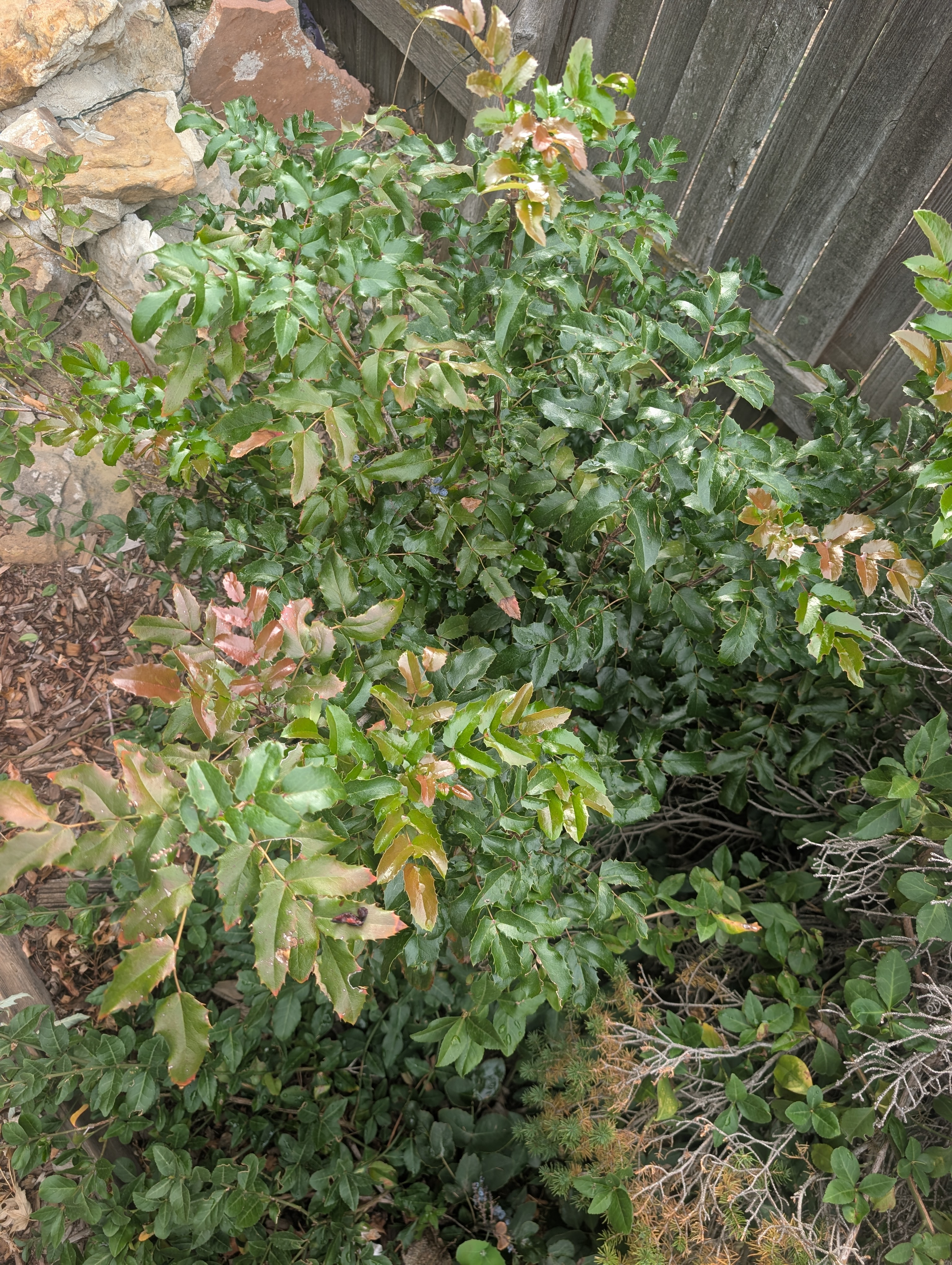
The dominant shrub has pinnately compound leaves with paired, glossy, holly-like leaflets and distinctly spiny margins. The copper-colored new growth and small bluish fruits visible within the foliage also support Oregon grape. The relatively elongated, shiny leaflets and upright, bushy growth favor Mahonia aquifolium over the generally lower-growing, duller-leaved creeping Oregon grape. Related species and garden hybrids can look similar, so exact species identification is slightly less certain than identification as an Oregon grape.
∨∨ more ∨∨
| gen: 2026/09/23:15:10 in 1 min 0.8 secname: Oregon grape |
| type: thingscientific name: Mahonia aquifolium (syn. Berberis aquifolium) |
| pts: 0confidence level: 93% |
models
- coregpt-6-astra
- imggpt-image-2
- voxelevenlabs_v3
^^ less ^^
It is a Oregon grape.

Scientific name: Mahonia aquifolium (syn. Berberis aquifolium).

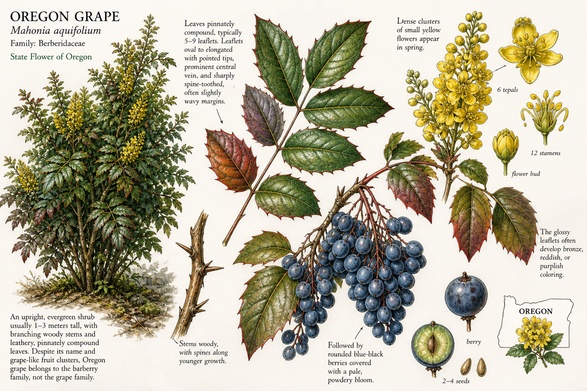
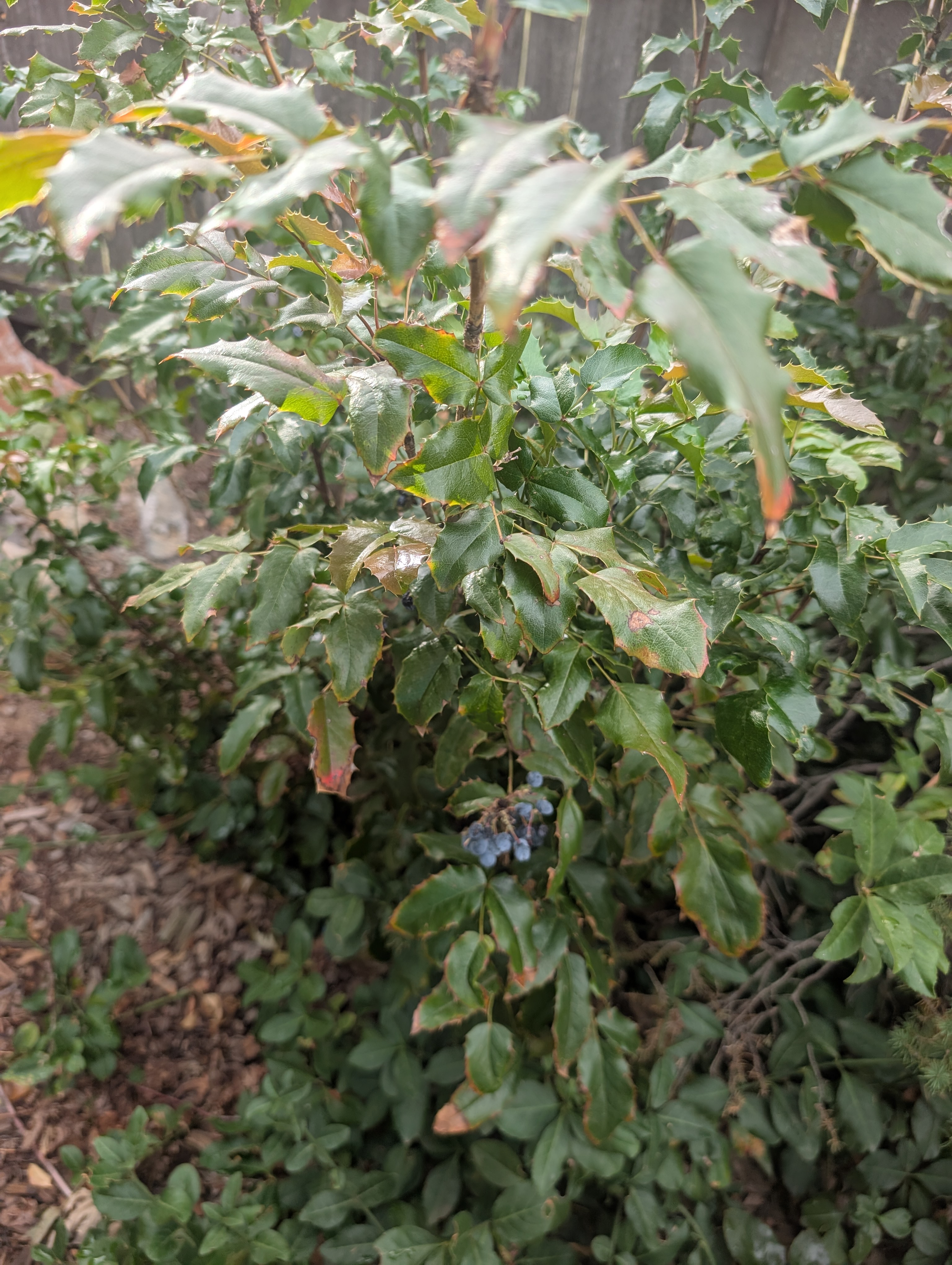
An upright, evergreen shrub usually 1–3 meters tall, with branching woody stems and leathery, pinnately compound leaves. Each leaf typically consists of 5–9 oval to elongated leaflets arranged in opposite pairs along a central stalk, with one terminal leaflet. Leaflets have pointed tips, prominent central veins, and sharply spine-toothed, often slightly wavy margins. Their upper surfaces are glossy dark green, sometimes developing bronze, reddish, or purplish coloring. Dense clusters of small yellow flowers appear in spring, followed by rounded blue-black berries covered with a pale, powdery bloom. The photographed plant has several reddish-edged leaflets and a hanging cluster of blue berries..

Despite its name and grape-like fruit clusters, Oregon grape belongs to the barberry family, not the grape family. It is also the state flower of Oregon..

The combination of holly-like, spiny leaflets arranged in compound leaves and clustered, powdery blue berries strongly identifies this as Oregon grape in the Mahonia group. True hollies have simple leaves rather than pinnately compound leaves. The relatively glossy, elongated leaflets and upright, densely branching habit favor Mahonia aquifolium over lower-growing or larger-leaved relatives. Closely related species and garden hybrids can look similar, so the exact species identification is slightly less certain than the genus.
∨∨ more ∨∨
| gen: 2026/09/06:17:15 in 49.7 secname: Coriander (cilantro) |
| type: thingscientific name: Coriandrum sativum |
| pts: 0confidence level: 97% |
models
- coregpt-6-astra
- imggpt-image-2
- voxelevenlabs_v3
^^ less ^^
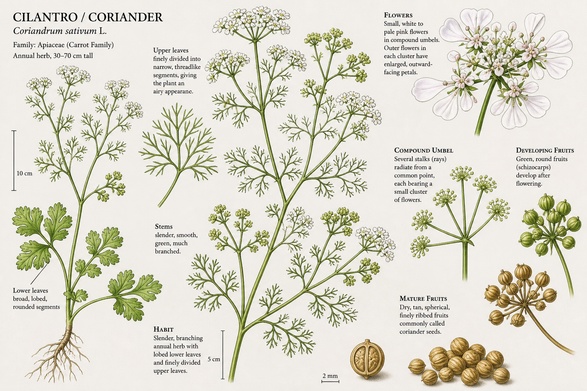
It is a Coriander (cilantro).

Scientific name: Coriandrum sativum.

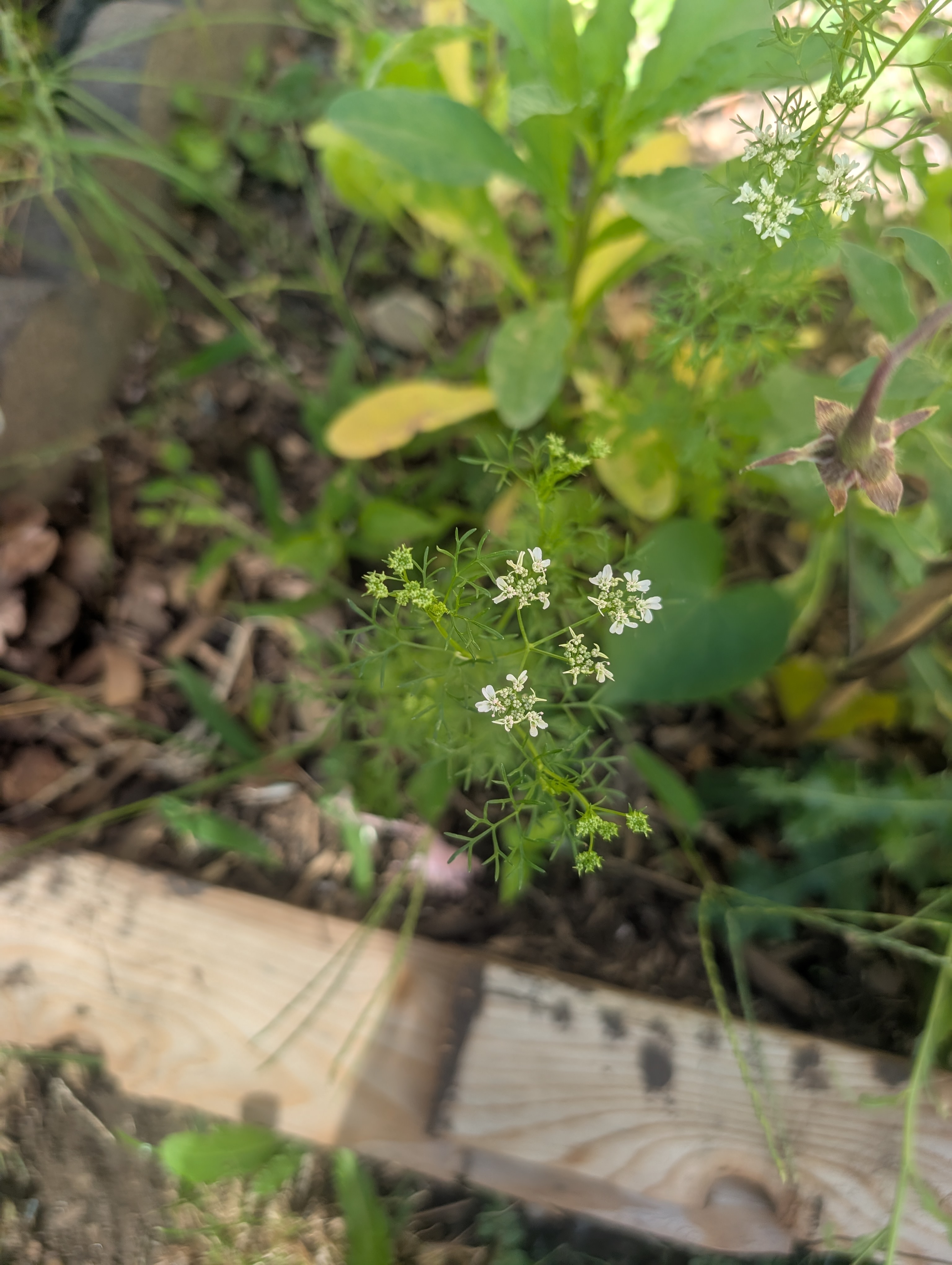
A slender, branching annual herb typically 30–70 cm tall, with smooth green stems. Lower leaves are broad and lobed, while upper leaves are finely divided into narrow, threadlike segments, giving the flowering plant an airy appearance. Small white to pale pink flowers grow in compound umbels: several stalks radiate from a shared point, each supporting a small flower cluster. Flowers around the outside of each cluster have noticeably enlarged, outward-facing petals. The fruits mature into round, tan, finely ribbed structures commonly called coriander seeds. The photograph shows the finely divided upper foliage, open white flowers, and green developing flower clusters..

Cilantro and coriander come from the same plant: in North American usage, cilantro refers to the leaves, while coriander usually refers to the dried fruits used as a spice. The broad leaves become much more finely divided as the plant begins flowering..

The foreground plant has finely dissected upper leaves and small compound umbels of white flowers, characteristic of the carrot family, Apiaceae. The particularly distinctive feature is the uneven petal size: outer flowers have enlarged white petals facing away from the center of each cluster. Combined with the relatively few umbel rays and delicate, narrow leaf segments, this strongly supports coriander. The broad leaves and large hanging structure in the background appear to belong to other plants.
∨∨ more ∨∨
| gen: 2026/09/06:17:00 in 1 min 0.9 secname: Purple milk-vetch |
| type: thingscientific name: Astragalus danicus |
| pts: 0confidence level: 84% |
models
- coregpt-6-astra
- imggpt-image-2
- voxelevenlabs_v3
^^ less ^^
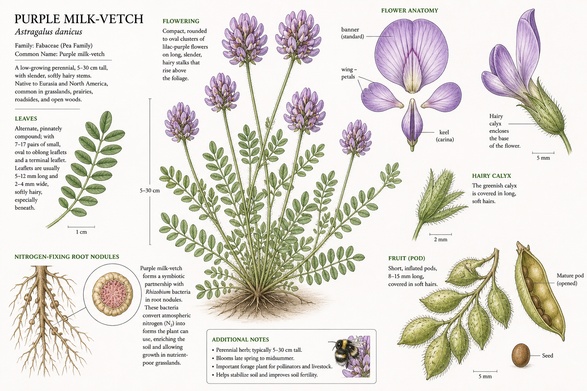
It is a Purple milk-vetch.

Scientific name: Astragalus danicus.

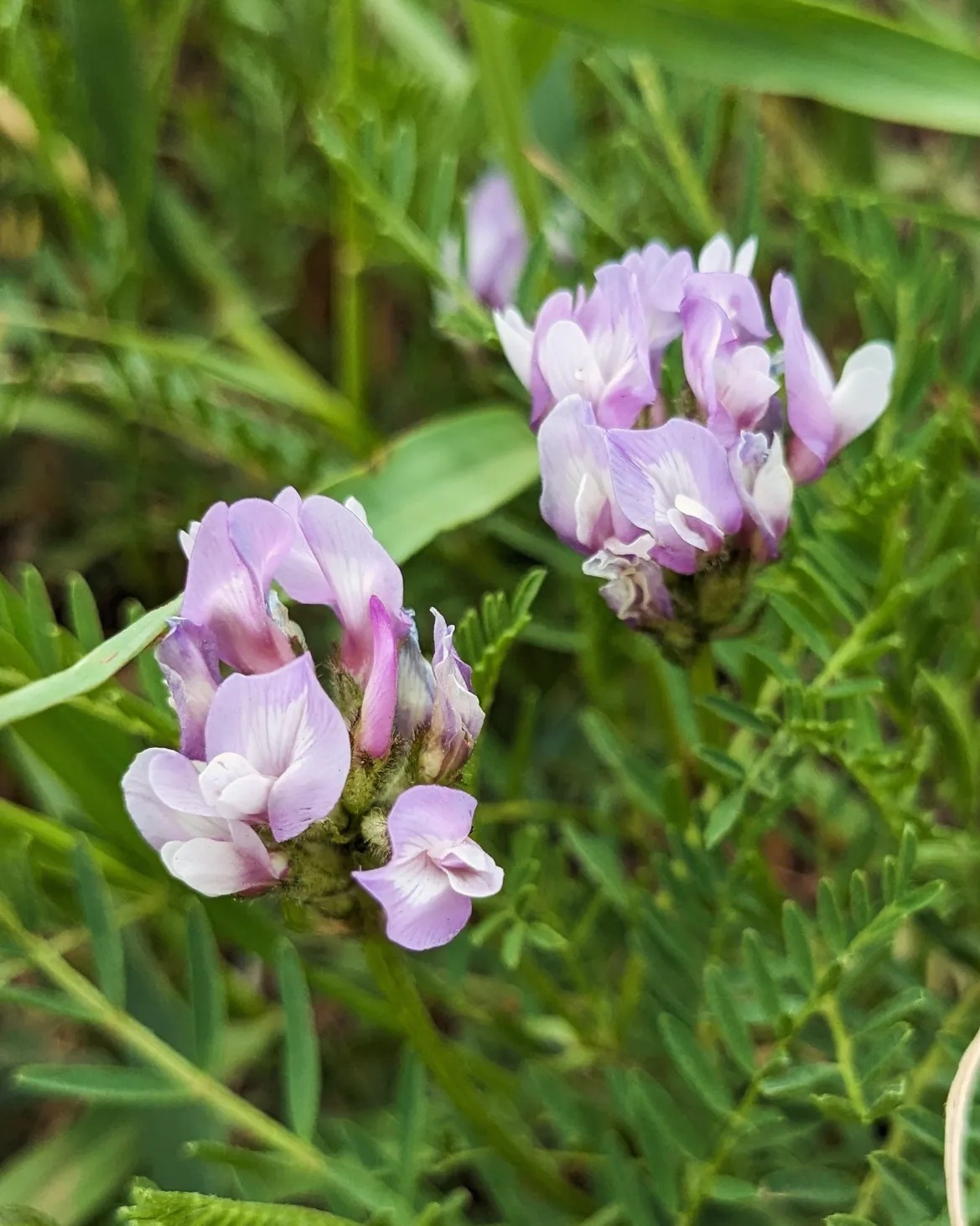
A low-growing perennial in the pea family, typically 5–30 cm tall, with slender, softly hairy stems. Its alternate, pinnately compound leaves bear numerous small, oval to oblong leaflets arranged in opposite pairs, plus a terminal leaflet. Compact, rounded to oval clusters of lilac-purple flowers rise above the foliage on long stalks. Each flower has a broad, upright banner petal with fine darker veins and a pale central area, two smaller wing petals, and a central keel. The flower bases are enclosed by conspicuously hairy greenish calyces. The fruits are short, inflated, hairy pods..

Purple milk-vetch forms a partnership with nitrogen-fixing bacteria in its root nodules, allowing it to obtain nitrogen from the air and grow in relatively nutrient-poor grassland..

The photograph shows compact clusters of pea-shaped, pale purple flowers with broad banners, whitish wing and keel petals, and densely hairy calyces. The surrounding pinnate foliage has many small, oblong leaflets. This combination strongly suggests an Astragalus milk-vetch, and the short, crowded flower heads and broad floral proportions are particularly consistent with Astragalus danicus. Similar Astragalus and Oxytropis species can be difficult to distinguish from a photograph; location and clear views of mature pods would help confirm the species.
∨∨ more ∨∨
| gen: 2026/08/29:21:14 in 48.4 secname: Common zinnia |
| type: thingscientific name: Zinnia elegans |
| pts: 0confidence level: 88% |
models
- coregpt-5.5
- imggpt-image-2
- voxelevenlabs_v3
^^ less ^^
It is a Common zinnia.

Scientific name: Zinnia elegans.

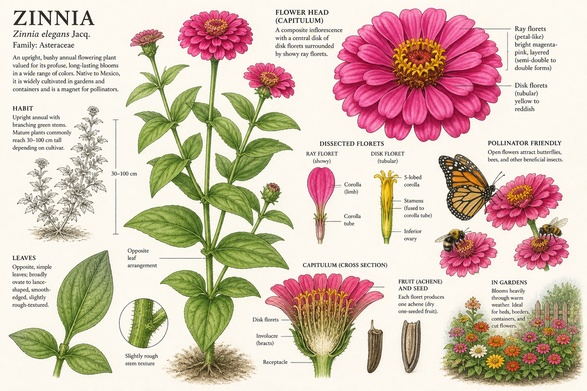
An upright annual flowering plant with branching green stems and opposite, simple leaves. The leaves are broadly ovate to lance-shaped, smooth-edged, slightly rough-textured, and arranged in pairs along the stem. The flower head is a composite inflorescence: a rounded central disk of small yellow to reddish disk florets, surrounded by showy petal-like ray florets. In the pictured form the ray florets are bright magenta-pink and layered in a semi-double to double arrangement, giving the head a full, rounded, daisy-like appearance. Mature plants commonly reach about 30–100 cm tall depending on cultivar, with solitary flower heads held above the foliage..

Zinnias are excellent pollinator plants; their open flower heads attract butterflies, bees, and other beneficial insects, and they are often used in gardens because they bloom heavily through warm weather..

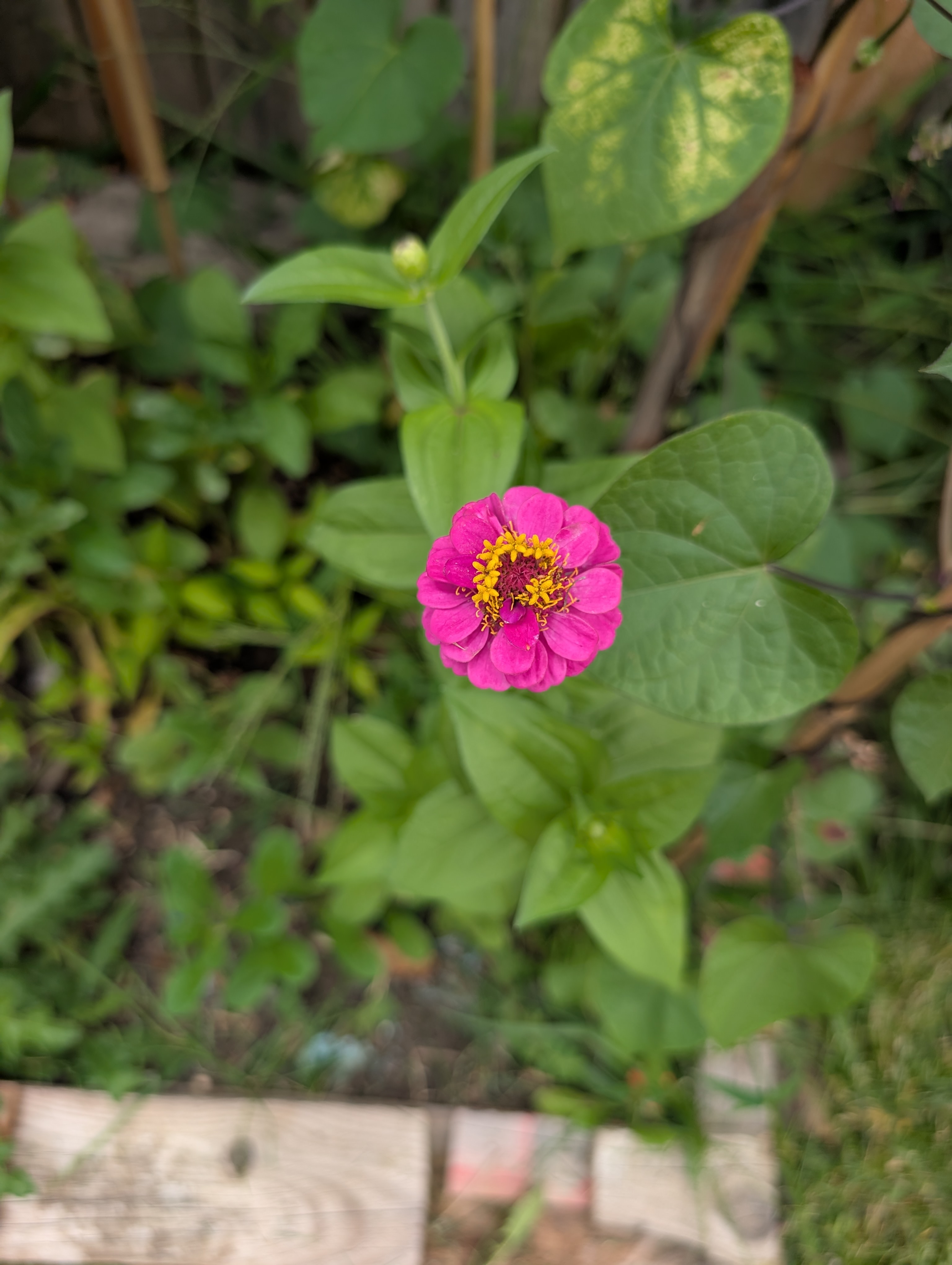
The visible flower has the classic zinnia structure: a bright pink composite head with many broad ray florets, a yellow central ring of disk florets, and a deeper reddish central disk. The surrounding foliage shows opposite, simple, entire leaves that are typical of Zinnia elegans. The garden setting and presence of a rounded green flower bud also fit cultivated zinnia. The image is somewhat blurred and only part of the flower is visible, so cultivar-level identification is not possible, but the plant is very likely a common garden zinnia.
∨∨ more ∨∨
| gen: 2026/07/15:16:06 in 1 min 44.2 secname: Common purslane |
| type: thingscientific name: Portulaca oleracea |
| pts: 0confidence level: 94% |
models
- coregpt-5.5
- imggpt-image-2
- voxgpt-4o-mini-tts
^^ less ^^
It is a Common purslane.

Scientific name: Portulaca oleracea.

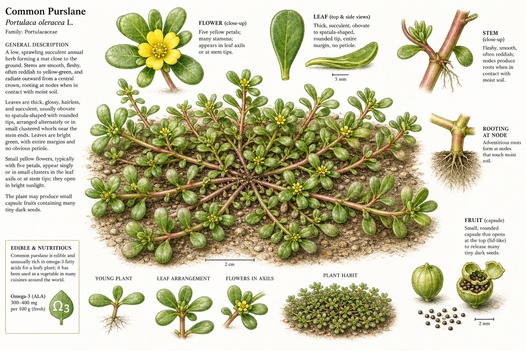
A low, sprawling succulent annual herb forming a mat close to the ground. Stems are smooth, fleshy, often reddish to yellow-green, and radiate outward from a central crown, rooting at nodes when in contact with moist soil. Leaves are thick, glossy, hairless, and succulent, usually obovate to spatula-shaped with rounded tips, arranged alternately or in small clustered whorls near the stem ends. Leaves are bright green, with entire margins and no obvious petiole. Small yellow flowers, typically with five petals, appear singly or in small clusters in the leaf axils or at stem tips; they open in bright sunlight. The plant may produce small capsule fruits containing many tiny dark seeds..

Common purslane is edible and unusually rich in omega-3 fatty acids for a leafy plant; it has been used as a vegetable in many cuisines around the world..

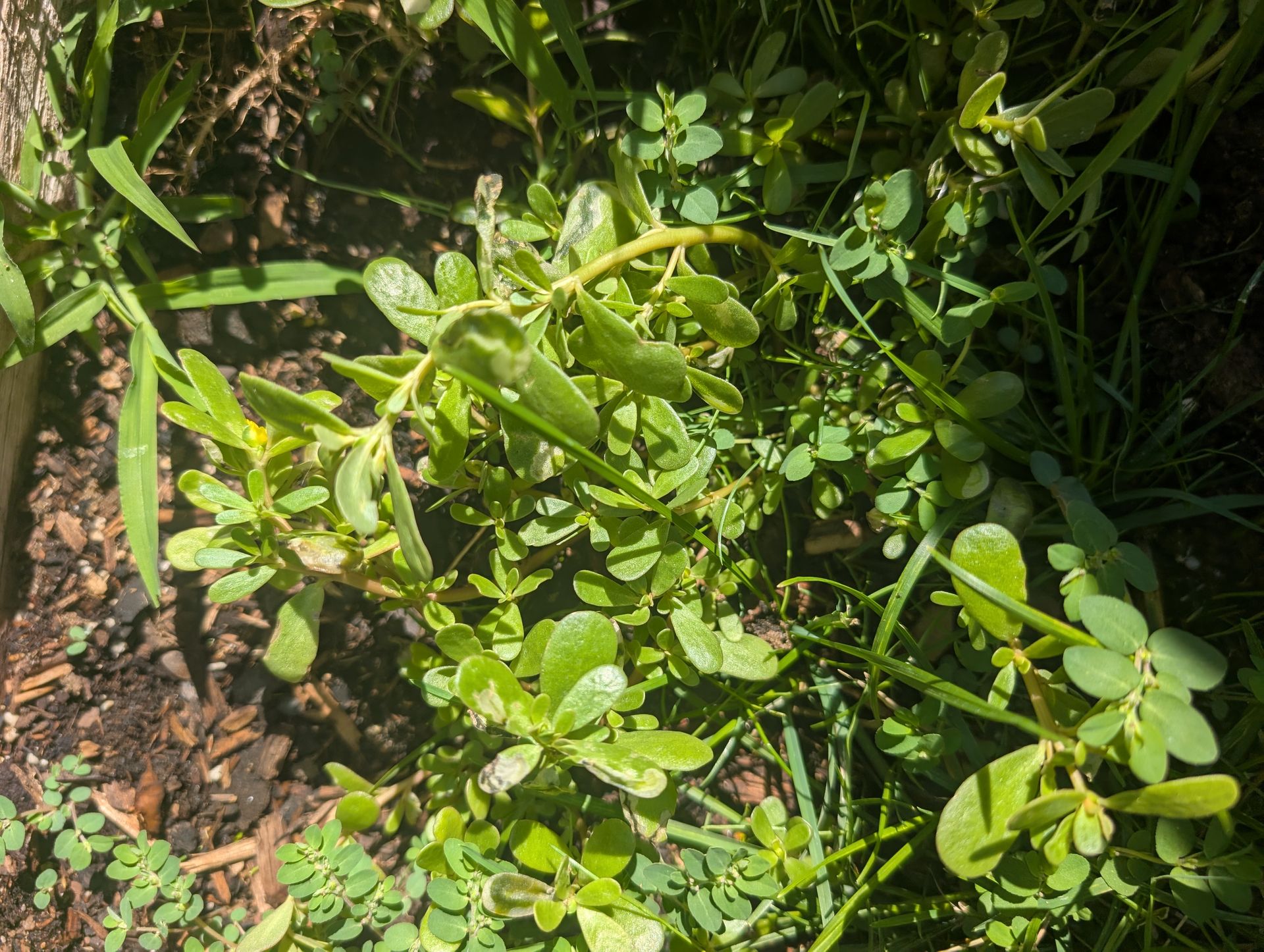
The plant in the image has the key traits of common purslane: prostrate, fleshy, smooth stems; glossy succulent oval-to-spatulate leaves; clustered leaf arrangement at the nodes; and a small yellow flower visible near the lower left. These features distinguish it from similar lawn weeds such as spotted spurge, which has thinner, non-succulent leaves and milky sap, and from clovers or oxalis, which have compound leaves rather than thick single succulent leaves. The mat-forming growth habit in disturbed garden soil is also typical of Portulaca oleracea.
∨∨ more ∨∨
| gen: 2026/07/14:01:20 in 1 min 37.3 secname: Lupine |
| type: thingscientific name: Lupinus sp. |
| pts: 0confidence level: 78% |
models
- coregpt-5.5
- imggpt-image-2
- voxgpt-4o-mini-tts
^^ less ^^
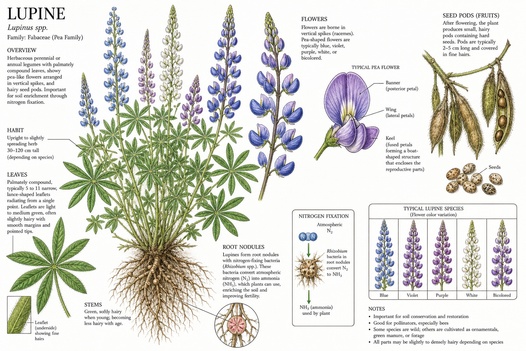
It is a Lupine.

Scientific name: Lupinus sp..

A herbaceous legume with upright to slightly spreading, softly hairy green stems. The leaves are palmately compound: typically 5 to 11 narrow, lance-shaped leaflets radiate from a single point like the fingers of a hand. Leaflets are light to medium green, often slightly fuzzy, with smooth margins and pointed tips. Mature plants produce vertical flower spikes or racemes bearing pea-shaped blossoms, commonly blue, violet, purple, white, or bicolored. Each flower has the typical legume structure with a banner petal, wing petals, and a keel. After flowering, the plant forms small, hairy seed pods containing hard seeds..

Lupines are members of the pea family and can form root nodules with nitrogen-fixing bacteria, helping enrich soil by converting atmospheric nitrogen into forms plants can use..

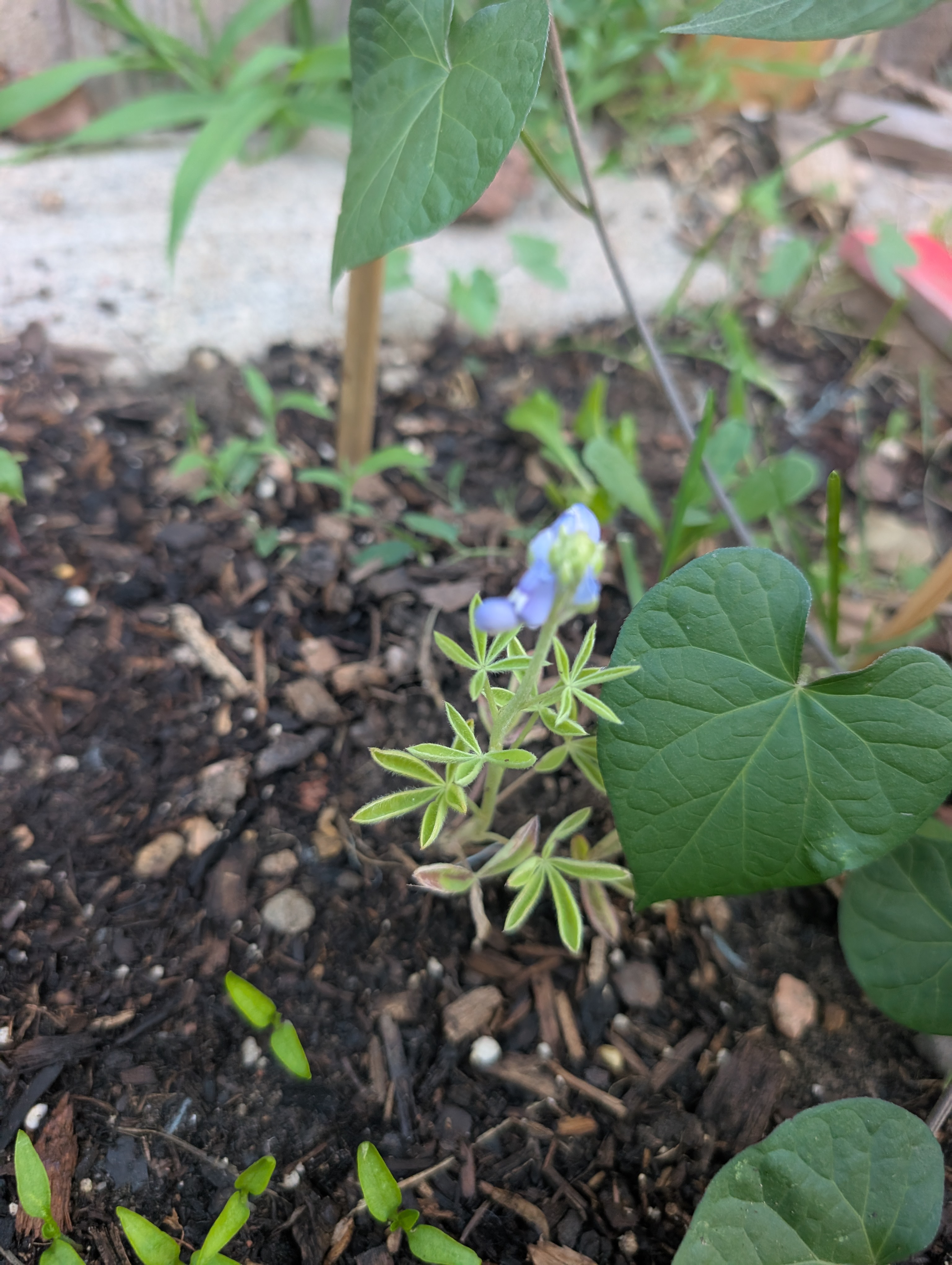
The clearest identifiable plant features are the palmate, star-like compound leaves with several narrow leaflets and the small blue-purple pea-type flower visible near the lower center of the image. These traits are characteristic of Lupinus, commonly called lupines or, in some regions, bluebonnets. The image also contains large heart- to shield-shaped leaves from a neighboring plant, so the identification is made from the lupine-like flower and compound leaves rather than those larger leaves. Because the photo is somewhat blurred and shows mixed vegetation, I can identify the genus with moderate confidence but not the exact species.
∨∨ more ∨∨
| gen: 2026/07/13:03:38 in 1 min 22.3 secname: Candied jalapeño peppers |
| type: thingscientific name: Capsicum annuum |
| pts: 0confidence level: 94% |
models
- coregpt-5.5
- imggpt-image-2
- voxgpt-4o-mini-tts
^^ less ^^
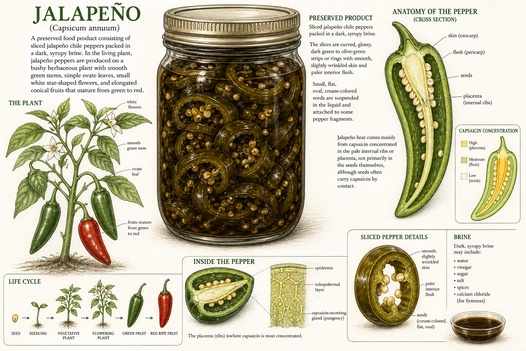
It is a Candied jalapeño peppers.

Scientific name: Capsicum annuum.

A preserved food product consisting of sliced jalapeño chile peppers packed in a dark, syrupy brine inside a glass jar. The visible pepper pieces are curved, glossy, dark green to olive-green strips or rings with smooth, slightly wrinkled skin and paler interior flesh. Small, flat, oval, cream-colored seeds are suspended in the liquid and attached to some pepper fragments. In the living plant, jalapeño peppers come from a bushy herbaceous pepper plant with smooth green stems, simple ovate leaves, small white star-shaped flowers, and elongated conical fruits that mature from green to red..

Jalapeño heat comes mainly from capsaicin concentrated in the pale internal ribs or placenta of the pepper, not primarily in the seeds themselves, although seeds often carry capsaicin by contact..

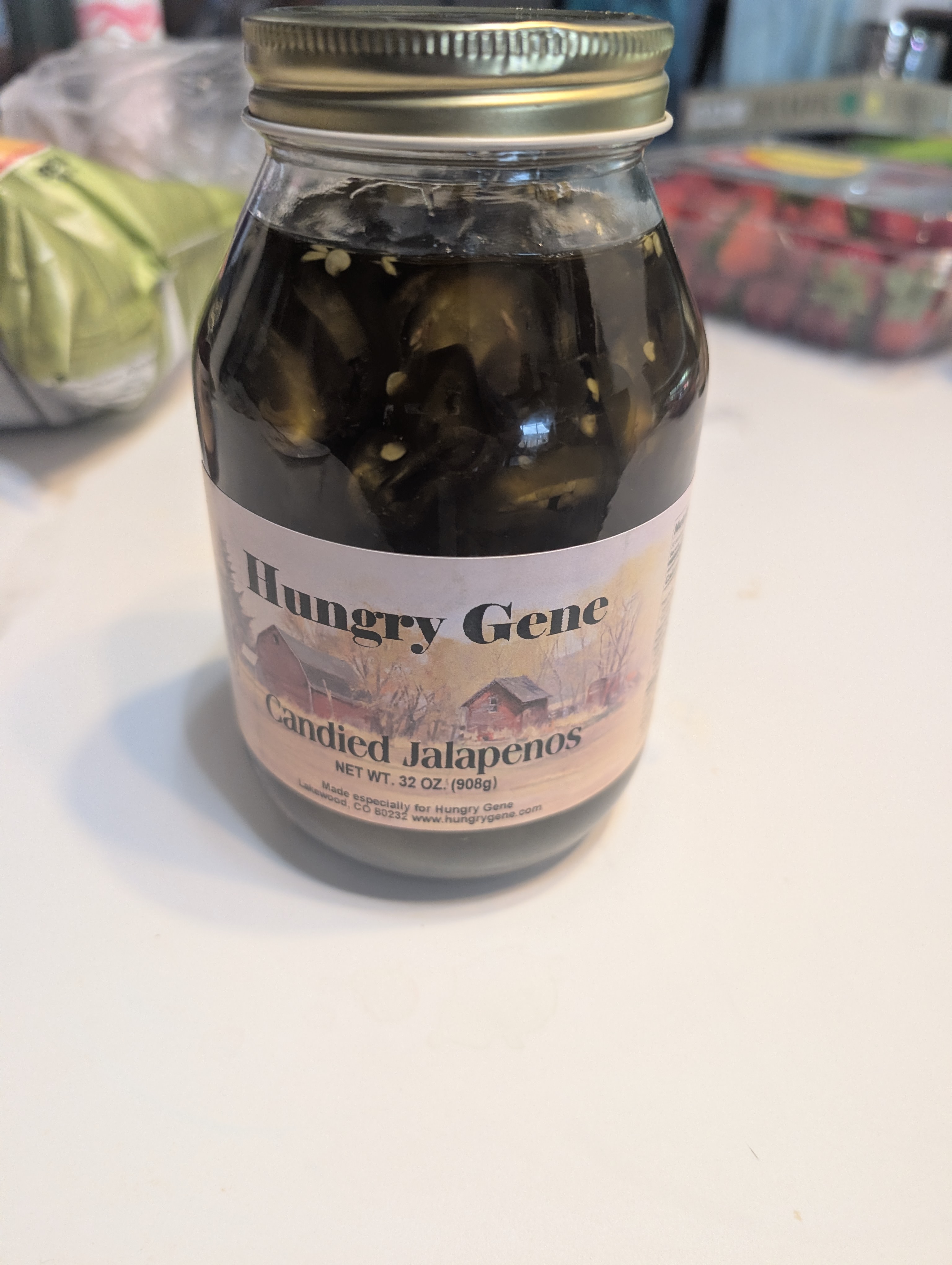
The jar contains green chile pepper pieces with many pale, flattened seeds typical of Capsicum peppers. The visible label text indicates candied jalapeños, and the shape, color, and seed structure match sliced jalapeño peppers rather than cucumbers, olives, or other pickled vegetables. Jalapeños are a cultivar group of Capsicum annuum, the same species that includes many sweet and hot peppers.
∨∨ more ∨∨
You made it to the bottom. Now dance!


owned and operated by: RPN Omnigalactic Insitutution as of: 2026/10/15: 04:44 in 0 ms
Enter Code
Login with Account