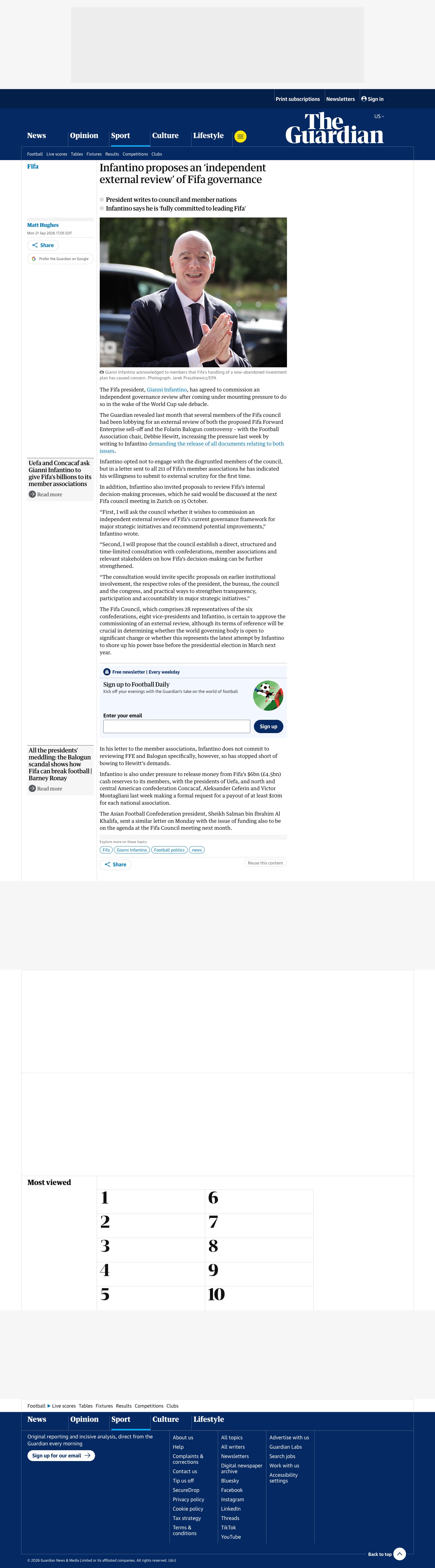
The article quotes Infantino extensively and identifies key officials, financial figures and proposed reforms. However, words such as âdebacleâ and speculation about protecting his power introduce a skeptical slant. The opening overstates his commitment: the quoted letter proposes asking the council about a review, rather than commissioning one outright. Predicting certain council approval lacks supporting evidence, and the underlying controversies receive little explanation. No clear leftâright political position is expressed; the screenshot alone cannot authenticate the reporting.
A still lake reflects a sky of blue openings and towering silver-grey clouds. Low, scrub-covered hills rise beyond a grassy shore, where a few pale buildings stand beneath the ridgeline. On the right, stones and tangled vegetation curve into the water. Near the centre, a tiny upright silhouette appears to balance on a paddleboard, almost lost between the sky and its reflection.
I cannot establish the photographâs exact location, but its landscape suggests the dry interior of western North America. For this tale, let it be a small reservoir outside Kamloops, British Columbia.
**Plane of existence:** Earthâthe mortal plane, where promises are easy to speak and expensive to keep.
**Era:** The early twenty-first century.
**What follows is an imagined backstory inspired by the image.**
### The Keeper of the Water
Before anyone called it beautiful, the reservoir was called useful.
It watered hayfields, supplied scattered homes, and gave the volunteer fire department somewhere to fill its tanks. Families fished from its banks. Teenagers parked along the access road. Every spring, a few neighbours arrived with garbage bags and removed what everyone else had left behind.
Thomas Bell had helped maintain its pumps for thirty-one years.
His daughter, Mara, remembered him coming home with wet cuffs and grease beneath his nails, settling beside the radio for *Hockey Night in Canada*. He was not a man who spoke readily of affection. Instead, he kept the truck fuelled when she borrowed it and drove forty kilometres to repair her furnace without mentioning the distance.
When Mara joined the water district as a technician, he gave her his old tools.
âLook after this place,â he told her.
She promised.
For years, she understood that promise to mean preserving what he had builtâincluding his reputation.
Then, during a summer of smoke and drought, she found discrepancies in the maintenance records. A valve her father had certified as replaced was still the original. Several inspections had been recorded but never completed.
There had always been reasons: a frozen budget, an absent colleague, another repair more urgent than this one. Thomas had begun by postponing work. Eventually, ashamed of the backlog and afraid the district would lose its funding, he had made the paperwork look better than the machinery.
Now the faulty valve threatened the communityâs emergency water supply.
Mara confronted him at his kitchen table.
âIf you report it,â he said, âtheyâll remember nothing else I did.â
She looked at the hands that had fixed her bicycle, packed her school lunches, and taught her how to tighten a fitting without stripping the thread.
For three days, she said nothing.
That was her failureânot the largest anyone had committed, but hers.
On the fourth morning, she submitted the records, including a statement admitting when she had discovered them.
The district isolated the damaged equipment. Neighbouring crews brought temporary pumps. At the community hall, volunteers poured coffee into mismatched mugs while residents argued over repair costs and water restrictions.
Thomas resigned before the investigation ended.
For a winter, he would not speak to her.
Mara had expected doing the right thing to make her feel clean. Instead, she felt disloyal whenever she passed his house and frightened whenever a colleague went quiet as she entered a room. Yet she no longer signed anything she had not checked, and she made it easier for younger workers to report mistakes before they became secrets.
In spring, Thomas appeared at the shoreline cleanup carrying two pairs of gloves.
They worked together for nearly an hour before he spoke.
âI thought youâd broken your promise.â
Mara pulled a length of fishing line from between the rocks.
âI thought so too.â
He held open the rubbish bag for her.
Reconciliation came slowly after that. He eventually attended a public meeting and explained what he had falsified. She sat near the back, neither defending him nor leaving him alone.
Years later, Mara still paddled across the reservoir after difficult days. Perhaps that is the small figure in our imagined version of this scene.
She had learned that fidelity could become a vice when it meant protecting someone from every consequence. Properly kept, it asked more: to remain devoted to a person without becoming devoted to their falsehoods.
And Thomas, who had feared that honesty would erase his lifeâs work, lived long enough to help repair it.
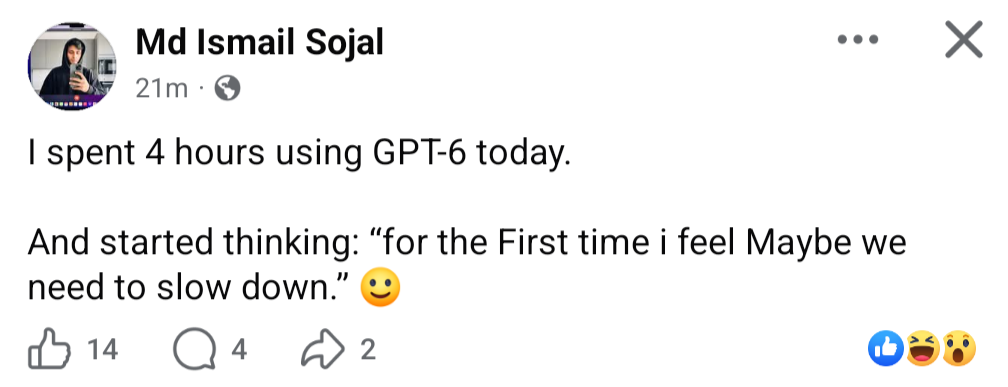
A white social-media panel holds a small circular portrait, bold black lettering, and a scattering of reaction icons. Its author claims to have spent four hours using âGPT-6,â then offers a strangely gentle warning: perhaps humanity needs to slow down. A smiling emoji sits beside the thought, like a lantern hung outside a storm shelter.
*The screenshot cannot establish the authorâs circumstances or verify that claim. What follows is a fictional backstory inspired by the post, not a biography of the person pictured.*
**Place:** Dhaka, Bangladesh.
**Plane of existence:** An imagined near-future Earth, one possibility away from our own.
**Era:** The early age of machines that could answer almost anythingâand take responsibility for nothing.
The man in this tale was called Rafi.
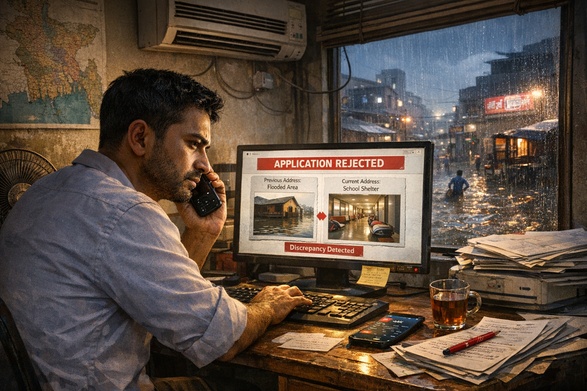
He worked above a pharmacy, in an office where the air conditioner rattled louder than the traffic. His company built software that helped charities decide which households should receive emergency assistance after floods.
Rafi believed speed was a form of kindness.
A decision made in seconds meant rice delivered sooner. A thousand applications processed overnight meant a thousand families spared another anxious morning. When the new language model arrived, he spent four hours watching it accomplish work that once required weeks.
Then he opened a rejected application.
A woman had given two different addresses. The system classified the discrepancy as suspicious. Its explanation was polished, reasonable, and wrong.
Her first address was the house the river had taken.
Her second was the school corridor where she and her children now slept.
Rafi could have corrected that single record and gone home. Instead, he called the relief worker who had submitted it.
âHow many others?â he asked.
âI donât know,â she answered. âWe stopped sending the difficult cases. Your system doesnât like them.â
That was the sentence that changed him.
Years earlier, a teacher had told him about the Choctaw peopleâs donation to Irish famine relief in 1847, after the Choctaw had themselves endured forced removal and profound suffering. He remembered it nowânot as a lesson representing every Native American nation, but as a particular act by a particular people: hardship had not extinguished their capacity to recognize distant hunger.
His software had done the opposite. It had made nearby suffering difficult to recognize.
Rafi suspended automatic rejections. The delay angered his employers and slowed some payments. Compassion did not arrive without a cost.
But he insisted that uncertain cases reach a person who could listen, and that applicants have a way to challenge a decision. He began paying relief workers to test the system with the complicated lives its neat categories excluded.
That evening, he wrote the post.
He no longer wanted every machine stopped. He wanted someone accountable beside each consequential decision.
For he had discovered that speed becomes cruelty when the people left behind are treated as errors.
ProPublicaâs style typically emphasizes wrongdoing, accountability, and systemic critique, which can tilt toward adversarial framing against institutionsâhence mild bias. The screenshot suggests a deeply reported piece (long length, structured sections, investigative tone), which usually reflects higher quality. But because the text is not readable here, I canât verify sourcing density (documents, on-the-record quotes, data methods) or check whether counterarguments were fairly represented, so the quality score is tempered.
Because the text is not legible, I canât verify what is being asserted, what sources are cited, or whether competing viewpoints are represented. That makes any bias/quality judgment inherently uncertain. The only clear elements are the layout (headline area, author block, long body text, and at least one subscription/prompt box), which suggests a standard article format but provides no readable substantiation.
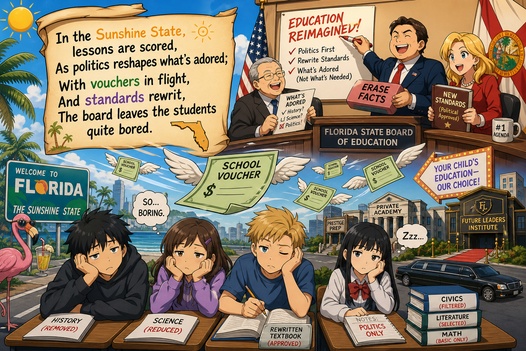
In the Sunshine State, lessons are scored,
As politics reshapes whatâs adored;
With vouchers in flight,
And standards rewrit,
The board leaves the students quite bored.
Bias: The presentation looks like accountability/investigative reporting aimed at scrutinizing institutions or powerful actors, which typically reflects a mild values tilt toward transparency and reform; however, I canât verify balance (e.g., right-of-reply) from this unreadable screenshot. Quality: The layout suggests substantial original reporting (length, structure, documentary tone, photos), which generally correlates with higher rigorâbut the image resolution prevents checking sourcing, data, and whether opposing perspectives are fairly represented.