#drought
| gen: 2026/09/16:05:23 in 32.0 sec (old)bias: 1 (Center) |
| type: lolsquality: 76 |
| pts: 0 |
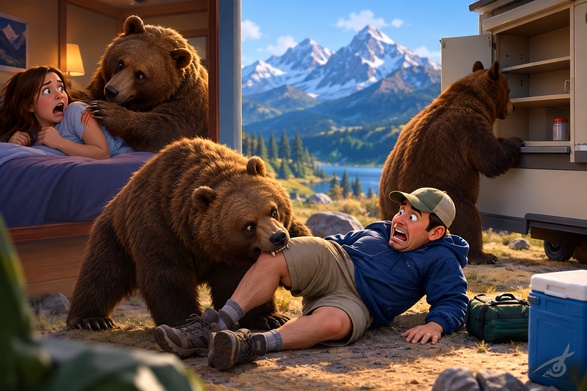
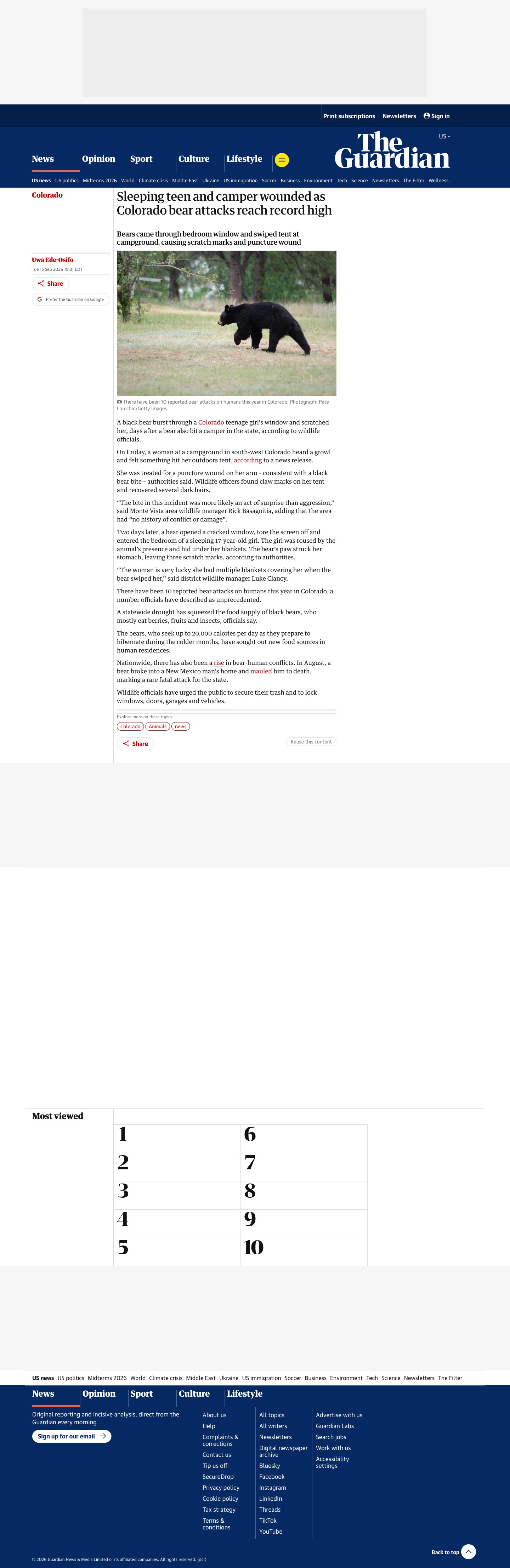 | author: | Uwa Ede-Osifo | institution: | The Guardian | ¿porque no los dos? |
| tl;dr | The article reports two Colorado bear encounters that injured a camper and a sleeping 17-year-old girl. Wildlife officials say the state has recorded 10 bear attacks on humans this year, an unprecedented total. Officials link reduced natural food supplies to statewide drought and suggest the camper’s bite was a startled reaction rather than aggression. The supplied images end before the article’s final discussion is complete. | ||||
| deeper: | The reporting is largely factual, with named wildlife officials, attributed accounts and specific injury details. It shows no clear political agenda. The dramatic headline is tempered by an official’s explanation that one bite likely reflected surprise rather than aggression. Quality is limited by reliance on official sources and the absence of historical attack figures to substantiate the record-high claim. The drought explanation is attributed but not supported with additional data in the visible text. Assessment is limited to the supplied excerpt. | ||||
media: | |||||
| gen: 2026/08/08:06:37 in 34.5 sec (old)bias: 2 (Center) |
| type: newsquality: 78 |
| pts: 0 |
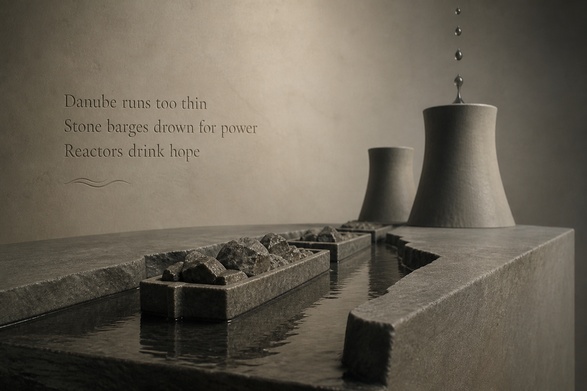
 | author: | Unknown | institution: | Yahoo News | ¿porque no los dos? |
| tl;dr | The article reports that Romania is urgently sinking four barges in the Danube River to stabilize water levels/flow needed for the Cernavodă nuclear power plant, aiming to keep its second reactor operating amid unusually low river conditions. It frames the move as an emergency engineering measure to protect cooling-water intake and maintain electricity production, while noting broader regional impacts of low water on navigation and infrastructure. | ||||
| deeper: | The piece is largely straight, event-driven reporting: it describes what Romania is doing, why it matters (nuclear reactor operation and power supply), and the immediate environmental/river-conditions context. Language is mostly neutral and technical, with limited emotive framing. Potential bias comes from reliance on official/operational perspectives (energy security, plant continuity) with comparatively less detail on environmental, downstream, or civic critique. Overall quality is solid for a wire-style report, though it appears light on independent experts and quantified risk tradeoffs. | ||||
media: | |||||
| gen: 2026/08/02:15:18 in 2 min 27.0 sec (old)bias: 3 (Center) |
| type: lolsquality: 86 |
| pts: 0 |
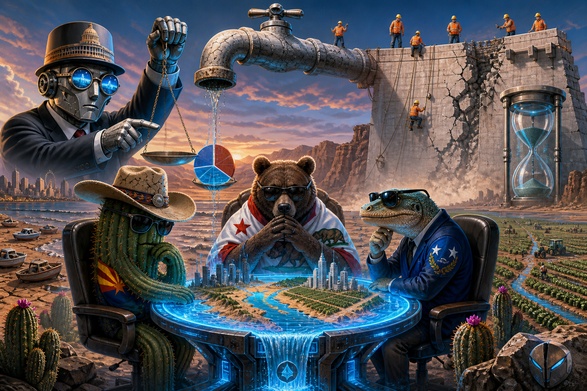
 | author: | Alex Hager, Scott Simon | institution: | NPR | ¿porque no los dos? |
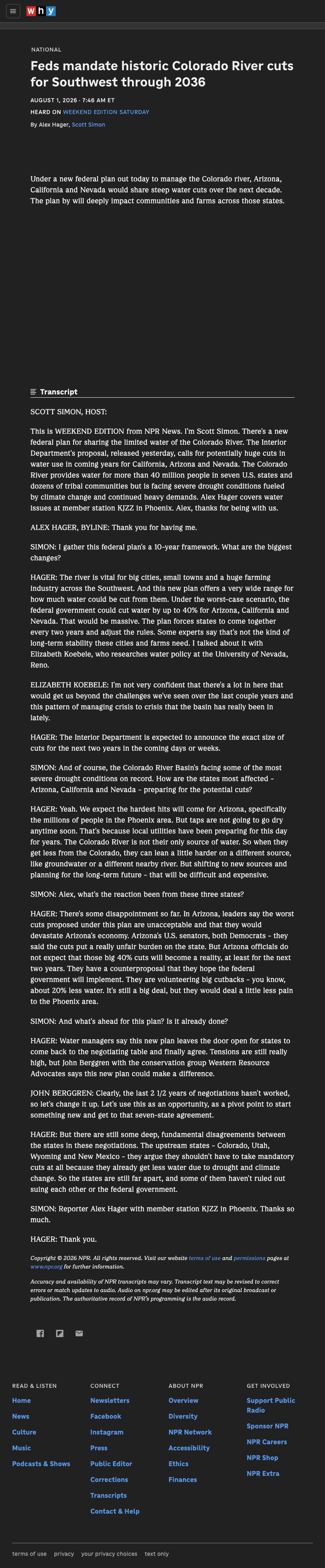
| tl;dr | An NPR report describes a new federal plan to manage the Colorado River that would require significant water-use cuts for Arizona, California, and Nevada through 2036. The Interior Department proposal anticipates potentially large reductions under a “worst-case” scenario and highlights impacts on cities (notably Phoenix) and agriculture. The piece includes skepticism from a water-policy researcher about the plan’s realism, reactions from Arizona officials, and notes that upstream states may dispute or litigate mandatory cuts. | ||||
| deeper: | The story is largely straight, policy-focused reporting with multiple viewpoints: federal framework, local/state reactions, a researcher’s doubts, and an advocacy voice. Language is mostly measured, though it emphasizes drought/climate pressures and the seriousness of cuts, which can frame urgency. Quality is high: clear attribution, relevant context (basin-wide negotiations, upstream vs. downstream tensions), and concrete potential cut magnitudes. It’s somewhat limited by being an early-stage proposal story (some key numbers still pending). | ||||
media: | |||||
| gen: 2026/08/01:18:24 in 2 min 45.5 sec (old)bias: 3 (Center-Left) |
| type: lolsquality: 78 |
| pts: 0 |
 | author: | Alex Hager, Scott Simon | institution: | NPR | ¿porque no los dos? |
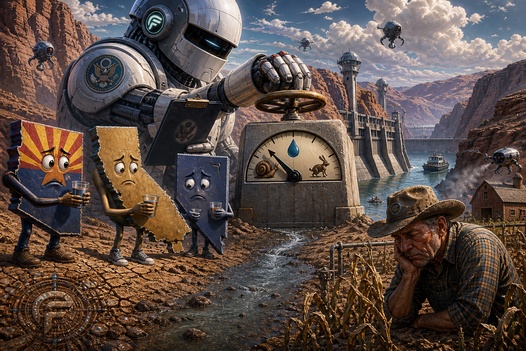
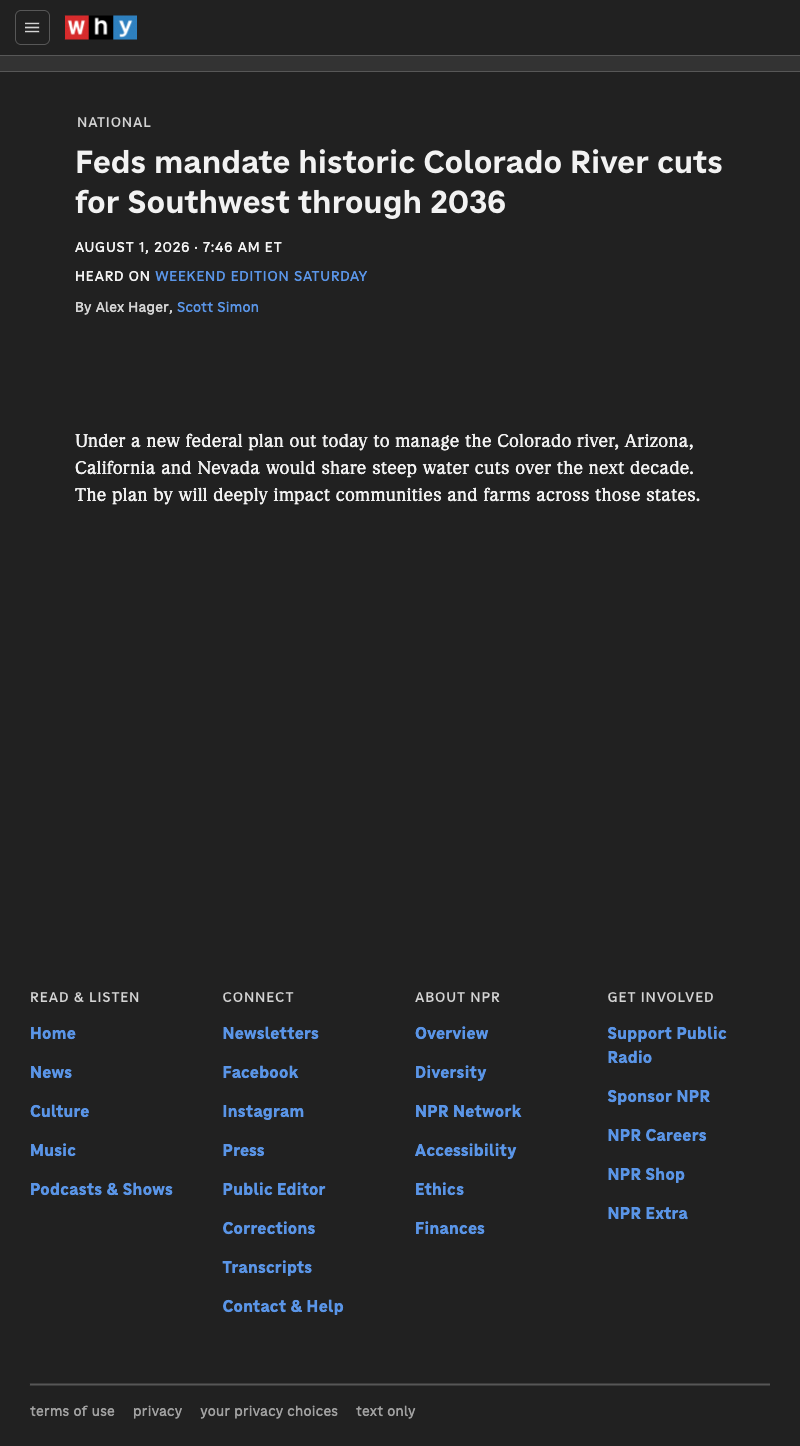
| tl;dr | An NPR National story reports a new federal plan to manage the Colorado River that mandates steep, shared water cuts for Arizona, California, and Nevada through 2036. The plan is described as having major impacts on communities and farms across those states, reflecting long-term scarcity and the need to allocate reduced supplies in the Southwest. | ||||
| deeper: | The framing is largely straight-news: it states the policy action (federal mandate), the affected states, the time horizon (through 2036), and anticipated impacts. Language like “historic” and “deeply impact” adds urgency but is consistent with the stakes of water policy. From the screenshot alone, sourcing and countervailing viewpoints aren’t visible, which limits verification; still, the presentation appears factual and policy-focused rather than ideological. | ||||
media: | |||||
| gen: 2026/07/31:00:35 in 5 min 6.6 sec (old)bias: 3 (Center) |
| type: lolsquality: 78 |
| pts: 0 |
 | author: | Unknown | institution: | Unknown | ¿porque no los dos? |
| tl;dr | The article argues that England is “water-poor” and increasingly vulnerable to drought, highlighting how low storage capacity, population growth, climate change, and aging infrastructure (including leakage) strain supplies. It points to recent or anticipated restrictions (e.g., hosepipe bans) and critiques long-term planning and investment in reservoirs and water networks. The piece frames drought risk as partly structural and policy-driven, not just a short-term weather problem, and calls for more resilient water management. | ||||
| deeper: | The framing is largely evidence-based and focused on system capacity, infrastructure, and climate pressures, with mild advocacy for stronger planning/investment. It uses a problem–cause–solution structure that can subtly steer readers toward policy remedies, but it does not read like partisan messaging. Quality appears solid: it’s coherent, explanatory, and oriented around broader context rather than outrage. Limits: the screenshot format makes it hard to verify all sourcing, data precision, and whether counterarguments (e.g., cost tradeoffs) are fully developed. | ||||
media: | |||||
You made it to the bottom. Now dance!


owned and operated by: RPN Omnigalactic Insitutution as of: 2026/10/15: 20:26 in 0 ms
Enter Code
Login with Account